
HR responsibilities: Duties of the people managing the staff


What are the main HR responsibilities?
HR responsibilities cover the full employee life cycle, from hiring and payroll to training, compliance, and workplace safety.
- HR finds, hires, and trains the people who keep a company running.
- The team also handles records, pay, benefits, policies, and legal rules.
- Above all, good HR builds a safe and fair place to work.
Behind every business is a team of people who find, hire, and train employees to make the company work. That team is the human resources (HR) department, or the lifeblood of companies. HR is vital to every organization because it gives structure and order.
It also helps companies cope with fast changes in the market. As a result, the workforce stays steady even when the business shifts.
People often link this team with just “hiring” and “firing.” However, there are many more HR responsibilities that the people managing the staff take on each day. Some firms even outsource core HR functions to keep costs low and quality high.
What is HR?
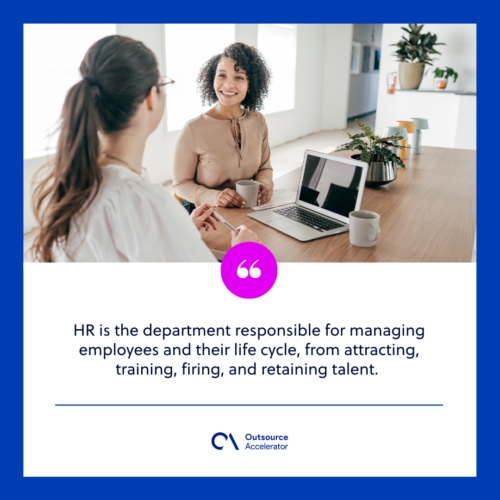
HR is the department that manages employees and their life cycle. This life cycle runs from attracting and training talent to firing and retaining it.
HR staff are people with strong communication and people skills. Many hold credentials like a two-year degree in HR management or a Master of Science in Human Resources.
The people in HR like to support others and see them succeed. In turn, HR helps a company meet its demand for higher-quality employees.
What does an HR department aim to do?
HR does far more than recruit, hire, onboard, train, retain, and fire staff. In addition, it manages performance, sets compensation, and runs benefit programs.
A strong HR team also keeps the company within the law. This matters for a firm of any size.
Other than that, the HR department is also in charge of the following:
- Providing opportunities for career development
- Addressing issues and concerns in the workplace
- Developing company policies and making sure they work
When done well, HR lifts company efficiency. It keeps order and structure while it supports and helps employees.
So companies that want an HR department, and people who want an HR career, should learn these core duties first.
12 Common HR responsibilities
HR can build a positive workplace by managing a good life cycle. That means shaping every stage of an employee’s time before, during, and after the job. It also means building good ties between coworkers so both personal and company goals get met.
First, there are seven HR responsibilities that keep this life cycle strong.
Recruitment
The first HR responsibility is finding qualified people for open roles. This duty drives the whole workforce forward.
HR specialists may write and post job descriptions, screen candidates, and run interviews. For this reason, many teams study the different recruitment methods before they start a search.
They also track that all hiring paperwork is complete. This runs from the start to the end of the hiring process.
Records management
The second HR responsibility is records management. HR teams manage private data like contracts, salaries, job duties, discipline notes, and reviews.
They must keep this data private and secure at all times. Many now use employee record management software to keep files safe yet easy to find.
Good records also help employers read demographic data and spot skill gaps. As a result, the company stays in line with the law.
Employee relations management
The third HR responsibility is managing employee connections. HR plays a big role in keeping a workplace that feels cohesive.
The team improves ties between managers, supervisors, and staff. It also handles union plans, and it drafts and reads labor agreements.
Disputes still come up from these issues. So HR settles them through training or discipline.
Payroll processing
Another HR responsibility is running payroll for employees. The team also looks after benefit programs, such as retirement plans and health care.
HR can run payroll in-house or hand it to outside experts. Many firms lean on dedicated payroll processing services as they grow.
Compensation and benefits consolidation
Besides payroll, HR teams help set the pay structure. For example, they set pay ranges for each role and level.
HR can also check the data to see if pay meets market rates. This keeps offers fair and current.
Benefit packages often include health and dental cover, life insurance, and retirement plans. Such perks help a firm care for its people.
A strong package also helps attract and keep talent. So HR must make sure the perks are enough.
Policy update and legal compliance
Here, HR must review and update its policies each year. The goal is to check if each one still helps the company and its staff.
Policies can also change after a big event. When that happens, HR makes the needed edits.
HR must also follow labor laws and rules. Two clear examples are the Civil Rights Act and the Fair Labor Standards Act.
Failure to comply can cause unsafe work, complaints, and unrest. Because of this, HR watches fair employment laws and fair pay standards.
Imposing disciplinary measures
Another HR responsibility is discipline. The aim is a safe workplace, free from harassment and other harmful acts. Clear workplace discipline protects both the staff and the firm.
When an employee breaks the rules, HR steps in with fair action. This shields other workers from threats.
Poor conduct can take many forms. For example, it may be weak job performance, rude behavior, or bad time management.
HR follows a set process for discipline. First comes a verbal warning, then a written notice, before any suspension or exit.
Handled badly, discipline can cost a good employee or lead to a lawsuit. Handled well, it helps people improve and thrive.
Fostering a safe and healthy workplace
Employee wellness drives better and happier work. So it is HR’s job to protect workplace safety.
HR staff run safety training and keep injury records. They also report and settle worker’s compensation claims. These duties follow the Occupational Safety and Health Act (OSHA).
Overall support for employees
Perhaps the top HR responsibility is support for employees. In practice, this shows up in three ways.
Training, management, and support
One key HR role is training and development. Workers need regular training when:
- They are new and still learning the company
- They need to stay healthy and perform well
- They must keep up with policy or legal changes
- Managers need leadership skills to guide their teams
Strong onboarding sets the tone from day one. For this reason, many teams use structured employee orientation to help new hires settle fast.
Supporting career growth
Next, HR supports each person’s career growth. The team offers and runs learning programs for staff.
This helps employees gain skills and do better work. In turn, both the person and the firm win.
Some companies run formal courses in-house. Others help through tuition aid or reimbursement.
Either way, support boosts worker satisfaction and loyalty. So it pays off over time.
Health and wellness
HR is the people operation of the company. So it must remember that employees are humans who need care and protection.
HR often helps with health and life issues. For example, it may support staff through disability, illness, debt, pregnancy, or adoption.
Frequently asked questions about HR responsibilities
What are the core HR responsibilities in a company?
The core HR responsibilities are recruitment, records, employee relations, payroll, benefits, policy, discipline, safety, and support. Together, these duties cover the full employee life cycle.
What skills do HR professionals need?
HR professionals need strong communication and people skills. Many also hold an HR degree or a related master’s. Above all, they must handle private data with care.
Can a business outsource its HR responsibilities?
Yes. Many firms outsource payroll, records, or full HR functions to expert providers. As a result, they cut costs while they keep quality high.
Why is legal compliance an HR responsibility?
Legal compliance keeps the company safe from fines and lawsuits. HR tracks labor laws, fair pay, and safety rules. So it must review policies every year.
How does HR support employee wellbeing?
HR runs safety training, offers benefits, and backs career growth. It also helps staff through hard life events. In short, it protects both health and morale.
Key takeaways
- HR responsibilities span the whole employee life cycle, not just hiring and firing.
- Core duties include recruitment, records, payroll, benefits, and legal compliance.
- Discipline and safety keep the workplace fair and free from harm.
- Training and career support raise both performance and loyalty.
- Many firms now outsource HR tasks to save money and gain expertise.






 Independent





