
How employment via outsourcing can benefit your business


- How employment via outsourcing can benefit your business
How can employment via outsourcing benefit your business?
Employment via outsourcing lets you focus on core work, cut overhead costs, and tap skilled specialists without building teams in-house.
- You free your staff to focus on revenue-driving tasks.
- You scale up by upgrading a service plan, not hiring more people.
- You gain experts and compliance support for a set monthly fee.
As a decision maker in a small to mid-sized firm, it pays to look closely at outsourcing. In many cases, it is a smart, sustainable option. For example, SMEs typically outsource tasks that sit outside core work, such as logistics and accounting.
Big firms can staff many departments, but SMEs often cannot. So they lack the spare people or budget for these tasks. Still, this limit can become an advantage. In fact, it opens the door to lower costs and higher profit. To weigh both sides, see the pros and cons of outsourcing for small businesses. Here are the main benefits your firm can gain.
1. Focus on core tasks
Payroll and finance are vital, yet they do not create sales. So it makes sense not to pour staff time into them. You could hand these to your HR team, but they are likely busy already.
Non-core work still needs the right experts. So SMEs should not try to handle it alone when it sits outside their skill set. In truth, firms gain most by playing to their strengths. As a result, outsourcing the rest is often the wiser move. After all, letting an overwhelmed employee manage sensitive data invites mistakes. The work is better left to qualified pros who do it well.
2. Cut down overhead costs
Hiring a provider costs far less than building a team from scratch. For example, think of the cost to staff and manage a content team in-house. Firms that outsource can scale up by upgrading a service plan. In contrast, those that build in-house must keep spending on people and tools as they grow.
The cost of a provider stays lower than hiring, training, and keeping new staff. In addition, you can see how outsourcing can benefit the company right away. Just remember that time is money. So spend it on work that sits at the heart of your business. For a fuller picture, review the key benefits of outsourcing. As a result, outsourcing frees time and resources to grow your services and client base.
3. Specialized BPO services
BPO companies that handle finance or customer service invest in strong tools. So they make the work faster and easier for their teams. As a result, they lift productivity without cutting quality.
These firms also keep track of laws and changes in their field. For example, a BPO that handles tax stays on top of new tax rules. So by outsourcing to specialists, you get accurate, timely work. In addition, you gain the latest technology and trained experts. Best of all, you enjoy this for a modest fee, with no extra spend on tools or training.
4. Staff leasing
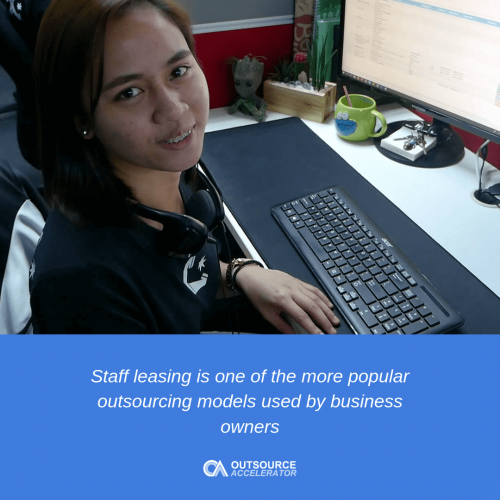
One big benefit of working with a BPO is simple. In short, it handles all labor laws and salary admin for your team. This model is known as staff leasing, and it suits many growing firms.
The Philippines has a very pro-labor system, and it comes with heavy red tape. So it is best, especially when you are new there, to stay clear of that bureaucracy. A good BPO partner will source and hire your team for you. In addition, it manages employment admin, compliance, and payments. It also advises you on best practice and fair prices.
Platforms like VirtualStaff.ph are built around this model, giving businesses access to Philippine-based staff while handling labor law compliance, payroll, and administration in the background. To compare setups, see this guide to staff leasing, seat leasing, BPO, and build-operate-transfer.
Understanding local labor laws and compliance
Most BPOs also cover the staff’s 13th month pay within their monthly desk fee. When you add it all up, that is a large saving. So a BPO can shield you from many hard admin tasks. Still, the BPO’s hands are somewhat tied. After all, it must follow the country’s labor laws too.
This means you must follow set steps to terminate, demote, or reprimand a worker. You might assume that contract staff are easy to hire and fire. In most cases, though, that is simply not true. In fact, the labor laws protect staff more than those in the UK, US, or Australia. So even as a contracting service, you must follow strict processes.
This is both good and bad. On the plus side, it ensures fair treatment and blocks exploitation. In practice, it rarely restricts employers much. Still, it is worth knowing in advance. So always learn the discipline and termination steps a BPO partner expects from you. For smaller firms, this guide on offshore staff leasing for small businesses is a helpful next read.
Frequently asked questions
What is employment via outsourcing?
It means a provider hires and manages staff on your behalf. So the team works for your goals, while the BPO handles payroll and compliance. As a result, you gain skilled workers without the full weight of local admin. This is common in staff leasing setups.
Is outsourcing only worth it for large companies?
No, small and mid-sized firms often gain the most. They lack spare staff for non-core work, so a provider fills that gap. In addition, they pay a set fee instead of building costly teams. As a result, they compete with far larger rivals.
Which tasks should a small business outsource first?
Start with non-core work that does not drive sales. For example, payroll, finance, and logistics are good early choices. Next, add specialist tasks that sit outside your skill set. So your own team stays focused on core growth.
Does a BPO handle labor law compliance for me?
Yes, a good BPO manages compliance, payroll, and admin. Still, it must follow the country’s labor laws, and so must you. So you need to follow set steps for discipline or termination. As a result, it is wise to learn these rules before you sign.






 Independent






