
How AI can solve complex business problems: The path forward


Across industries, businesses face increasingly complex problems that traditional solutions cannot effectively address.
Modern companies face complex challenges ranging from managing massive datasets to predicting market shifts in real-time. These hurdles require intelligent systems that can process information and make decisions much faster than any human team.
Artificial intelligence has emerged as the most powerful tool for addressing these complex challenges. Using AI to solve business problems enables organizations to tackle data-intensive tasks, predict trends with remarkable accuracy, and provide insights that help business leaders make smarter, more informed decisions.
According to IDC’s 2025 CEO Priorities research, 66% of CEOs report measurable business benefits from generative AI initiatives, particularly in enhancing operational efficiency and customer satisfaction.
The path forward involves understanding which business challenges AI can address most effectively, identifying the right applications for specific problems, and implementing solutions that create lasting competitive advantages.
Companies that master this approach position themselves to thrive in an increasingly complex and fast-paced business environment.
Identifying the business problems AI can solve
Common business problems AI can address
Business problems AI can solve span across virtually every aspect of modern operations, from reducing inefficiencies and operational costs to accelerating decision-making and improving customer satisfaction.
The most significant challenges that AI addresses include managing overwhelming data volumes, eliminating repetitive manual processes, and providing accurate predictions that support strategic planning.
Inefficiency represents one of the largest areas where AI creates immediate impact.
Manual processes that consume hours of employee time can be automated, freeing teams to focus on strategic work. High operational costs often result from resource waste or poor demand forecasting—areas where AI excels at optimization.
Key business challenges that AI addresses effectively include:
- Data overload, where organizations struggle to extract meaningful insights from massive information volumes
- Resource optimization challenges in scheduling, inventory management, and capacity planning
- Quality control issues that require consistent monitoring and immediate response to anomalies
- Customer service bottlenecks that result in long wait times and inconsistent support experiences
- Fraud detection and security threats that require real-time analysis of suspicious patterns
To maximize the effectiveness of AI solutions, many businesses choose to hire AI developers who have the expertise to create tailored solutions that fit specific business needs.
Professional AI developers understand how to design systems that integrate with existing operations while addressing unique industry requirements and regulatory constraints.
AI solutions for operational efficiency
AI applications in business problem-solving transform operational efficiency by automating repetitive tasks, streamlining complex workflows, and reducing human error in critical processes.
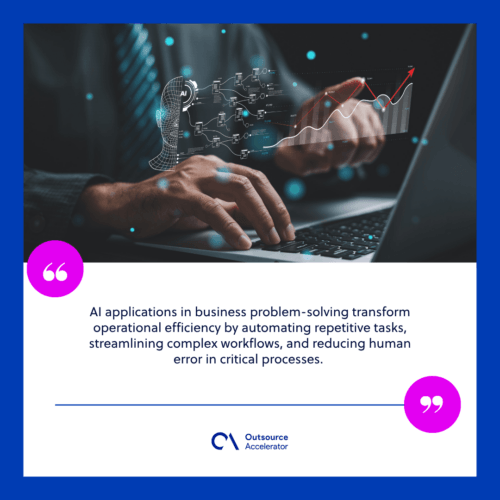
These applications enable businesses to accomplish more work with fewer resources while maintaining quality standards.
Automation offers the most immediate benefit, handling tasks such as data entry, document processing, and routine analysis continuously without breaks.
Workflow streamlining through AI identifies bottlenecks and optimization opportunities, coordinating multiple processes simultaneously to ensure efficient resource allocation.
AI in data analysis and decision-making
Using AI to solve business problems in data analysis enables organizations to transform raw information into actionable insights that drive better decision-making. AI-powered systems can process structured and unstructured data simultaneously, identifying patterns and relationships that human analysts might miss.
Decision support systems powered by AI can evaluate multiple scenarios, assess risks and benefits, and recommend optimal actions based on historical data and predictive modeling.
Real-time analysis capabilities allow businesses to respond immediately to changing conditions, enabling proactive management that prevents problems before they impact operations.
How AI applications are revolutionizing business problem-solving
Here are some ways that AI applications are streamlining work:
AI-powered predictive analytics
By leveraging predictive analytics, businesses can forecast future trends and customer behavior. This high-level AI application enables organizations to navigate market demands with a level of precision previously impossible.
This capability transforms business planning from reactive approaches to proactive strategies that capitalize on opportunities before competitors recognize them.
Market trend prediction through AI analyzes historical data, current market conditions, and external factors to forecast future market movements. These predictions help businesses adjust their strategies, allocate resources effectively, and identify emerging opportunities or threats before they significantly impact operations.
Customer behavior analytics give businesses the power to map out purchasing patterns and predict lifetime value with precision. These insights directly drive smarter decisions across marketing, product design, and customer support.
AI systems can identify which customers are likely to purchase specific products, when they’re most likely to buy, and what factors influence their decision-making processes.
Demand forecasting powered by AI helps businesses optimize inventory levels, production schedules, and resource allocation.
These systems can account for seasonal variations, promotional impacts, external events, and market trends to provide highly accurate predictions. By doing so, they reduce operational waste while ensuring that supply levels always meet customer demand.
Personalization and customer experience
Business problems AI can solve in customer experience include:
- Delivering personalized interactions at scale
- Optimizing customer journeys
- Creating engagement strategies that increase satisfaction and loyalty
AI enables businesses to treat each customer as an individual while maintaining operational efficiency across large customer bases.
Personalization engines analyze customer data to deliver customized product recommendations, content, and offers that align with individual preferences and behaviors.
These systems can process purchasing history, browsing patterns, demographic information, and engagement data to create unique experiences for each customer interaction.
Customer journey optimization uses AI to analyze how customers interact with businesses across multiple touchpoints, identifying friction points and opportunities for improvement.
This analysis enables businesses to streamline processes, reduce customer effort, and create smoother experiences that increase conversion rates and satisfaction.
Marketing strategy optimization through AI helps businesses deliver the right message to the right customer at the optimal time through the most effective channel. AI systems can test different approaches, measure results, and automatically adjust campaigns to maximize engagement and conversion rates.
Risk management and fraud prevention
Risk management and fraud prevention represent critical AI applications in business problem-solving solving where traditional rule-based systems often fall short. AI systems can analyze complex patterns, detect anomalies, and identify threats in real-time while adapting to new fraud techniques and emerging risks.
Fraud detection systems powered by AI can analyze transaction patterns, user behaviors, and contextual information to identify suspicious activities that might indicate fraudulent behavior.
These systems learn from historical fraud cases and continuously improve their detection capabilities as they encounter new patterns.
Risk assessment applications use AI to evaluate potential threats across various business areas, including credit risk, operational risk, and market risk.
These systems can process multiple data sources simultaneously to provide comprehensive risk profiles that inform decision-making and risk mitigation strategies.
Compliance monitoring using AI ensures that business operations comply with regulatory requirements and internal policies. AI systems can monitor transactions, communications, and processes continuously to identify potential compliance violations and alert appropriate personnel for immediate action.
Real-time threat detection capabilities enable businesses to respond immediately to security incidents, fraud attempts, or other risks before they cause significant damage.
These systems can coordinate responses across multiple security systems and provide detailed information to support investigation and remediation efforts.
Embracing AI for business transformation
Using AI to solve business problems will continue to evolve as a powerful tool for enhancing competitiveness and driving innovation.
As AI technologies become more sophisticated and accessible, businesses that embrace these capabilities position themselves to solve increasingly complex challenges while creating new opportunities for growth and market leadership.
The future of AI in business involves moving beyond individual applications to create integrated systems that transform entire business processes. Organizations that invest in comprehensive AI strategies will gain sustainable competitive advantages through improved efficiency, better decision-making capabilities, and superior customer experiences.
AI applications in business problem-solving will expand to address challenges that currently seem unsolvable, enabling breakthrough innovations in product development, customer service, and operational optimization.
Companies that begin exploring AI solutions now will build the expertise and infrastructure needed to capitalize on future advancements.
To succeed with AI, companies must strategically choose which problems to solve first while ensuring seamless integration with their current infrastructure. Beyond the technical setup, organizations must develop the internal skills and culture needed to drive continuous AI innovation.
Businesses that approach AI implementation thoughtfully will unlock the full potential of these technologies for transformative business impact.
The organizations that thrive in the coming decade will be those that view AI not as a technology add-on, but as a fundamental capability that enables them to solve complex problems, serve customers better, and operate more efficiently than ever before possible.






 Independent





