
Hire tech talent: How to build a high-performance technology team


This article is a submission by Remote Latinos. Remote Latinos connects businesses with top talent from Latin America. Their platform facilitates the hiring of professionals from over 40 countries in Latin America.
Technology drives modern growth. Whether you run a startup, agency, SaaS platform, or enterprise operation, your ability to execute depends on the quality of your technical team.
But hiring tech talent is one of the most expensive, competitive, and high-risk decisions companies make.
The challenge is not just finding developers, engineers, or technical operators. It is identifying professionals who can deliver outcomes, collaborate cross-functionally, adapt to evolving tools, and contribute to long-term scalability.
This guide explains how to hire tech talent strategically, avoid common hiring mistakes, and build a system that attracts and retains high-performance professionals.
Table of Contents
- What hiring tech talent really means
- Why hiring tech talent is a strategic decision
- 4 common mistakes when hiring tech talent
- Key traits to look for in tech professionals
- How to hire tech talent step by step
- Remote vs In-house tech talent
- Onboarding and retaining technical teams
- Building the tech talent engine
- FAQs
- References
What hiring tech talent really means
Hiring tech talent is often reduced to resume scanning: frameworks, certifications, and years of experience. But technical skill alone does not predict performance.
According to Adler (2022), performance-based hiring must focus on outcomes, not credentials. In technical roles, this means defining what success looks like in measurable terms:
- Features delivered within timeline
- System stability improvements
- Automation efficiency gains
- Reduced bug recurrence
- Infrastructure scalability
Hiring tech talent is not about “who knows the most tools.” It is about who can create consistent, measurable impact.
Why hiring tech talent is a strategic decision
Bruce Tulgan (2022) explains that in the modern economy, talent is the show. Competitive advantage increasingly depends on the quality of your people.
In technology roles, this is amplified because:
- One strong engineer can dramatically increase output
- One weak hire can slow an entire team
- Technical debt compounds quickly
- Poor architecture decisions are expensive to reverse
Hiring tech talent is not an HR task. It is a strategic investment decision that affects product velocity, operational reliability, and revenue growth.

4 common mistakes when hiring tech talent
1. Hiring for tools instead of thinking
Kumler (2020) warns that resumes filled with buzzwords are poor predictors of performance. A developer who lists 15 frameworks may lack problem-solving discipline.
2. Skipping structured evaluation
Herrenkohl (2010) emphasizes that structured hiring reduces costly errors. Casual interviews often reward personality alignment over competence.
3. Rushing under delivery pressure
When deadlines loom, companies hire quickly to “fill the gap.” This urgency often creates long-term setbacks.
4. Ignoring cultural and communication fit
Technical brilliance without communication clarity leads to cross-functional friction. In distributed teams, this becomes even more critical.
Key traits to look for in tech professionals
Strong tech talent consistently demonstrates:
- Systems thinking
- Debugging discipline
- Clear written communication
- Ownership mentality
- Ability to estimate realistically
- Adaptability to evolving tools
Johnson (2022) notes that long-term performers combine skill with accountability and growth mindset. In tech roles, this translates into consistent code quality, documentation habits, and continuous learning.
How to hire tech talent step by step
Step 1: Define measurable outcomes
Following Wintrip (2017), define results instead of vague responsibilities. For example:
Instead of: “Build backend systems.”
Define: “Design and deploy a scalable API supporting 10,000 monthly active users within six months.”
Outcome clarity filters stronger candidates.
Step 2: Use structured technical evaluation
Painter and Haire (2022) demonstrate that structured evaluation improves predictability. Combine:
- Scenario-based technical questions
- Small paid test projects
- Code review discussion
- System design walkthrough
Live problem-solving reveals more than static resumes.
Step 3: Assess communication and ownership
Ask candidates:
- Describe a production failure you handled
- How do you document your work?
- How do you push back on unrealistic timelines?
Tulgan (2022) emphasizes that modern professionals must balance autonomy with accountability. Tech hires should demonstrate both.
Step 4: Consider pre-vetted talent pools
Pre-vetted talent pools reduce baseline screening time and risk. Herrenkohl (2010) notes that narrowing candidates early allows deeper evaluation of alignment and potential.
When hiring remote tech talent, curated networks can significantly reduce misalignment risk while expanding access to global professionals.
Remote vs In-house tech talent
The global shift toward remote work has expanded access to technical professionals worldwide.
Remote hiring offers:
- Broader talent pools
- Cost efficiency
- Flexible scaling
- Time zone coverage advantages
However, remote success depends on structured management systems:
- Clear documentation standards
- Defined sprint cycles
- Transparent performance metrics
- Consistent feedback loops
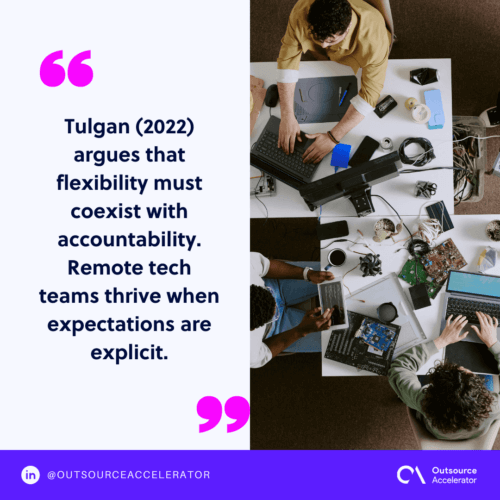
Tulgan (2022) argues that flexibility must coexist with accountability. Remote tech teams thrive when expectations are explicit.
Onboarding and retaining technical teams
Hiring is only the beginning.
Painter and Haire (2022) identify onboarding pillars that apply directly to tech roles:
- Clarity of expectations
- Access to tools and systems immediately
- Clear 30–60–90 day milestones
- Defined documentation protocols
- Regular code review sessions
Retention depends on growth pathways. Johnson (2022) highlights that high performers stay when they see:
- Skill progression opportunities
- Ownership expansion
- Transparent evaluation criteria
Tech talent retention is driven by challenge, autonomy, and impact.
Building the tech talent engine
To hire tech talent effectively, companies must move beyond resume screening and reactive hiring.
Strategic hiring requires:
- Outcome-based role definition
- Structured evaluation
- Practical skill testing
- Cultural and communication assessment
- Strong onboarding systems
In competitive markets, the organizations that treat technical hiring as a disciplined system rather than a rushed task will outperform those who chase credentials without structure.
Technology evolves quickly. But disciplined hiring frameworks remain consistent.
FAQs
How long does it take to hire tech talent?
With a structured process, 3–6 weeks is typical. Rushed hiring increases long-term risk.
Is remote tech talent reliable?
Yes, when supported by clear expectations, documentation standards, and accountability systems.
Should I hire generalists or specialists?
It depends on the stage. Early-stage companies benefit from adaptable generalists. Scaling teams often require focused specialists.
What is the biggest mistake when hiring developers?
Hiring for tool familiarity instead of outcome ownership and problem-solving ability.
References
Adler, L. (2022). Hire with your head: Using performance-based hiring to build outstanding diverse teams (4th ed.). John Wiley & Sons.
Johnson, K. (2022). How to recruit, hire and retain great people. G&D Media.
Kumler, E. (2020). How not to hire: Common hiring mistakes and how to avoid them. HarperCollins Leadership.
Painter, A. J., & Haire, B. A. (2022). The onboarding process: How to connect your new hire. Team Solution Series.
Tulgan, B. (2022). Winning the talent wars: How to hire and retain the best people in a competitive marketplace. W. W. Norton & Company.
Wintrip, S. (2017). High-velocity hiring: How to hire top talent in an instant. McGraw-Hill Education.






 Independent





