
5 Ways how outsourcing is helping fintech firms


Fintech is fast becoming one of the most exciting industries in the world. More people now use fintech apps every day. So they enjoy the many benefits this sector offers.
To meet rising demand, fintech startups and leaders delegate some tasks to outsourcing firms. This kind of partnership works well. It helps financial services providers run daily operations and focus on high-value work.
What is fintech outsourcing?
Fintech outsourcing is the practice of hiring third-party providers to handle key financial technology tasks, so firms can cut costs and scale faster.
In short, it lets fintech companies pass routine or technical work to expert teams. As a result, the internal team can focus on growth.
- It gives fast access to skilled tech and finance talent.
- It lowers costs versus a full in-house team.
- It helps startups scale up or down with ease.
What is fintech?
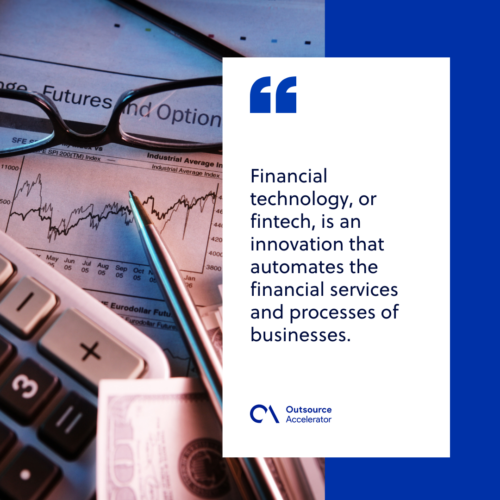
Financial technology, or fintech, is innovation that automates the financial services and processes of businesses. It is a fast-growing field. It serves both consumers and companies everywhere.
Fintech is not new. Technology has shaped finance since the arrival of credit cards and ATMs. Still, newer advances have made it more popular than ever. These include machine learning, blockchain, and data science.
What do fintech startups do?
Fintech companies make financial services easier to reach. They do this by adding new technologies, such as artificial intelligence (AI), blockchain, and data science. Some even build on machine learning to spot fraud and score risk.
Because of this, anyone can now send money and see it arrive right away. For example, grocery shopping has become fast and simple. Investing is now easier and safer too, with just a few taps on a screen. Even blockchain and cryptocurrency are open to anyone with a phone or computer.
How can outsourcing help fintech companies in the industry?
Fintech outsourcing is a strategy where companies hire third-party providers. These partners help run daily operations well. Because it eases the load on the internal team, this approach is cost-effective for startups and small firms.
When set up and managed well, an outsourced team offers many benefits. Here are the main ones.
Access to skilled employees
Outsourcing agencies help small fintech firms find and hire the right talent. This matters a lot today. After all, tech and development experts are in short supply. So partnering with a provider gives you skilled teams fast. Many firms tap IT outsourcing services for this reason.
Faster project delivery
Fintech firms outsource to speed up delivery. They skip the long search for new hires. So projects start sooner and finish faster. On top of that, experienced partners bring past projects they can use as a guide.
Better data handling
Financial services means you must collect and analyze numerous data often. So many firms now blend in-house staff with a fintech software partner. This lifts the whole service.
Outsourcing partners help set up trusted analytics tools. They also build clear dashboards. In addition, they provide cybersecurity experts who protect sensitive data. To learn more, see how outsourced cybersecurity services guard fintech systems.
Cost-efficiency
Outsourcing costs less than a full in-house team. With a provider, you skip payroll, computer costs, and management fees. You also save on office space, which is hard for a startup. Building apps gets easier too, since you do not start from scratch.
Flexibility and scalability
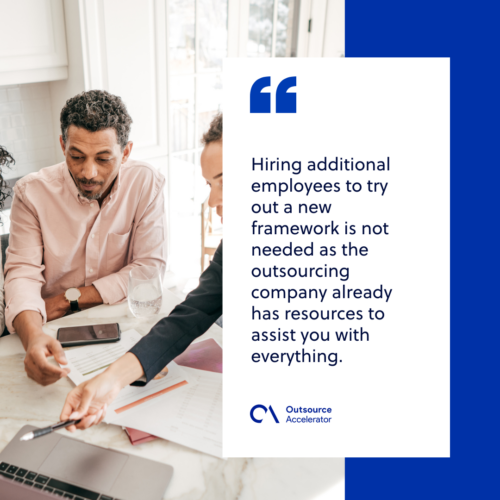
Most startups need flexibility. A good provider gives you what you need to run the business. You also skip hiring just to test a new framework. Because of this, fintech startups can scale up or down with ease. For deeper context, read this guide to outsourcing for startups.
Explore fintech outsourcing with Infinit-O
For many fintech companies, the right partner is a real edge. It helps them stay a step ahead of rivals. Infinit-O could be the perfect partner for you.
At Infinit-O, you gain access to a pool of skilled professionals. They can handle sales, sales enablement, marketing, customer service, software engineering, financial services, data analytics, and HR. With the latest tools and automation, you can delegate many tasks while you focus on other work.
Partnering with Infinit-O gives you five key benefits:
- Cost reduction. High-quality service and skilled teams with 70% operational cost savings.
- Scalability. Can respond fast to every shift your business demands.
- Access to world-class talent. Its A+ recruitment process attracts top talent with a high retention rate.
- Operational excellence. Collaborative SLAs and metric-driven performance.
- Trusted partnership. Rely on Infinit-O’s >97% client retention rate and 75 Net Promoter Score. The firm is also ISO 27001 and 9001 certified, plus GDPR and HIPAA compliant.
Visit Infinit-O’s website now to explore their other offerings. You can also compare it with proven models of software development outsourcing for fintech.
Frequently asked questions about fintech outsourcing
Which fintech tasks are best to outsource?
Good candidates include software development, QA testing, and data analytics. Customer support, compliance checks, and back-office work also fit well. In general, start with tasks that are clear, repeatable, or highly technical.
Is fintech outsourcing secure and compliant?
It can be, with the right partner. Look for ISO 27001, SOC 2, GDPR, and PCI DSS coverage. Then set clear data rules and access limits in the contract. So security stays strong from day one.
How much can fintech outsourcing save?
Savings vary by role and location. Many firms cut labor costs by 40% to 70% offshore. You also save on office space, tools, and hiring. Still, the exact figure depends on scope.
Onshore, nearshore, or offshore: which is best for fintech?
Each has trade-offs. Onshore offers close time zones but higher costs. Nearshore balances cost and overlap. Offshore gives the lowest cost and a large talent pool. So match the model to your budget and hours.
How do I choose a fintech outsourcing partner?
Check their fintech track record first. Next, confirm their security certificates and compliance. Then review sample work and client references. Finally, run a small pilot before you scale.






 Independent





