
12 call center soft skills to look for in agents


At a glance
- Call center soft skills are the people skills, such as communication, empathy, and patience, that shape every customer conversation.
- The 12 most important include active listening, emotional intelligence, problem-solving, adaptability, and conflict resolution.
- They drive customer satisfaction, first-call resolution, and loyalty, often more than technical knowledge does.
- You can build them through role-play, call reviews, coaching, peer mentoring, and well-being support.
In customer service, soft skills separate great call center agents from average ones.
Product knowledge and technical training matter. Still, it’s an agent’s ability to communicate clearly, show empathy, and solve problems calmly that defines the customer experience.
Customers care about that experience. In Salesforce’s 2022 State of the Connected Customer report, 88% of customers said the experience a company provides is as important as its products or services.
Hiring and developing agents with the right soft skills therefore leads to happier customers, better retention, and lasting loyalty. Here’s what to look for.
What are soft skills?
Soft skills are personal qualities that shape how someone works and interacts with others. They’re less about technical ability and more about attitude, behavior, and communication.
Hard skills, by contrast, are technical abilities that are easier to teach and measure. Soft skills are harder to quantify, but they often have a bigger impact on daily interactions.
For example, common soft skills include communication, empathy, adaptability, teamwork, and emotional intelligence.
What are soft skills in a call center?
In a call center, soft skills decide how well agents connect with customers. Every call carries your brand’s voice, so each one shapes your reputation.
These skills go beyond being polite. For instance, they include staying calm on stressful calls, listening actively, and adjusting tone to fit the customer’s mood.
The U.S. Bureau of Labor Statistics lists many of them as important qualities for customer service representatives, including communication, listening, patience, and problem-solving.
Practiced consistently, they lead to shorter calls, higher first call resolution, and better satisfaction scores.
Call center soft skills every agent needs
Many soft skills help, but these 12 are essential for anyone in a customer-facing role. Prioritize them when you hire, train, and review your agents.
1. Communication skills
Clear communication is the foundation of good service, so agents must explain things simply and understand customer concerns accurately.
Good communication in call centers also covers tone, pace, and plain language. When agents avoid jargon and confirm understanding, customers feel heard.
2. Active listening
Active listening means giving customers your full attention, acknowledging their feelings, and responding thoughtfully.
Customers often call when they’re frustrated, so they need to feel genuinely heard. Agents who listen well find the real issue faster and avoid assumptions that cause mistakes.
3. Empathy
Empathy is the ability to understand and share another person’s feelings. In a call center, it turns routine support into meaningful service.
Phrases such as “I understand how frustrating that must be” help customers stay calm and cooperative. As a result, empathy builds trust, especially on complaints and sensitive issues.
4. Emotional intelligence
Emotional intelligence (EQ) is the ability to manage your own emotions and read other people’s. For agents, high EQ means staying professional even when a call gets heated.
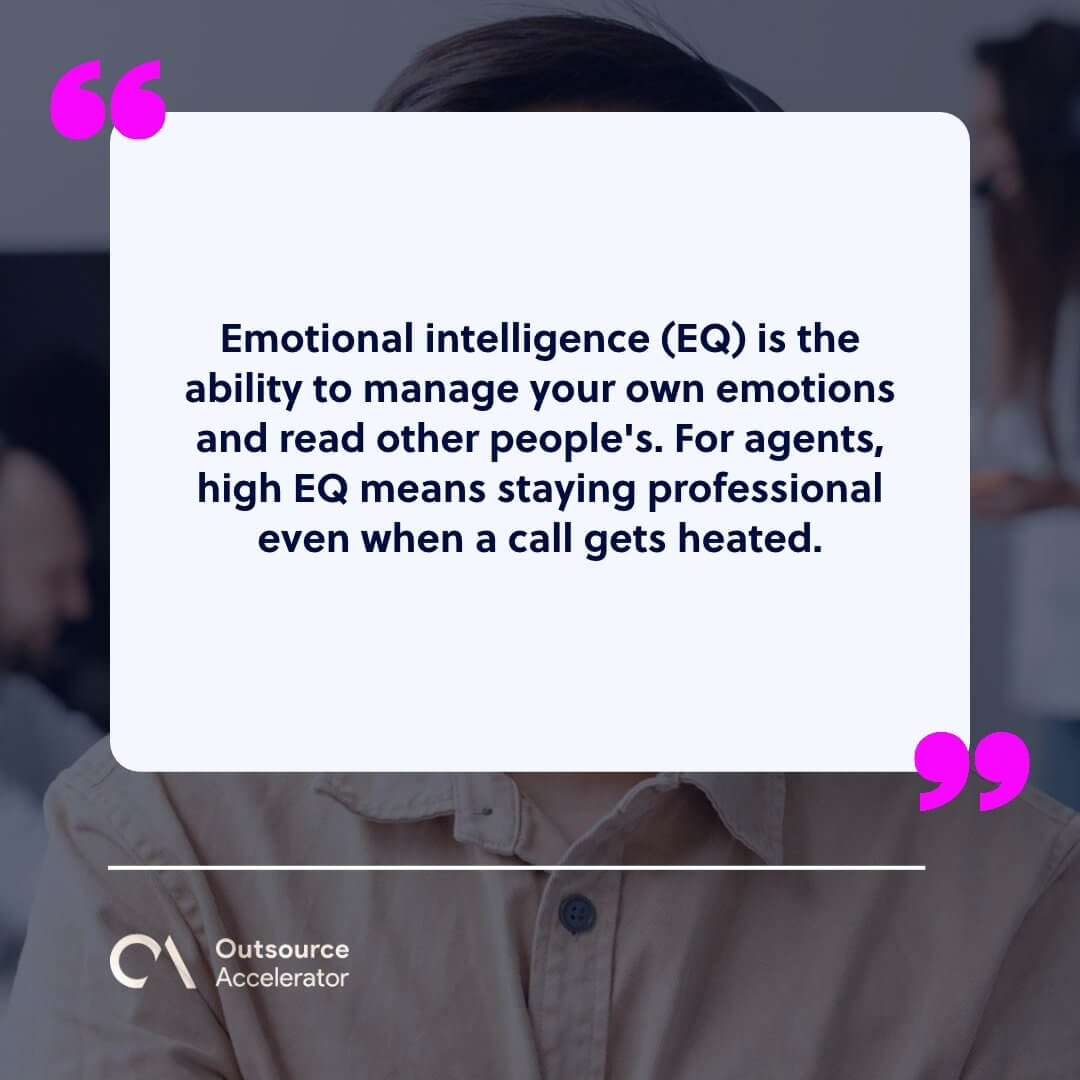
Agents with strong EQ de-escalate tension and adapt their style to each caller. In turn, emotional intelligence improves customer experience across the whole team.
5. Patience
Call center work can be repetitive and stressful. In addition, agents often deal with upset, confused, or difficult customers.
Patience lets them stay calm and courteous under pressure. In practice, a patient agent listens carefully, explains clearly, and never rushes the customer.
6. Problem-solving
Good problem-solving means spotting the real issue quickly and offering a practical fix within company guidelines.
It also takes resourcefulness. For example, agents need to know where to find information and when to escalate a case. Fast, accurate fixes reduce resolution time and lift satisfaction.
7. Adaptability
Customer service changes constantly, with new products, policies, and tools. AI is accelerating that shift. Gartner predicts that agentic AI will autonomously resolve 80% of common customer service issues by 2029.

That means human agents will handle more of the complex, emotional calls. So adaptability matters more than ever, both with new tools and with each new caller.
8. Time management
Call centers depend on efficiency, so agents must balance empathy with productivity, resolving calls fully without unnecessary delays.
Good time management keeps service level agreements (SLAs) on track. It also lowers stress, which keeps performance steady.
9. Conflict resolution
Conflict resolution helps agents handle complaints calmly and find outcomes that work for both the customer and the company.
In practice, it involves staying neutral, using positive language, and focusing on solutions. Agents who master it can turn unhappy customers into loyal ones.
10. Teamwork
Agents spend most of their day with customers. However, working well with colleagues and supervisors is just as important.
For example, team players share knowledge, support peers, and keep standards consistent. Consequently, morale improves and turnover falls.
11. Positive attitude
A positive attitude shapes how customers see your company. Even on hard calls, friendliness makes customers feel valued.
Upbeat agents also tend to earn higher satisfaction scores. In addition, they recover faster from stressful calls, which helps prevent call center burnout.
12. Attention to detail
Accuracy matters, because small mistakes can cause billing errors, confusion, or repeat calls.
Detail-oriented agents get customer data, instructions, and follow-ups right the first time. That’s especially important in finance, healthcare, and telecommunications.
How to develop call center soft skills
Hiring people with the right traits is only the start. To keep service quality high, you need ongoing training and feedback. These seven methods work well:
- Communication and empathy training: Run workshops on tone, active listening, and empathetic language. Use real call recordings as examples.
- Role-play exercises: Simulate tricky customer situations in training. Soft skills games make this practice more engaging.
- Constructive feedback: Supervisors should review calls regularly and give specific feedback, highlighting strengths as well as gaps.
- Peer learning: Pair experienced agents with new hires to pass on practical know-how.
- Well-being support: Burnout erodes soft skills fast. So offer breaks, wellness programs, and recognition.
- Measurable goals: Track metrics that reflect soft skills, such as customer satisfaction (CSAT) and first call resolution (FCR).
- Technology: Use call analytics and call center quality monitoring to assess tone and empathy, then target training where it’s needed.
Making soft skill development an ongoing priority builds a more capable, confident, and customer-focused team.






 Independent






