
An insider guide to business process mapping


What is business process mapping?
Business process mapping is the visual layout of how work gets done in a company, step by step, so teams can follow, review, and improve it.
- It shows each task in order, from a clear start to a clear end.
- It helps new staff learn a role fast, even after someone leaves.
- It points out slow spots so you can fix them and scale.
Business processes are a core part of any strong operation. The clearer and simpler complex tasks are, the better staff perform. A good process flow shows how tasks are done. As a result, things stay in order across the company. This is where business process mapping comes in handy. Business process maps lay out the steps for every part of the work in plain terms. This article gives a full guide to business process mapping, what it offers, and its types.
Table of contents
What is business process mapping?
Business process mapping features
Business process mapping vs. Business process modeling
3 types of business process maps
Benefits of business process mapping
5 best practices to apply in business process mapping
5 common tools for business process mapping
Why use a business process map?
What is business process mapping?
In short, business process mapping is the visual view of a firm’s inside and outside work. Its main goal is simple. So it helps all stakeholders work in sync.
Process maps often show up in staff handbooks or standard operating procedures. In some cases, company websites add them to an FAQ section. Because they are simple and clear, HR teams often use them. So they set the standard for good work and steady improvement.
Straying from a process map can trigger infraction reports. In turn, those show up in staff records. So following the guidelines matters. After all, management treats them as a real standard for direction and goals.
Business process mapping features
Here are common features you find in business process mapping software.
Task-oriented
First, business process maps are built from single tasks. Task owners can be a department, the whole company, or one person. Meanwhile, the key part is the order of steps. So a task counts as done only when the steps are complete. This order repeats daily. As a result, a new hire can follow it even after someone resigns.
General
Still, staff turnover is normal and happens all year. Even so, the process map details stay the same when new people take the post. In addition, this logic works across the board. It also works at every level of management.
Time-bound
In fact, each process model has a clear start and end. The end of one process often starts a chain of tasks. Those can run at the same time or one after another. Either way, the map has a clear time frame. So you can review and improve it later.
Business process mapping vs. Business process modeling
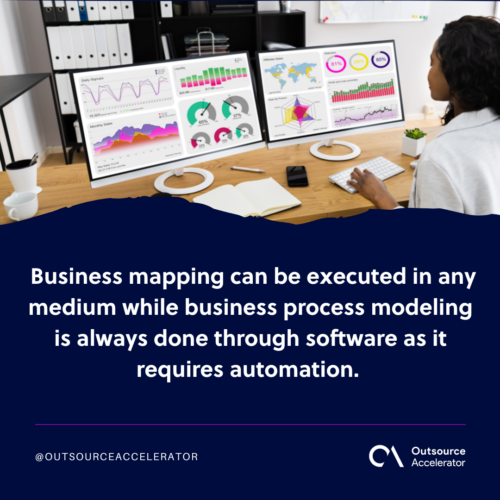
People often mix up business mapping and business modeling. Both flesh out details and mark key steps in an operation. The difference lies in the medium used. Business process mapping can be done in any medium. For example, paper, a tablet, or a whiteboard all work. However, process improvement projects need automation. So they are almost always done through software.
3 types of business process maps
Below are common types of process maps used in work and school settings.
1. Flow charts
This is the most common type of process map. Flow charts are a clear set of arrows and boxes. They lead from a set start to an end. You can even draw them by hand on paper or boards. Microsoft Office is another tool for flow charts, mainly for SOPs and manuals. Some use Adobe Photoshop, but that is mostly for printing a process onto a tarpaulin. The main plus of this map is its simplicity. However, its downside is a lack of flexibility. So complex, multi-step work can be hard to show.
2. Diagrams
Next, diagrams are much like flow charts. They also use symbols, shapes, lines, and a clear direction. What sets them apart is their wider view. Here, steps are split and process owners are named. As a result, teams can see how much they must work together. This also makes it easy to spot the point person on a project. In short, a data flow diagram builds better synergy. It shows that all teams share one goal.
3. Stream map
Finally, this is among the more technical process maps. It is used in lean six-sigma work. So it is rarely shown to staff or put in manuals. This tool is hard to grasp in depth. Mostly, planners and managers use it. The goal is to optimize the flow and explain each option in detail.
Benefits of business process mapping
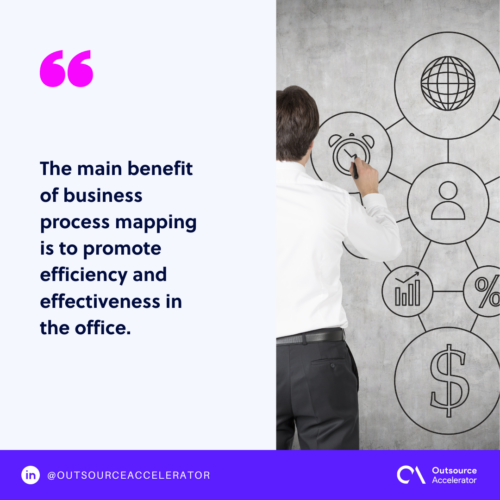
The main benefit of business process mapping is clear. It drives efficiency and better output in the office. It also builds a culture of excellence that fits growth goals. Once that culture takes hold, companies find it easier to scale. In fact, clear maps often support wider business process outsourcing plans.
Other benefits of a business process map include the following:
- Clear process documentation and a visual view
- A shared understanding of the process across the company
- Steady control over how the process runs
- Agreed best practices and norms
- Leaner operations with fewer redundancies
- Greater awareness of processes
- Better fit with industry standards
- Improved staff training and growth
The list is not complete. Business process mapping offers many benefits. Depending on the goal and the company, its impact can show up in many ways. For example, it pairs well with the benefits of automation when you digitize each step.
5 best practices to apply in business process mapping
The idea of optimizing work with process maps can be exciting. However, not all maps work well. Some cause more confusion if they are not planned with care. Below are five best practices to consider as you build maps.
1. Keep it simple
The simplest approaches are often the best. The main goal is to get compliance. If maps are too complex, they cause confusion. As a result, they defeat the whole point of optimization.
2. Stay up to date
Circumstances change over time. So revisit your maps often to catch new issues. This keeps performance strong and drives ongoing improvement. Sometimes a better method appears during the work. You can then fold it in, keeping the map open to growth.
3. Identify the purpose
The overall goal should guide the whole mapping project. First, ask who the map is for. Is it for end-users or staff? The answer shapes the direction. So be clear about the goal from the start.
4. Be as reasonable as possible
The goal is to optimize the process, not to push deadlines to the extreme. Instead, set realistic and fair expectations. That is what makes a map work.
5. One step at a time
Every process has exceptions and sub-tasks. Trying to map them all at once slows you down. So start with the most common steps and situations. Then build from there.
5 common tools for business process mapping
Business process mapping tools help teams show workflows visually. In turn, they help spot bottlenecks and streamline work. Many of these tools support AI workflow automation as well. Here are five tools businesses can use.
1. Lucidchart
First, Lucidchart is an easy diagramming tool. It lets teams build flowcharts and process maps together in real time. Its cloud platform also adds easy access and links with other apps.
2. Microsoft Visio
Next, Microsoft Visio is a strong diagramming tool. It offers many templates and shapes for detailed maps. It also works well with other Microsoft Office products. So it feels familiar to many users.
3. Bizagi Modeler
Bizagi Modeler is a free tool. It offers a full suite for modeling with BPMN, the Business Process Model and Notation. In addition, it supports collaboration and exports models in several formats.
4. Draw.io
Meanwhile, Draw.io is an open-source diagramming tool. It lets users build flowcharts and maps at no cost. It has a simple interface too. Plus, it links with Google Drive for easy sharing.
5. Miro
Finally, Miro is a flexible online whiteboard. It supports shared mapping and brainstorming sessions. Its drag-and-drop features and templates make workflows easy to show. As a result, teams can add input in real time.
Why use a business process map?
Business process mapping supports a company’s goal of higher profit. It helps you find the best way to do tasks. In short, you use the least time and the fewest resources. This practice also builds a more open, growth-ready culture. With clear processes, checking compliance gets easier. So does fixing any gaps. Clean maps even improve how you handle data processing services and reporting.
Mapping also feeds directly into workplace productivity. For deeper analysis, some teams pair maps with the KDD process to turn raw data into insight. To better understand business process mapping, we at Outsource Accelerator help companies of all sizes find the right partner. Book a call to get started with your operational needs.
Business process mapping FAQs
These common questions help you map your business processes well.
What are the four steps of process mapping?
The four steps of process mapping usually include the following:
- Identify the process. Pick the process you want to map and set its boundaries.
- Gather information. Collect data on how it runs now, including inputs, outputs, and key stakeholders.
- Create the map. Use flowcharts or diagrams to show each step and decision point.
- Analyze and improve. Review the map to find waste, then plan ways to optimize it.
These steps build a clear view of the process. As a result, improvements come easier.
What are level 1, 2, 3, 4 process maps?
Level 1 to 4 process maps show different layers of detail. Each level adds more depth:
- Level 1 gives a high-level view of the whole process, with major phases and key outcomes.
- Level 2 breaks each phase into subprocesses, so you see how parts interact.
- Level 3 goes deeper into subprocesses, with steps, roles, and interactions.
- Level 4 gives the most detail, capturing every action, task, and decision point.
This layered approach helps teams grasp processes fully, from broad strokes to fine detail.
Is business process mapping the same as a flowchart?
They are related but not the same. Business process mapping gives a full view of a process. It often adds roles, inputs, and outputs. A flowchart is one type of diagram. It shows steps and decisions in a simple format. So a flowchart can be part of a map. Still, mapping covers a wider look at the whole process.
What is an example of process mapping?
For instance, take the customer order fulfillment process in a retail business. The map might show receiving the order and processing payment. Next, it covers picking items, packing the order, and shipping it. Each step names who is responsible and what tools are used. As a result, you spot decision points and areas to improve.
Key takeaways
- Business process mapping shows how work flows, step by step, from start to end.
- Maps stay steady through staff turnover, so new hires learn roles fast.
- Flow charts, diagrams, and stream maps each fit different needs.
- Keep maps simple, current, and tied to a clear purpose.
- Clear maps drive efficiency, easier scaling, and better productivity.






 Independent





