
Choosing the right offshoring partner for your business


This article is a submission by Guerilla Staffing Solutions. Guerilla Staffing Solutions is a family-owned outsourcing firm based in Clark, Philippines.
What should you look for in an offshoring partner?
The right offshoring partner fits your goals, your budget, and your industry, and backs that fit with a proven track record and clear communication.
- Define your needs first, then match them against each provider’s skills and experience.
- Check real capabilities: expertise, infrastructure, data security, and cultural fit.
- Confirm the cost and scalability align with your budget and expected return.
Are you trying to cut costs so you can keep your day-to-day operation running? Maybe you want the cheapest way to make your business recession-proof. If so, you may want to consider going offshore.
This strategy has long proven itself as a way to sustain businesses. First, its main advantage is clear: it lowers your operating costs. Still, it would be wrong to assume that cutting costs is all offshoring offers.
In fact, offshoring is now part of the business world, and experts see its full potential. Many clients choose this business strategy for its strong results and the value it brings. To weigh the wider picture, this look at offshoring versus outsourcing helps.
As a first-timer, you might feel a little hesitant, and that is understandable. Still, when you look closer, you will find many success stories. For example, big companies like Slack and Skype have used this strategy for software development. Both firms spread that work across several countries.
Is going offshore good for your business?
Offshoring is good for any business as long as it is done right. Of course, you still need to weigh your own situation. That includes your business goals, budget, and resources.
The word offshoring can feel complex and risky. After all, it exposes you to communication barriers, cultural differences, and security risks. Still, with a good offshoring partner, those risks stay small. Instead, you gain benefits that are hard to find at home, such as:
- Advanced skills and specialized knowledge. You get top talent working in your business at a fraction of the usual cost.
- Diverse team. You gain access to broad knowledge, which gives you an edge over competitors.
- Recession-proof operations. Your business can keep running through a crisis, such as a natural calamity or an economic downturn.
- 24/7 service availability. You can ask your partner for help whenever issues arise, since most providers run around the clock.

How to choose the right offshoring partner?
Many outsourcing and offshoring companies have emerged in recent years. As a result, finding the right partner for your business can feel hard.
So you need a careful, strategic approach. That way, the provider you pick is the one your business truly needs. Below are some steps to help you find the best offshoring partner.
Define your business requirements
First, define your business requirements before you list any partners. Be clear on what you want and expect. Decide which skills, expertise, and experience your staff should have, since they drive your business growth. This step helps you see which providers fit your goals.
Research potential partners
Next, search for potential partners. Start with one question: where do you prefer to offshore your staff? Besides India, there are several strong destinations, and one of them is the Philippines. The country has been in this industry since the early 1990s. What sets it apart is its people.
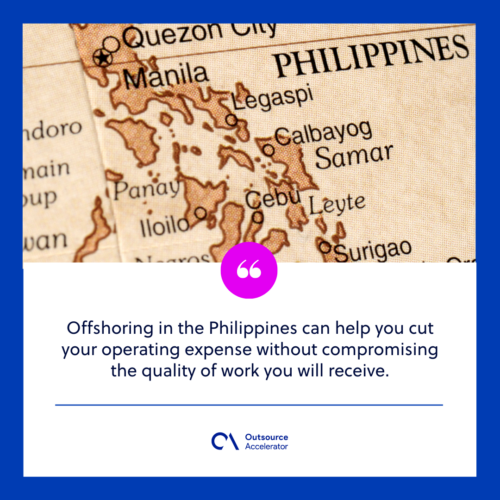
Filipinos are known for their work ethic and top-tier skills. So offshoring in the Philippines can cut your costs without hurting quality. If you want help scoping this, an offshoring consultant can guide the search. Once you pick a location, start finding partners there.
First, look for companies with relevant industry experience and a proven track record. In addition, use online directories, industry associations, and referrals. For now, list as many as you can. For a broader view, these offshore outsourcing models show the main ways to structure the work.
Evaluate potential partners’ capabilities
Then, evaluate your shortlist one by one. Use the requirements you set earlier. As a result, it is easier to spot the perfect fit. So be thorough and check their real capabilities. For example, assess their expertise, technical skills, infrastructure, and resources. In addition, review their communication channels, data security, and cultural fit.
Evaluate the cost and scalability
Finally, weigh the cost and scalability of the partnership. Always check this. It makes sure the cost of offshoring lines up with your budget and expected return. To plan growth, see how firms build and manage an offshore team over time.
What does Guerilla Staffing Solutions offer?
Guerilla Staffing Solutions is one of the many BPOs in Clark, Philippines. It is a family-owned business run by five sisters. Each one brings her own entrepreneurial spirit and strengths.
In practice, the team focuses on the best-suited staffing solutions for every business. In addition, it keeps prices affordable without cutting the quality of work clients receive.
Frequently asked questions about choosing an offshoring partner
Here are quick answers to common questions about picking an offshoring partner.
What is the difference between outsourcing and offshoring?
Outsourcing means hiring an outside firm to handle a task. Offshoring means moving that work to another country. So offshoring is one form of outsourcing, done across borders to cut costs or reach new skills.
How long does it take to onboard an offshoring partner?
It depends on the role and the provider. A small team can start in a few weeks. Still, complex functions may take a couple of months to plan, hire, and train well.
Is offshoring only about saving money?
No. Cost savings are the headline, but they are not the whole story. For example, offshoring also brings specialized skills, a diverse team, and round-the-clock coverage.
Which country is best for offshoring?
There is no single answer. For example, India and the Philippines both rank high. Still, the best choice depends on the skills you need, your budget, and your target time zone.
How do I protect data when I offshore?
First, check each provider’s security measures and compliance record. Next, set clear terms in the contract. Finally, agree on access controls and regular reviews before any work begins.






 Independent






