
Summary: Bold – Peter Diamandis


 BOLD by Peter H. Diamandis
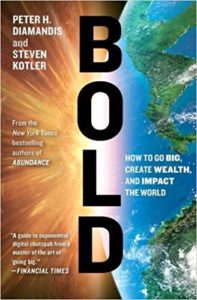 BOLD by Peter H. Diamandis
How to Go Big, Create Wealth, and Impact the World
What is the book Bold by Peter Diamandis about?
Bold is a how-to guide by Peter H. Diamandis and Steven Kotler on using exponential technology, crowdsourcing, and crowdfunding to build big, world-changing companies.
- Part one covers the exponential tech that disrupts large firms.
- Part two shares lessons from founders like Musk, Bezos, Page, and Branson.
- The book works as both a manual and a manifesto for bold founders.
I. One sentence summary of the book
Bold is a clear how-to guide. In short, it shows how to use exponential technologies, crowdsourcing, and crowdfunding.
II. Book overview
Overall, this book is a full how-to guide on exponential tech, crowdsourcing, and crowdfunding. First, the opening part looks at the technologies now disrupting Fortune 500 firms. As a result, founders can move from a simple idea to a billion-dollar company far faster than before.
Meanwhile, the second part draws on lessons from Larry Page, Elon Musk, Richard Branson, and Jeff Bezos. For example, the authors unpack the power of artificial intelligence and robotics. The tone stays upbeat, yet it keeps a strong entrepreneurial spin.
Bold is not just a manual. It is also a manifesto. So it reads as a go-to resource for founders who want to use today’s tools. Much of its advice still shapes modern types of entrepreneurship.
III. Recommended for
Maybe you make shoes. Maybe you work in mining. Either way, the authors’ energy for what is possible will win you over.
The “Six D’s of Exponentials” lays the groundwork. In addition, the authors share cheap, powerful tools open to everyone right now. You can use them to fund, build, and market your idea.
The book also covers robotics and artificial intelligence. As a result, you grasp how much the world may change in the next few decades.
It digs into crowdsourcing, crowdfunding, and exponential tech. So this book suits investors, startups, and founders with big ideas. For a wider view, the latest entrepreneurship statistics back up many of its claims.
 IV. Author biography
 IV. Author biography
Dr. Peter H. Diamandis is a global innovator. Specifically, he works in innovation, incentive prizes, and commercial space.
In 2014, Fortune Magazine named him one of “The World’s 50 Greatest Leaders.”
In addition, Diamandis co-founded Human Longevity Inc. (HLI) and serves as its vice-chairman. He also co-founded Singularity University, a graduate-level school in Silicon Valley, and acts as its executive chairman.
He is a New York Times bestselling author too. His books include Abundance: The Future Is Better Than You Think and BOLD: How to Go Big, Create Wealth & Impact the World.
V. Lessons
1. Think “exponentially”
Long ago, only pharaohs, kings, and emperors could solve society’s biggest problems. Then the Industrial Revolution arrived. As a result, power shifted to industry chiefs with the money and the know-how to modernize society. Today the picture looks very different. Now anyone with big ideas, drive, and access to new tech and capital can make that idea real.
“Today the shift from ‘I’ve got a neat idea’ to ‘I run a billion-dollar company’ is occurring faster than ever.”
Linear growth means small, steady steps. Commerce once followed that path. However, new tech has launched growth into an “exponential” world.
Together, the Six D’s of Exponentials explain this power. In fact, the last stages carry the most force.
- “Digitalization”: The chain reaction from information technology starts here. As a result, it makes teamwork easier.
- “Deception”: Growth is tiny at this stage. So it is hard to see and value.
- “Disruption”: The impact becomes clear to a wider crowd. At this point, you either disrupt yourself or get disrupted.
- “Demonetization”: This means money leaves the equation.
- “Dematerialization”: Once-solid objects take less-solid forms.
- “Democratization”: Costs drop so low that almost anyone can afford the tool.
“Companies consistently fail when they rest on their laurels and think that what worked yesterday will work today or tomorrow.”
Still, exponential tech often fails to live up to its hype. In the early days, it is often hard to apply.
2. “Skunk Works” to change the world
Small, focused challengers often outwit large firms on new tech. To keep up, big-firm leaders must split new projects from the daily grind. This mindset drives real workplace innovation.
“Today’s world is awash in data…mining this treasure trove for useful tidbits can be worth billions of dollars.”
For strong innovation, appeal to what knowledge workers want:
- Autonomy, the wish to steer your own path
- Mastery, the wish to steer it well
- Purpose, the need for the work to mean something
So give people the room to think, take risks, fail, and try again. As a result, this freedom builds a culture of experiments and faster learning.
3. People who changed the world
Elon Musk, Richard Branson, Jeff Bezos, and Larry Page show real passion and drive. They take big risks. In addition, all four share one key trait: a relentless focus on the customer.
“If you’re not embarrassed by the first version of your product, you’ve launched too late.” (LinkedIn founder Reid Hoffman)
Common traits of these entrepreneurs
- Risk taking and risk reduction
- Constant experimentation
- Long-term thinking
- Passion and motivation
- Customer focus
- Rational and hopeful thinking
4. Crowdsourcing
Crowdsourcing first grew around 2000 with online T-shirt design. Then it spread to virtual worlds. Today you can outsource almost any task to freelancers. As a result, brands now pay far less than before for the same quality and volume of ads. The same logic drives outsourcing for startups today.
“Just three or four decades ago, if you wanted to access a thousand core processors, you’d need to be the chairman of MIT’s computer science department or the secretary of the US Defense Department. Today the average chip in your cell phone can perform about a billion calculations per second.”
You have likely helped crowdsource something without knowing it.
Still, use crowdsourcing with care. First, read each profile and review before you choose. Next, write a clear project brief. Then work closely with your team.
Crowdfunding
Crowdfunding soon followed, starting with Kickstarter. So if you have a great idea, tap the crowd to fund, build, and market it. As a result, you can do all three faster and at a lower cost.
Types of crowdfunding
- Donation
- Debt
- Incentive
- Equity
5. Incentive contests
Incentive contests offer huge prizes for new ideas. First, set a clear target. Next, open the contest to a large crowd of innovators. Then run it long enough to match the size of the challenge. Finally, write rules that spark creativity and reward the results you want.
Three motivators
- Recognition
- Money
- Frustration
VI. Other learnings to look out for
1. To change the world
- Networks and sensors: billions of smartphones and tablets now exist. In addition, sensors sit in our cars and even jet engines.
- Sensor visions: this huge network may generate trillions of dollars in value.
- Infinite computing: computing power keeps growing fast.
- Artificial intelligence: for example, a system can recognize a face and give you the name.
- Robotics: the new workforce. Much of this now shows up as robotic process automation in business.
2. Google’s eight-point innovation principles
- Prioritize the user
- Share everything
- Look for ideas in many places
- Think big but start small
- Never fail to fail
- Spark with imagination, fuel with data
- Be a platform
- Have a mission that matters
VII. Personal takeaways
- Think big and bold. As a result, you keep your drive and draw people who share your vision.
- Run incentive contests. So you can spark genius in people and teams worldwide.
- New tech, bigger networks, and faster computers put huge power in ordinary hands at a low cost.
- Exponential growth models have already replaced the old linear ones.
- Use crowdsourcing to build and market your ideas.
- Learn to innovate.
- Remember the Six D’s: digitalization, deception, disruption, demonetization, dematerialization, and democratization.
- More people now connect through the web. As a result, our shared brainpower keeps growing.
VIII. Final words
The book mostly covers exponential technologies. Still, you will also learn these points along the way:
- How the Six D’s model explains the levels of innovation.
- How fast change creates new chances through crowdsourcing and crowdfunding.
- How to use widely available tools to make your big idea real.
For more on the author and the book, please visit the link below.
http://diamandis.com/bold
IX. What other people are saying
- “A visionary roadmap for people who believe they can change the world, and invaluable advice about bringing together the partners and technologies to help them do it.” (President Bill Clinton)
- “Abundance showed us where our world can be in 20 years. BOLD is a roadmap for entrepreneurs to help us get there.” (Eric Schmidt, Executive Chairman, Google)
- “I loved Peter Diamandis’ and Steven Kotler’s book Abundance, their writing and their Vision. BOLD is an amazing sequel, a book that every entrepreneur should read. It is inspiring, filled with incredible insights and offers a practical how-to game plan for going big and impacting the world.” (Michael Dell, CEO, Dell Computers)
- “In BOLD, Diamandis and Kotler have written another dazzler. A riveting look inside the world of exponential entrepreneurship, action-packed and action-oriented. I’ve purchased a copy for my entire team at Cisco.” (Padmasree Warrior, CTO & Chief Strategy Officer, CISCO)
- “This is a manual for today’s big thinkers to become tomorrow’s bold leaders, using crowd-powered tools accessible to everyone.” (Booklist)
Frequently asked questions
Who wrote the book Bold?
Bold was written by Peter H. Diamandis and Steven Kotler. Diamandis also co-founded Singularity University. In addition, he wrote the bestseller Abundance.
What are the Six D’s of Exponentials?
They are digitalization, deception, disruption, demonetization, dematerialization, and democratization. Together, they map how a new technology grows and spreads.
Who should read Bold?
The book suits founders, investors, and startup teams. It also helps leaders at larger firms. So anyone who wants to use new tech for growth will gain from it.
What is the main idea of Bold?
The core idea is simple. Today, ordinary people can solve huge problems. Thanks to cheap tech, crowdsourcing, and crowdfunding, bold ideas now scale faster than ever.
How does Bold compare to other business books?
Bold focuses on exponential tech and big, fast growth. For a different angle on scaling a company, you can also read our summary of Scaling Up by Verne Harnish.






 Independent





