
Book review and summary: Scaling Up – Verne Harnish


What is the summary of Scaling Up by Verne Harnish?
This Scaling Up book summary shows how a few firms grow fast while most stall. Verne Harnish says growth rests on four areas: People, Strategy, Execution, and Cash. Master all four, and you can scale up 10x.
- Attract and retain the right people, then let great managers coach them.
- Build a clear, differentiated strategy and execute it without fail.
- Keep plenty of cash, because growth burns cash fast.
Verne Harnish wrote Scaling Up to answer one question. Why do a few companies make it while the rest do not? So this Scaling Up book summary breaks down his four keys and main lessons.
Note: Outsourcing can be a key enabler of scaling up. So why not see how it can help your business?
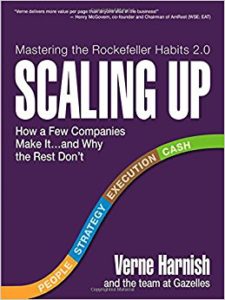
Scaling Up review
In general, most new ventures stay small, like “mice.” However, a few grow into “gazelles.” They break the $1 million mark and scale to $10 million, $100 million, and even $1 billion.
To keep growing, gazelles rely on solid processes and good habits. As a result, they avoid the usual traps of fast growth. They focus on four areas: People, Strategy, Execution, and Cash.
From these four areas, the keys to scale are clear. First, attract and retain the right people. Next, build a differentiated strategy and drive flawless execution. Finally, keep enough cash to weather any storm. Underlying them are the Rockefeller Habits, ten habits that support strong execution.
Who should read Scaling Up?
First, this book is a dense compendium of leadership and talent ideas. It reads like a textbook, with a clinical, practical style. In short, the goal is to help firms scale up 10x across the four key areas.
With these tools, teams stay engaged and customers do your marketing. Each key area gets its own chapters, worksheets, charts, and illustrations. However, the textbook style makes it hard to read cover to cover.
The writing is full of jargon and consultant-speak. So it takes patience to digest. Still, its depth makes it a strong read, especially for CEOs and their executive teams.
About the author, Verne Harnish

Verne Harnish is a founding member of the Entrepreneurs’ Organization (EO). For fifteen years, he chaired EO’s premier CEO program, “Birthing of Giants.” He also led WEO’s “Advanced Business” program, both held at MIT.
He is the founder and CEO of Gazelles. In addition, he has spent three decades helping companies scale up. He also writes a regular column for Fortune magazine.
Verne wrote Scaling Up and Mastering the Rockefeller Habits. With Fortune’s editors, he also wrote The Greatest Business Decisions of All Time. Today, he invests in several scale-ups and lives in Barcelona, Spain.
INTERESTED IN SCALING UP? READ THE COMPLETE GUIDE TO OUTSOURCING
Key lessons from the Scaling Up book summary
The lessons fall under the four keys to scale. So let us walk through each key and its lessons.
Key 1: Attract and retain the right people
Lesson 1: Recruitment strategy and finding “A players”
“You need a minimum of 20 applicants per position (frontline to senior) if you want to dramatically increase your odds of hiring A players.”
First, you will not find great hires on job boards alone. So build a recruitment strategy and seek about 20 candidates per opening. As a result, your odds of a top hire go up.
From there, prescreen to cut half the field. For example, use online screens and exams. Then interview the rest and use a scorecard of the skills you need. Remember, candidates must also fit your culture.
Lesson 2: People matter
“People join companies. They leave managers. Therefore, to keep your team happy and engaged, you need one thing above all else: great managers, not free lunches or yoga classes!”
First, put the right people in the right roles, especially in leadership. As a result, these leaders make sure the right people do the right things. Next, invest in their training and give them stretch assignments. Spend 2% to 3% of payroll on development.
Choose managers for their coaching skills, not their technical skills. As they coach, they should remind people of the greater purpose. In addition, they should recognize good work, because people excel when they feel valued. Finally, managers should delegate so they can coach and plan ahead.
Lesson 3: Pay people well
“‘Fairness’ does not mean ‘sameness.’ You need to be creative and flexible in order to keep your top talent happy, from a compensation-package perspective.”
Underpaying people only ensures mediocrity. So pay top staff well, even if it means hiring fewer of them. As a result, you retain talent and avoid costly rehiring.
Key 2: Create a truly differentiated strategy
Lesson 4: The value of having values
“Finding employees’ strengths and focusing workers on those assets is the most important people-management tool we can suggest.”
First, core values are the rules that define your culture. They give a clear “should or shouldn’t” test for every decision. As a result, your values act like an immune system that rejects poor fits.
Core values are also the starting point of strategy. They name your core purpose and the problems you solve. From there, you align hiring, rewards, and every other activity.
Lesson 5: The 7 Strata of Strategy
“A good plan now is better than a great plan too late.”
Strategy is always a work in progress. So a small strategy team should meet for an hour each week. In addition, Harnish recommends a seven-level approach:
- “Words you own (mindshare)”: Own words that define you in the market. For example, Volvo owns “safety.” Use these words in your content and search terms.
- “Sandbox and brand promises”: Know your most valuable customers. Appeal to their emotions as well as their needs. Then promote brand promises that keep them coming back.
- “Brand promise guarantee (catalytic mechanism)”: State the one thing you will always deliver. For example, a full refund. Then make it painful to fail on that promise.
- “One-PHRASE Strategy (key to making money)”: Focus on one main benefit. For example, Apple’s “closed architecture.” You can only lead on one thing.
- “Differentiating activities (3 to 5 hows)”: Set out how your service differs from rivals. Make sure it cannot be copied cheaply or quickly.
- X Factor (or the 10x Advantage): Find the thing you do that beats rivals by at least ten times.
- Profit per X and BHAG: Pick a “big hairy audacious goal” that links purpose and strategy. Then set one critical profit metric.

Key 3: Drive flawless execution
Lesson 6: Execution is everything, the “Rockefeller Habits”
“Handling a company’s growth successfully requires three things: an increasing number of capable leaders, a scalable infrastructure and the ability to navigate certain market dynamics.”
The Rockefeller Habits are ten habits that support strong execution. In short, they form a framework to guide and monitor your work. As a result, activities stay aligned with both strategy and people.
At the core, break your BHAG into a 90-day focus. In addition, set a quarterly theme to rally the team. Remember, everything needs a number tracked by a KPI. If you do not measure it, it will not get done. So post your metrics and goals where meetings happen.
Key 4: Have plenty of cash to weather the storm
Lesson 7: Cash is king
“What is more important, profit or cash? If you’re a growing business, it’s cash.”
Stop saying, “this is just how our industry works.” Instead, keep strong cash reserves. Even great teams and strategy cannot save a firm with cash trouble.
Firms need cash to grow, yet nothing burns cash faster than growth. So keep your cash flow tight and closely watched. For example, tighten accounting, collect receivables fast, and send error-free bills on time.
Other lessons to look out for
- First, of the four areas, cash is the most pressing. Without cash flow, there is no growth.
- In addition, accountability is vital. So every goal needs a named owner.
- Meanwhile, gazelles drive most of the nation’s job growth and innovation.
- For example, their leaders praise good work, delegate, and use data to plan ahead.
- Gazelles are rare, even among firms past the $1 million mark. Most stall out or screw up.
Personal takeaways
- Great leaders and managers are central to scaling up. They steer daily work and keep it aligned with the BHAG. As a result, coaching skills matter more than technical skills.
- Cash is truly king. Without it, growth cannot happen, even with the best team and strategy. So cash should be the first area a firm secures.
- The first Rockefeller Habits keep people aligned, accountable, and engaged in open, honest debate.
Final words
Scaling Up gives firms the tools and ideas to grow. Still, scaling up is not easy. If it were, every company would do it.
The title itself is a reminder. Some firms will make it, and the rest will not. To see how outsourcing can help you scale, explore more and get a free quote here.
What other people say about Scaling Up
- “Verne Harnish has once again proven he’s the Growth Guy. Scaling Up is packed with the tools to help you bust through the barriers to growth and climb learning curves faster. But don’t let your leadership team carry the load alone, multiply your impact by sharing the book with every employee on your team.” (Liz Wiseman, best-selling author of Multipliers and Rookie Smarts)
- “The idea of guiding a company from the small tide pools to the big seas of business can be exhilarating, but also daunting without a detailed set of directions. Scaling Up provides those directions, along with a remarkably detailed map for how to get there safe and happy.” (Robert B. Cialdini, best-selling author of Influence)
- “Verne Harnish is more committed to helping companies grow than any other person on the planet. Really. He’s also radically practical in his approach and that is reflected throughout this terrific book.” (Patrick Lencioni, president, The Table Group; best-selling author of The Five Dysfunctions of a Team and The Advantage)
- “Scaling Up is a blueprint for building a growth company. With this book, Verne has pulled back the curtain on how the fastest-growing companies in the world fuel their growth. Scaling Up gives you an insider’s view into the inner workings of the most successful companies on earth. A must-read for an ambitious entrepreneur.” (John Warrillow, founder of The Sellability Score and author of The Automatic Customer and Built to Sell)
- “We’ve scaled up our company from a single office near Calgary to 2,000 employees in 165 locations across Western Canada. Verne’s tools and techniques have been critical to helping us drive and manage this growth during my 20 years as CEO, and ultimately to freeing me up as the founder to pursue other interests.” (Scott Tannas, founder and Vice Chairman, Western Financial Group; senator, Canadian Parliament)
Frequently asked questions about the Scaling Up book summary
What is the main idea of Scaling Up?
The main idea is simple. Growth rests on four areas: People, Strategy, Execution, and Cash. Master all four, and you can scale up 10x.
What are the four decisions in Scaling Up?
The four decisions are People, Strategy, Execution, and Cash. Each one supports the others. As a result, a gap in any area can stall growth.
What are the Rockefeller Habits?
They are ten habits that support strong execution. For example, they keep teams aligned and accountable. In addition, they tie daily work to clear numbers and goals.
Who should read Scaling Up?
The book fits CEOs and their executive teams best. It reads like a textbook, so it takes patience. Still, its depth makes it worth the effort.
Key takeaways
- This Scaling Up book summary centers on four areas: People, Strategy, Execution, and Cash.
- Hire A players, then let great managers coach and retain them.
- Build a differentiated strategy using the 7 Strata framework.
- Drive execution with the Rockefeller Habits and clear KPIs.
- Guard your cash, because growth burns it fast.






 Independent





