
Organizational citizenship behavior: Definition, types, and best practices


What is organizational citizenship behavior, and why does it matter?
Organizational citizenship behavior is when employees go beyond their job duties to help coworkers and the company, without being asked or rewarded.
- It lifts morale, teamwork, and daily output at work.
- Dennis Organ named five core types back in 1988.
- Leaders can grow it with simple, steady habits.
Organizational citizenship behavior has become a key idea in the modern workplace. The old top-down hierarchy long shaped the business world. However, in recent years, team-based and autonomous work has taken its place. As a result, this shift has changed today’s workplace dynamics. So a more flexible, creative, and open setting is now possible.
Employees that operate autonomously[1] can finish their tasks on their own. They can also make choices without asking a manager first. Through organizational citizenship behavior (OCB), self-driven staff show skills beyond their roles to help the company grow. This links closely to healthy workplace dynamics across a team. In this article, we will cover what OCB means, its main types, and best practices at work.
What is organizational citizenship behavior (OCB)?
First, most workers know their main job is simple. They must do their tasks, avoid disruptive acts, and deliver good work. However, through OCB, employees go further. So they take on extra work that is not strictly required.
Organizational citizenship behavior is also called the good soldier syndrome. Managers and leaders usually view these acts in a good light. This good quality of a team member helps the company and boosts overall efficiency.
Here is how OCB can lift the social and mental side of work:
- It motivates coworkers to act the same way and make OCB their norm.
- It improves how well employees do their jobs.
- It raises workplace productivity and morale.
Types of organizational citizenship behavior
From a historical perspective,[2] Dennis Organ studied organizational citizenship behavior in 1988. His research found five common behaviors. When shown in a group setting, they boost how well the team or company works.
- Altruism
- Conscientiousness
- Sportsmanship
- Courtesy
- Civic virtue
These five behaviors are explained below, along with more forms of OCB.
Altruism
In short, altruism happens when an employee helps a coworker and asks for nothing back. For example, a worker may help a colleague finish a project. Still, the employee does it even when the task is not part of their own day.
Conscientiousness
In short, conscientiousness is the trait of being organized, efficient, and dependable. So staff who show this form of OCB may do so in these ways:
- Arriving at work early to finish a project
- Working to beat team goals for the quarter
- Coming up with a fresh way to handle a process
Sportsmanship
Sportsmanship means owning your mistakes and staying positive under stress. It also means giving others support and cheer. For example, a worker may stay upbeat even when things go wrong. In a typical office, they choose not to complain or spread rumors about a rejected proposal. As a result, the payoff for the company is clear. Fewer complaints mean managers can focus on other key tasks.
Courtesy
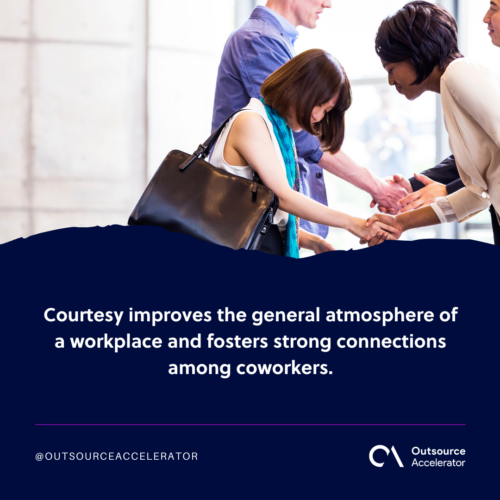
In other words, courtesy means being kind and respectful to coworkers, customers, and suppliers. As a result, it lifts the mood at work and builds strong bonds among coworkers.
Civic virtue
Similarly, civic virtue means taking care of the company’s wellbeing and adding to its success. For example, it can mean joining extra activities when needed. This can happen inside or outside the company. So it builds a sense of community and strong ties among coworkers.
Self-development
Meanwhile, this form of OCB covers workers who grow their own skills. For example, they may focus on:
- Skill development
- Personal goal setting
- Reflective learning
Employees who practice self-development are fully invested in their own growth.
Organizational compliance
Employees who follow the company’s rules and norms while going the extra mile show this form of OCB. As a result, this helps the company because it needs less supervision. So it lets firms be more open with macromanagement.
Organizational citizenship: Best practices
Managers and leaders can support these OCB habits with a few simple best practices:
- Encourage teamwork. Workers will feel they play a real part in helping others when a culture of collaboration starts early. This kind of empowerment in the workplace helps OCB take root.
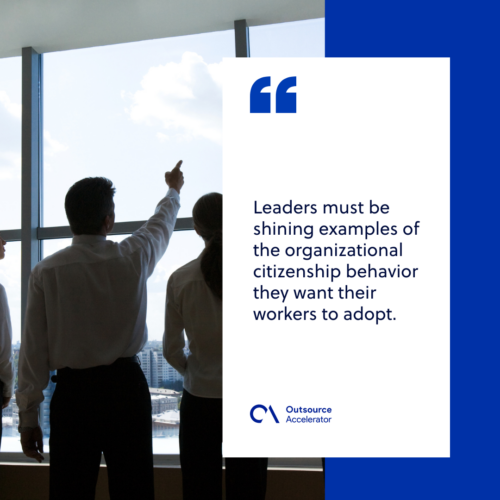
- Set an example. Leaders must model the organizational citizenship behavior they want to see.
- Connect OCB to company goals. Its types should tie into company goals. As a result, this helps grow the culture that OCB stands for.
Organizational citizenship behavior fosters team cooperation
Not every employee will show organizational citizenship behavior. Still, it can bring real gains for your team and your firm. Moreover, if you want to strengthen the bonds among your people, now is a great time to build OCB into your culture. The right employee engagement tools can make that job easier.
Frequently asked questions about organizational citizenship behavior
What are the five main types of organizational citizenship behavior?
Dennis Organ named five in 1988. They are altruism, conscientiousness, sportsmanship, courtesy, and civic virtue. Later work added self-development and organizational compliance.
Why is organizational citizenship behavior important?
It lifts morale, teamwork, and output. As a result, managers spend less time on complaints. So they can focus on bigger goals.
How can managers encourage OCB?
They can lead by example and reward helpful acts. In addition, they can build a culture of teamwork early. Because of this, staff feel safe to go the extra mile.
Is organizational citizenship behavior required in a job?
No, it sits outside formal duties. So it is voluntary by nature. Still, many strong teams treat it as a shared work ethic.
Key takeaways
- Organizational citizenship behavior is voluntary work that helps coworkers and the company.
- The five core types are altruism, conscientiousness, sportsmanship, courtesy, and civic virtue.
- OCB boosts morale, teamwork, and productivity, so managers gain time for key tasks.
- Leaders grow OCB by setting an example and tying it to company goals.
Article references:
[1] employees that operate autonomously: Noordegraaf, M. (2020), “Protective or connective professionalism? How connected professionals can (still) act as autonomous and authoritative experts.” Journals of Professions and Organization, Vol. 7 (2), pp. 205-223. doi: 10.1093/jpo/joaa011






 Independent






