
5 Common data entry errors and ways to prevent them


What are the most common data entry errors?
The most common data entry errors are inaccurate inputs, wrong formatting, and transposition mistakes. Others include unit or representation inconsistencies and data misinterpretation. All of them harm data quality.
- Most errors trace back to gaps in skills, experience, or technology.
- Even small mistakes, like a misplaced decimal, can cause costly problems.
- Training, good tools, and strong processes prevent the majority of them.
Every business looks for better ways to stay ahead. For example, avoiding data entry errors is one of them. The right tools and the right people are vital to the success of every organization.
Efficiency and accuracy matter in both the workforce and the tech stack. In data entry processes especially, it is vital to keep data accurate. As a result, detailed and reliable records help firms avoid problems. They also help teams make quick, confident decisions about growth.
How do data entry errors affect overall data quality?
Data entry errors create inaccurate databases. As a result, they can hurt an organization’s success. Worse, they can hit profits directly. In fact, many companies lose a lot of money to poor data management.
Businesses that treat data as an asset invest in strong data management strategies. In turn, they improve their decision-making.
Decisions drawn from poor or inaccurate data can hurt your business. As a result, they lead to poor outcomes. In addition, flawed data slows digital transformation. That is because data quality is a key factor in training artificial intelligence (AI) and using machine learning well.
5 common data entry errors
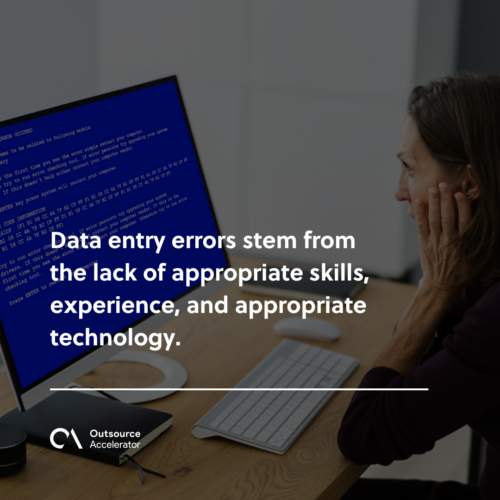
Data entry errors stem from a lack of the right skills, experience, and technology. Below are the five common data entry errors that firms should watch for.
1. Inaccurate data inputs
Incorrect data inputs are the most common error in data entry. An unintentional mistype can lead to a bigger problem in the short or long term.
It also produces wrong information, disorganization, and inaccurate records. For example, an error can be as simple as placing a decimal point in the wrong spot.
2. Wrong data formatting
Incorrect formatting can happen even with the latest data entry software. For example, staff may enter correct data in the wrong column or field. They may also enter the same information many times.
Adding extra, needless information is also possible. In some cases, the software cannot sort it out.
3. Transposition errors
Transposition errors occur when numbers or letters get swapped. As a result, they create incorrect sequences. This happens by accident. Still, it is always important to double-check all data before the next task.
4. Representation and unit inconsistencies
This error covers inconsistencies in time, date, and address formats. It can also appear in measurement formats or other units. As a result, records become hard to compare.
5. Data misinterpretation
This error happens when numbers get mixed in with words. Recording passwords or codes is a common example. In some cases, a letter O may be read as the number 0.
6 ways to prevent data entry errors
These mistakes may be small and accidental. Still, they can cause serious harm. For example, they may cost a lot of money and take a long time to fix. To help companies avoid them, here are a few tips.
1. Employ appropriate staff
When workloads pile up, it is the right time to hire more staff. This is especially true for growing businesses.
More staff keeps in-house data entry operators from burning out. In addition, you can choose to outsource. Third-party providers like SixEleven offer skilled data entry clerks. They can shoulder the processing workload of your internal team.
2. Provide proper training
Proper training is not only for new hires. Even skilled, experienced staff need training from time to time.
Training should stress the value of accurate data. Because of this, data entry agents see that they are responsible for the quality of their work.
3. Provide a good working environment
The type of working environment has a direct impact on performance. For business leaders, it is vital that staff feel no discomfort or pressure. Otherwise, it could affect their abilities.

4. Constantly improve data entry processes
Better data entry processes include automation tools that save time and support high data integrity. You can automate repetitive tasks. Still, agents need to check that all data is correct and accurate.
5. Always update your systems
System upgrades keep tools reliable and fully working. So companies should upgrade and automate their technology to stay ahead. In addition, using various software tools helps reduce staff workload.
6. Add validation rules and double-entry checks
Build guardrails into the process itself. For example, validation rules can reject impossible dates or out-of-range numbers. Meanwhile, double-entry or peer review catches typos before they reach the database. As a result, errors are caught at the source, not after they spread.
Preventing these errors keeps data management running smoothly. That is why organizations should strengthen their processes by following the tips above.
Key takeaways
- The five common data entry errors are inaccurate inputs, wrong formatting, transposition, unit inconsistencies, and misinterpretation.
- Poor data quality damages decisions, profitability, and AI or machine learning projects.
- Most data entry errors come from gaps in skills, experience, or technology.
- Training, a good environment, and updated systems prevent the majority of mistakes.
- Validation rules, double-entry checks, and outsourcing add extra layers of accuracy.
Frequently asked questions
What causes most data entry errors?
Most stem from a lack of the right skills, experience, or technology. In addition, fatigue, heavy workloads, and unclear processes raise the risk of mistakes.
How do data entry errors affect a business?
They corrupt records, distort reporting, and lead to poor decisions. Because inaccurate data costs time and money to fix, errors hit profits directly. They also slow digital projects.
What is a transposition error in data entry?
A transposition error happens when numbers or letters are swapped, such as typing 1243 instead of 1234. It is easy to make and easy to miss, so double-checking entries is essential.
Can outsourcing reduce data entry errors?
Yes. Specialized providers bring trained clerks, quality checks, and dedicated capacity. As a result, they reduce overload on internal teams and improve accuracy.
What tools help prevent data entry errors?
Validation rules, automation, double-entry verification, and dedicated data entry software all help. Together, they catch mistakes early and keep records clean.






 Independent





