
PEZA incentives, requirements and locations


What are PEZA incentives and who qualifies?
PEZA incentives are the tax breaks and non-fiscal perks for companies registered inside Philippine special economic zones. In short, they remain one of the biggest reasons global firms build outsourcing operations here.
The Philippine Economic Zone Authority rewards qualified locators with lower taxes, duty-free imports, and simpler procedures. Here is the quick answer before the detail:
- Registered enterprises can access an income tax holiday, a preferential 5% tax on gross income, and duty-free importation.
- Eligible sectors include IT and business process outsourcing, tourism, manufacturing, agro-industrial, and medical tourism.
- Companies must locate inside a PEZA economic zone and file documentary, technical, and financial requirements to qualify.
The Philippines keeps growing as one of the fastest-moving economies in Asia. Much of this is due to its business process outsourcing (BPO) sector. As a result, the country keeps encouraging foreign investors to set up here. This creates jobs and opens opportunities for Filipinos.
However, the information technology and business process outsourcing (IT-BPO) industry is not the only sector on the government’s agenda. Below, we explain the agency behind it all: PEZA. In addition, we cover its purpose, membership perks, and role in Philippine BPOs.
What is PEZA?
The Philippine Economic Zone Authority (PEZA) is an agency attached to the Department of Trade and Industry (DTI). Its job is to help locator companies that operate across the country’s special economic zones.
Founded in 1995 under Republic Act 7916, PEZA promotes, oversees, and assists foreign-registered business enterprises and their operations. Because being PEZA-registered carries real advantages, the BPO sector benefits the most.
For example, the agency actively encourages more BPO companies to invest in the Philippines. This helps develop PEZA-registered IT-BPOs nationwide.
PEZA incentives and benefits of a registered company
Under existing laws, a PEZA-registered company can claim both fiscal and non-fiscal benefits. In addition, investors and their families can enjoy several of these perks.
Fiscal incentives
Beyond the chance to operate inside a major economic center, registered business enterprises (RBEs) can also claim:
- Income Tax Holiday (ITH) of up to six years
- A special tax rate of 5% of gross income after the ITH, plus exemption from all national and local taxes
- Tax-free and duty-free importation of machinery, raw materials, and equipment
- VAT zero-rating of local purchases of goods and services
- Exemption from wharfage dues on import shipments of equipment
- Exemption from expanded withholding tax
Non-fiscal incentives
Aside from these tax incentives, the economic zone authority also gives foreign members and their families further benefits, such as:
- Simplified import-export procedures
- Employment of non-resident foreign nationals in supervisory, technical, or advisory positions
- Special Non-Immigrant Visa with multiple-entry privileges
- Extended visa assistance to foreign nationals, their spouses, and dependents
Advantages for the BPO industry
With access to tax incentives and prime economic centers, the BPO industry continues to thrive. Meanwhile, it benefits from competitive labor and equipment costs. As a result, firms from SMEs to enterprises can expand into ecozones and reach more clients.
This also creates more jobs for Filipinos in far-flung locations. In addition, IT-BPO companies can improve take-home pay and invest in employee skills. This opens opportunities for many Filipinos below the poverty line.

Eligible sectors and services for PEZA incentives
PEZA registration is available to the following sectors:
- Information technology (IT) sector and IT-BPOs
- Tourism sector
- Medical tourism sector
- Agro-industrial sector
- Manufacturing sector
To promote the IT industry, PEZA and the DTI encourage more foreign tech businesses to invest. Because of this, IT parks and buildings rise across the country. Eligible IT service activities include:
- Software development
- IT-enabled services (for example, data entry, transcription, and call center work)
- Content development
- Knowledge-based and computer-enabled services (for example, architectural and engineering consultancies)
- Business process outsourcing (BPOs)
- IT research
- Other IT-related services
PEZA requirements for BPO firms
To claim these benefits, companies must register and locate inside a PEZA special economic zone. In addition, they must submit documentary, general and technical, and financial requirements. Because these vary by sector, IT-BPO applicants should prepare the following.
Documentary requirements
- Duly filled application form (notarized)
- Corporate profile, which contains:
- A brief history of the company
- Existing and proposed business activities and projects
- Affiliated PEZA-registered companies
- Affiliated Bureau of Investments (BOI)-registered companies
- Principal officers and bio-data
- Audited financial statements for the past 3 years
- SEC Certificate of Registration
- Board Resolution authorizing the PEZA application and designating a representative
- Project Brief
- Project Feasibility Study
- Anti-graft certificate
General and technical requirements (for the feasibility study)
- Parent company and product brochures
- Description of the new project
- Detailed organizational chart
- Project timeline
- Potential market
- Service and process flow chart
- Detailed list of equipment (country of origin, capacity, and costs)
- Detailed list of materials (sources and prices)
- Area requirement
- Equipment layout
- Electricity and water requirement
- Waste and water disposal plan
- Principal officers and corresponding bio-data
- SEC Certificate of Registration
- Articles of Incorporation
Financial data and documentary requirements
- Matrix of employees with salary and position
- Matrix of foreign experts to be hired
- Projected volume of sales
- Breakdown of other USD costs
- Number of workdays and shifts per year
- Sources of financing
- Latest audited financial statement
- Parent company’s latest sales volume and value, net income, total assets, and number of employees, if applicable
Once the requirements are complete, officials review the application. Then they submit it to the PEZA Board for approval. After approval, the applicant receives a PEZA Board Resolution. In some cases, the agency may request more documents.
PEZA special economic zones and locations
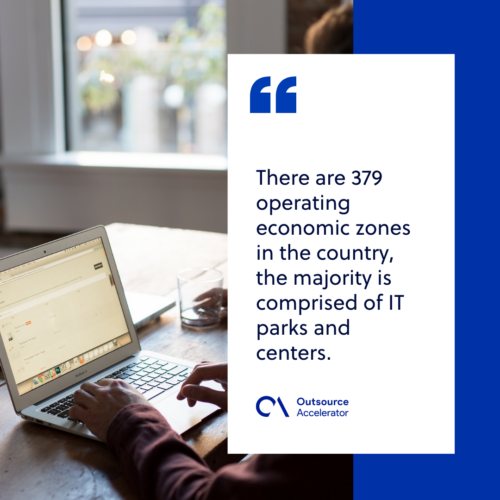
As of late 2024, there were more than 420 operating ecozones across the Philippines. IT parks and centers make up the largest share. Most sit in the key cities of Metro Manila, especially Quezon City, Makati, and Taguig.
However, PEZA keeps pushing development into other regions to create jobs and grow local economies. This also helps ease congestion in Manila. Meanwhile, the government keeps approving new zones. For example, PEZA launched 14 new ecozones in January 2026 and aims to open around 30 during the year.
In addition, President Marcos lifted the long-standing moratorium on new IT parks in Metro Manila. By mid-2026, five Metro Manila IT parks had applied for PEZA ecozone status.
Baguio City Economic Zone
The Baguio City Economic Zone is one of three ecozones in the popular tourist destination. The others are the John Hay Economic Zone and the SM Cyberpark. The zone began to thrive in 2013 as BPO firms such as Sitel expanded there. It has since supported thousands of jobs across sectors, with the majority tied to BPOs.
Cavite Economic Zone
The Cavite Economic Zone sits in Rosario and General Trias City, about 30 kilometers south of Metro Manila. Founded in 1980, it grew through five phases and now hosts hundreds of companies.
In January 2019, the government created another special economic zone in the province. This is the Cavite IT ecozone, also known as VistaHub BPO Molino. It aims to attract foreign investors, create jobs, and link industries across the Philippines.
Clark Freeport Zone
PEZA worked with the local government, the Bases Conversion and Development Authority (BCDA), and the Clark Development Corporation (CDC). Together, they drew more foreign businesses to the country through the Clark Freeport Zone.
It is one of four districts under development in Clark, Pampanga. The others are Clark Global City, Clark International Airport, and New Clark City. Because of this, workers in the area can find jobs close to home and spend more time on recreation and family.
Mactan Economic Zone
The Mactan Economic Zone, formerly the Mactan Export Processing Zone, is a 119-hectare zone in Cebu. PEZA and the Mactan Export Processing Zone Chamber of Exporters and Manufacturers have managed it since 1984. Over time, it has grown into a hub that PEZA plans to develop further into a township.
Metro Manila IT parks and centers
Manila consistently ranks among the world’s top outsourcing “super cities,” according to Tholons rankings. Its IT parks contribute to that standing. As a result, Metro Manila still holds the largest number of IT parks in the country.
The most prominent are in McKinley Hill in Taguig, Rockwell Business Center in Makati, Eastwood City, and UP-Ayala Technohub in Quezon City. One advantage of setting up in Manila is easy access to government agencies. After all, it is the country’s business center.
PEZA updates and investment growth
PEZA has been turning several economic zones into townships, or smart cities. These include housing, banks, and commercial centers for growing IT-BPO companies. As a result, officials and workers can live, learn, work, and play without traveling in and out of the ecozones. You can read more on the township plan here.
The agency has also worked to add knowledge and technology innovation zones, modeled loosely on Silicon Valley. In addition, it has set up institutes that train workers and reduce skill mismatch. More background is available in this article.
On investment, PEZA recorded ₱80.585 billion in approvals during the first half of 2023. This greenlit ecozone developer and locator projects. Momentum then accelerated. In 2024, PEZA approved roughly ₱186 billion in investments, which surpassed the previous year. You can review the 2023 figures here.

PEZA and work-from-home rules for IT-BPOs
For several years, PEZA locators faced one big policy question. Could IT-BPO staff work from home without losing tax incentives? At first, RBEs could only run a small share of remote work. Meanwhile, the Fiscal Incentives Review Board (FIRB) pushed firms back on-site to protect those incentives.
That debate is now largely settled. The CREATE MORE Act, signed in 2024, made flexible work official for registered enterprises. Under the law, PEZA-registered IT-BPO RBEs may keep their incentives while running up to 50% of their workforce remotely.
Since then, regulators have loosened the cap further. In 2026, the FIRB approved expanding the work-from-home limit in economic and freeport zones to as much as 90%. This move came amid energy-supply pressures. As a result, hybrid and remote setups are now a permanent part of the PEZA landscape rather than a temporary measure.
Key takeaways
- PEZA incentives combine fiscal perks (income tax holiday, 5% special tax, duty-free imports) with non-fiscal benefits like simplified procedures and special visas.
- To qualify, companies must locate inside a PEZA ecozone and file documentary, technical, and financial requirements for board approval.
- The Philippines has more than 420 operating ecozones, with 14 new zones launched in early 2026 and around 30 targeted for the year.
- The CREATE MORE Act (2024) lets PEZA-registered IT-BPOs run up to 50% remote work while keeping incentives, later expanded toward 90% in 2026.
Frequently asked questions about PEZA incentives
What are the main PEZA incentives for BPO companies?
The main PEZA incentives include an income tax holiday of up to six years and a special 5% tax on gross income afterward. They also include duty-free importation of equipment, VAT zero-rating on local purchases, and simplified import-export procedures.
Who is eligible for PEZA registration?
Companies in IT and BPO, tourism, medical tourism, agro-industrial, and manufacturing sectors can register. In addition, they must operate inside a PEZA special economic zone and submit the required documentary, technical, and financial paperwork.
How many PEZA economic zones are there in the Philippines?
As of late 2024, there were more than 420 operating ecozones, with IT parks and centers forming the largest group. PEZA launched 14 new zones in early 2026 and aims to open around 30 during the year.
Can PEZA-registered IT-BPO companies work from home?
Yes. Under the CREATE MORE Act of 2024, PEZA-registered IT-BPO enterprises can keep their tax incentives while running up to 50% of their workforce remotely. Regulators expanded that cap further in 2026.
What taxes do PEZA-registered companies pay after the income tax holiday?
After the income tax holiday, qualified enterprises can pay a special rate of 5% on gross income. This replaces all national and local taxes, subject to the conditions of their registration.






 Independent





