
Outsourcing to Cebu: A guide to the Philippines’ second BPO hub


- Cebu is the Philippines’ second IT-BPM hub, offering big-city infrastructure with lower cost and lighter congestion than Manila.
- It has deep, diverse talent drawn from across the Visayas and Mindanao, spanning voice, fintech, and technical roles.
- Companies use Cebu as a primary delivery site and Manila as a backup, or the reverse, for business continuity.
- Getting started is about defining roles, choosing a location strategy, and vetting providers for culture and retention.
When people picture outsourcing to the Philippines, they usually picture Metro Manila. Yet the country’s second-largest outsourcing hub sits 570 kilometers south, in Cebu, and for many companies it is a destination in its own right rather than a fallback.
On the 603rd episode of the Outsource Accelerator Podcast, Silver Cepeda, Chief Sales Officer of Cebu Tele-Net, made the case for the city after a decade building operations there.
This guide explains what makes Cebu work, how it compares to Manila, and how to start.
What makes Cebu an outsourcing destination?
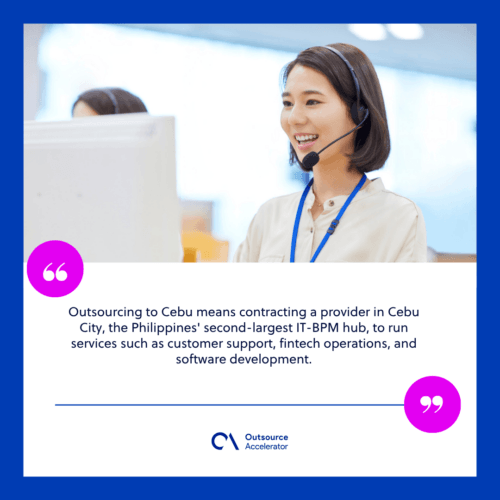
Outsourcing to Cebu means contracting a provider in Cebu City, the Philippines’ second-largest IT-BPM hub, to run services such as customer support, fintech operations, and software development. The city pairs a relaxed, provincial character with genuine big-city capability, a combination Silver knows well.
“It has a province taste, but the thing is it’s a metropolitan city. It’s a big city. The IT infrastructure is there.”
Its central location matters too. Cebu draws candidates from across the Visayas and from Mindanao, giving providers a wide talent catchment.
The broader Philippine industry it belongs to reached roughly $40 billion in export revenue and 1.9 million workers in 2025, according to IBPAP figures reported by the Inquirer, now more than 8% of national GDP.
Local advocacy runs through the Cebu IT-BPM Organization, which represents the city’s firms to national bodies. Growth is also spreading beyond Metro Manila to regional hubs like Cebu, with the industry targeting roughly $42 billion in exports and close to 2 million jobs in 2026.
Cebu vs Manila for outsourcing: Cost, talent, and lifestyle
Silver has a memorable way of framing the difference for clients.
“It’s like Cebu is like the California of USA, while Manila is the New York. So we get less traffic here, and the beaches are just 30 minutes away.”
That lifestyle gap is not just quality-of-life marketing. Lower congestion and a lower cost of living feed directly into labor costs and, in turn, into staff retention.
Here is how the two hubs compare on the factors that matter most to buyers.
| Factor | Cebu | Manila |
|---|---|---|
| Cost of living and labor | Lower | Higher |
| Traffic and commute | Lighter, shorter | Heavy, long |
| Talent pool | Deep, Visayas and Mindanao catchment | Largest in the country |
| Typical two-site role | Primary delivery | Backup or overflow |
| Lifestyle | Provincial feel, coast nearby | Dense capital metro |
What to outsource to Cebu: services and roles
Cebu is not limited to entry-level voice work. Its providers cover a broad service mix, and Silver has rarely hit a hiring wall in ten years.
Voice and customer support
Call center and customer experience work remains the backbone of Cebu delivery. The city’s contact center community supports large English-language operations for North American and other global clients.
Fintech and back office
Regulated, detail-heavy work has grown quickly. At Cebu Tele-Net, for example, fintech accounts make up the bulk of operations, alongside transportation and e-commerce support.
Technology and developer talent
Complex technical and developer roles are increasingly served from Cebu, often through specialized units. Silver’s confidence in local supply is blunt.
“I haven’t met yet a challenging role that would make me say, ‘Let’s post this in Manila first before we do it in Cebu.'”
Using Cebu for business continuity
One of Cebu’s quieter advantages is resilience. Because the Philippines is exposed to typhoons and other disruptions, mature providers run two sites so work never stops.
Silver describes a model that flips the usual pattern.
“We only have one rate for Philippines… Normally a big call center here in the Philippines would open up in Manila and then back it up with Cebu. So for us, we do it reverse.”
The practical takeaway is simple. A single national rate and a paired-site setup let you place primary delivery in Cebu while keeping a Manila backup, or the other way around, without a cost penalty.
How to start outsourcing to Cebu
Standing up a Cebu team rewards a deliberate approach. These four steps keep the process grounded.
1. Define your roles and service model
Start by mapping the exact roles, volumes, and service levels you need. Clarity here tells a provider whether Cebu can staff the work and how fast.
2. Choose a location and continuity strategy
Decide whether Cebu is your primary site, your backup, or part of a paired setup. Confirm the provider offers one national rate so location does not distort your budget.
3. Vet providers for culture and retention
Cebu’s edge is stability, so weigh culture and attrition, not just price. Ask how a provider retains staff and how it aligns its people with your brand.

4. Plan a phased onboarding
Adopt the provider’s proven process first, then improve it together. Silver’s own method is consultative and patient.
“Listen to the guy, identify where the problem is, empathize with them, and deliver a solution.”
Key takeaways
- Cebu is the Philippines’ second IT-BPM hub, with big-city infrastructure at a lower cost than Manila.
- Its central location gives providers a deep, diverse talent pool across voice, fintech, and technical roles.
- A paired Cebu and Manila setup, on one national rate, adds real business-continuity protection.
- Success depends on defining roles clearly, choosing a location strategy, and vetting providers for culture and retention.
- Cebu is best seen as a primary destination in its own right, not a discount alternative to Manila.






 Independent





