
A Japanese-Led Philippine Call Center with Silver Cepeda of Cebu Tele-Net

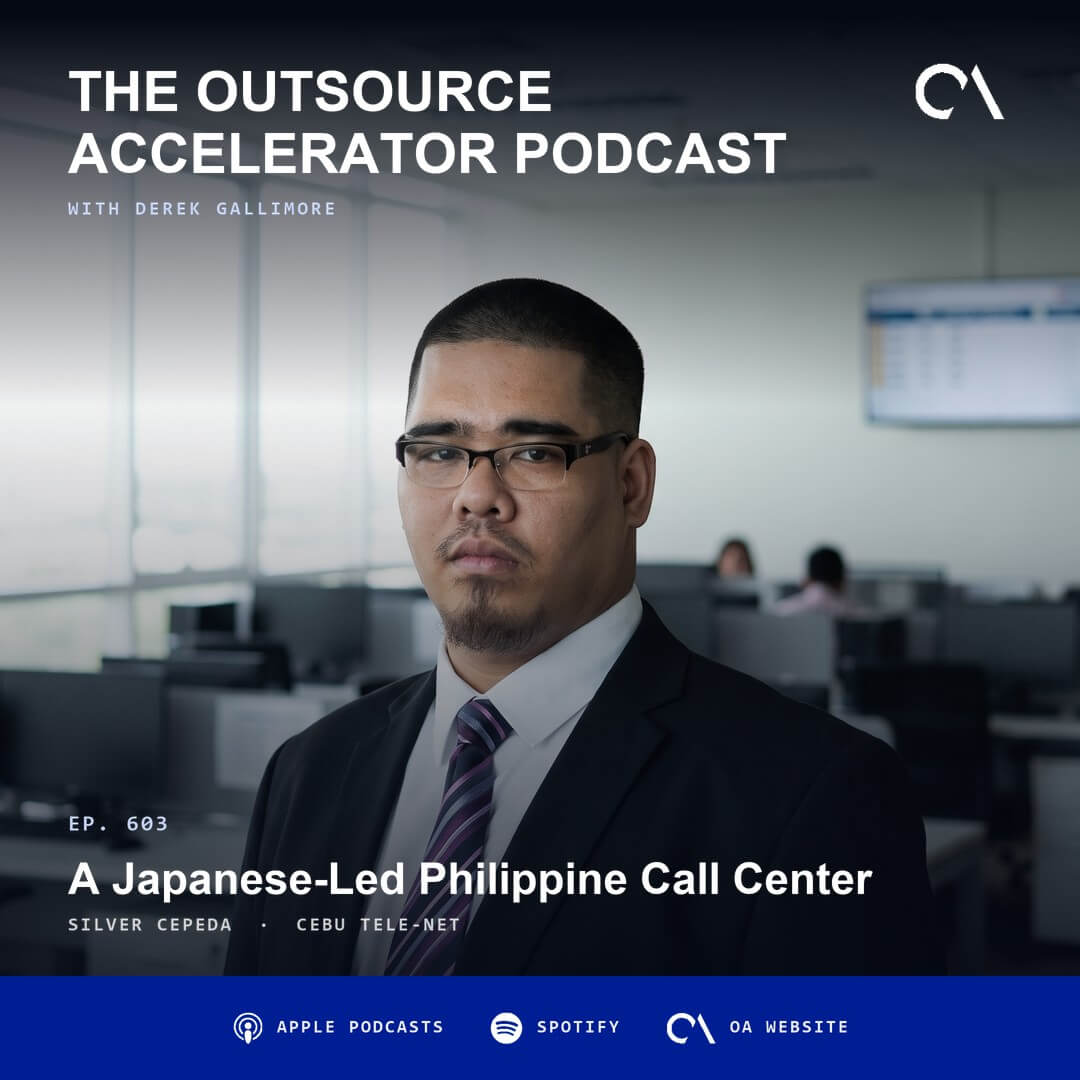
Silver Cepeda has spent nearly two decades in the outsourcing industry, and the last ten building one of Cebu’s more distinctive call centers, a story he shared on the Outsource Accelerator Podcast. As Chief Sales Officer of Cebu Tele-Net, part of the Tokyo-headquartered Telenet group, he has grown its English-language operation from a handful of people to more than 700.
The conversation covers what makes a Japanese-owned call center different, why Cebu works, and Silver’s grounded, practical read on AI.
Inside Cebu Tele-Net
Cebu Tele-Net is deliberately not chasing scale for its own sake. Silver describes a boutique model built around client retention and two service philosophies, one Japanese and one Filipino.
“We’re kind of a boutique call center. We’re not aiming to have all the seats in the BPO world. Our goal is to have clients that stay with us.
So we run on Japanese hospitality called omotenashi, and of course the signature branding of our Filipino kind of service, which is malasakit.”
The group splits work across three locations: Japan for Japanese-language services, Las Vegas for onshore US work, and Cebu for offshore English. Around 80% of clients are in North America, with a core concentration in fintech. Silver has been there through the whole climb.
“I joined the company when they had like three, four people doing English services, and right now we’re at 700 plus.”
Why Cebu works
Silver moved to Cebu early in his career and never looked back. He has a favorite way of framing it for clients.
“The way I describe it to clients, it’s like Cebu is like the California of USA, while Manila is the New York. So we get less traffic here, and the beaches are just 30 minutes away.”
That lower cost of living feeds directly into labor costs. It also shapes an unusual operating choice, where Cebu leads and Manila plays backup.
“We only have one rate for Philippines… Normally a big call center here in the Philippines would open up in Manila and then back it up with Cebu. So for us, we do it reverse.”
On talent depth, Silver is unequivocal after ten years of hiring there.
“I haven’t met yet a challenging role that would make me say, ‘Let’s post this in Manila first before we do it in Cebu’… So for the past 10 years working with Cebu Tele-Net, I don’t see that challenge here so far.”
More complex developer roles sit with a separately branded sister company, Chronostep, which recruits entirely in Cebu and has grown to about 80 staff.
The Japanese difference
The Japanese ownership is more than a corporate detail. To teach Silver what omotenashi meant, the company flew him to Japan to feel it firsthand.
“They brought me to Japan, and they had me experience how Japanese would anticipate the need of the customer. Like, you don’t have to sometimes tell what you need. They would proactively ask you.”
One habit stuck with him. In the Japanese centers, agents bow when they apologize on a call, even though the customer cannot see it.
A grounded take on AI
Silver has watched the tools evolve since he took Amazon calls in 2007, and he is calm about AI. He reaches for history to explain why.
“When calculators came in, we didn’t lose any mathematicians. When Google opened up, libraries didn’t close.”
For him, the technology changes the work rather than erasing it. He points to speech analytics that now push answers to agents instead of making them search.
“Agents don’t have to go to the knowledge base. The knowledge base comes to them and tells them what are the options that the agents need to take.”
His conclusion is that human service becomes more valuable, not less.
“Human experience is gonna be a premium service… People will crave having that genuine person that you’re talking to, somebody who can sympathize with you or empathize towards your problem and give you that human touch.”
Rolling out AI without breaking things
Silver’s caution is earned. He recounts a client that rushed an AI booking system and paid for it.
“I had a limousine client that adapted to a booking system with AI, and it made the whole system that they have messed up, and we ended up fixing for the next two months.”
His approach now is to slow down, define what success looks like, and stage adoption rather than flipping a switch.
Selling outsourcing is still human
After ten years in sales, Silver does not believe a bot will replace the core of what he does. Outsourcing, he says, is an emotional decision.
“Dealing with clients, specifically if they want to outsource some part of their business, is still, for me, an emotional choice… You’re letting go of some part of the business that you have established for a couple of years, and these guys from the Philippines are gonna start doing your work. So it’s scary for some.”
His method has stayed consistent: consultative selling that starts with listening.
“Listen to the guy, identify where the problem is, empathize with them, and deliver a solution.”
For Silver, the future of the call center is not a choice between technology and people, but a blend of Japanese hospitality, Filipino care, and AI used carefully to make the human touch count for more.
To learn more about Cebu Tele-Net, visit ctnp-corp.com or connect with Silver Cepeda on LinkedIn.
And if you would like to learn more about what we do in the outsourcing space, send us an email at [email protected].






 Independent





