
7 customer support back-office tasks you can outsource

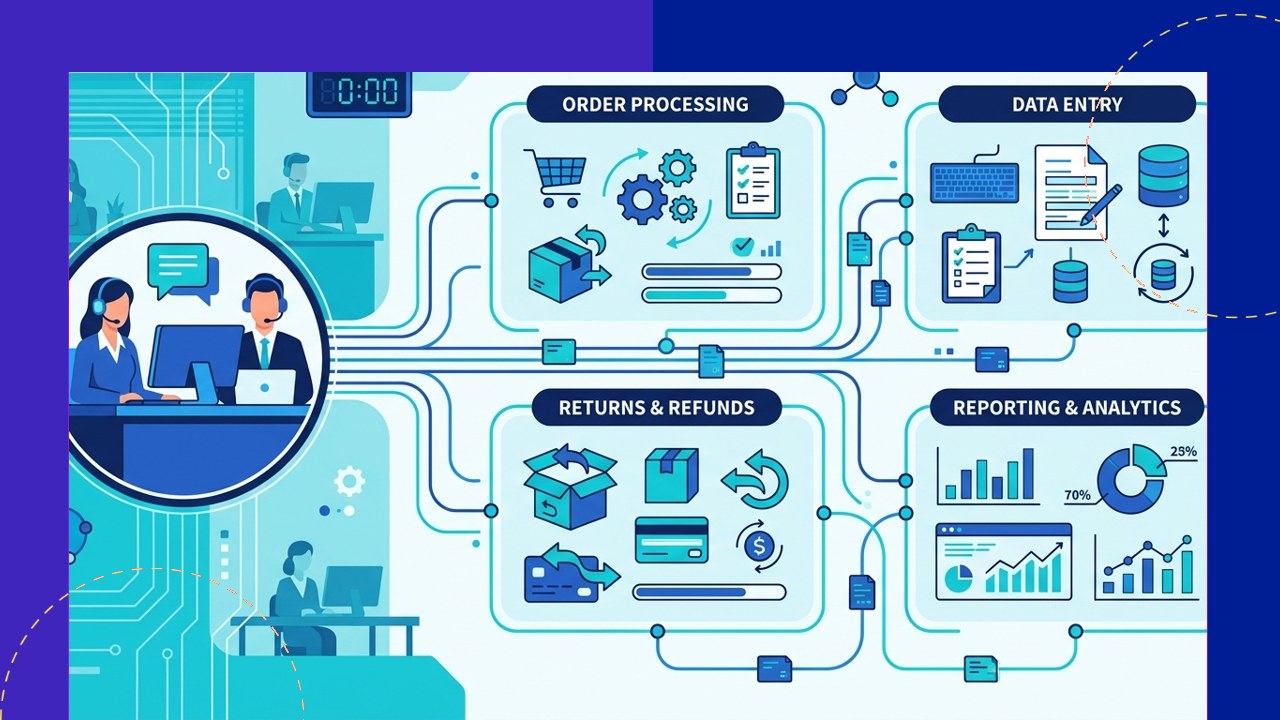
- Much of the work behind good customer support happens off the phone, inside the back office.
- Rule-based, high-volume jobs like order processing, refunds, and data entry outsource cleanly.
- Keep judgment-heavy, brand-sensitive work in-house, and hand repeatable volume to a partner.
Great service often looks like one quick, friendly reply. Behind that reply sits a stack of customer support back-office tasks that the customer never sees. Someone updates the order, tags the ticket, and logs the outcome. These jobs are steady, rule-based, and time-consuming. As a result, they are strong candidates to move off your core team’s plate.
Outsourcing these tasks is not only about saving money. In its 2024 survey, Deloitte reports that 83% of executives are leveraging AI as part of their outsourced services. In short, providers now bring tools and process discipline, not just extra hands. This guide lists seven back-office tasks that sit well with an outsourcing partner.
The table below shows why each task fits. For a wider view, see this explainer on how back office outsourcing works.
| Task | Why it outsources well | Keep in-house? |
|---|---|---|
| Order processing | Clear rules, high volume | No |
| Returns and refunds | Policy-driven, repeatable | Exceptions only |
| Data entry and CRM updates | Simple, steady, measurable | No |
| Ticket triage and tagging | Follows a fixed taxonomy | No |
| Email and chat backlog | Templated, off-peak friendly | No |
| QA and call scoring | Scorecard-based, objective | Calibration only |
| Reporting and analytics | Scheduled, data-driven | Strategy only |
1. Order processing
Every purchase creates back-office work. Someone confirms the order, checks stock, and pushes it to fulfillment. This work is repetitive, and it follows a clear script. Because of that, an offshore partner can run it well once you document the steps. A trained team can process orders during your off-hours too. As a result, customers wake up to shipped items instead of a queue. Give the team clear rules for holds, cancellations, and address changes. Then track accuracy and turnaround as your two main metrics.
2. Returns and refunds handling
Returns are predictable, even when customers are frustrated. Most cases follow a simple policy: check eligibility, approve, refund, and update the record. An outsourcing provider can own this flow end to end. However, you should set a clear escalation path for edge cases. For example, a damaged high-value item may need a manager’s review. Keep those exceptions in-house, and let the partner handle the bulk. This split keeps refund times short and your own staff free. Clear rules also protect you from inconsistent decisions across agents.
3. Data entry and CRM updates
Clean customer records make every other task easier. Yet keeping them clean is slow, manual work. Agents log contact details, tag accounts, and fix duplicates all day. This is a classic back-office job to hand off. An offshore team can update your CRM after each interaction. As a result, your records stay current without pulling senior staff away. Set a simple data standard so entries stay consistent. Then audit a sample each week to catch errors early. Accurate data also feeds better reporting later in the chain.
4. Ticket triage and tagging
Support tickets arrive in a messy pile. Before anyone solves them, someone must sort, tag, and route each one. Good triage sends the right ticket to the right queue fast. This work follows a fixed taxonomy, so it outsources well. It also cuts pressure on your senior agents, who then handle only real problems. Self-service reduces the load too. HBR notes that 81% of all customers attempt to take care of matters themselves before reaching a live rep. Because of that, sharp routing of the rest matters even more.
5. Email and chat backlog
Phone lines get attention, but email and chat backlogs pile up quietly. Many of these messages need a templated answer, not a deep fix. A partner team can clear routine replies using approved macros. As a result, response times drop and your core team focuses on complex cases. This task also suits time-zone coverage very well. An offshore team can work the queue overnight while you sleep. Give them a library of vetted responses and clear tone rules. Then flag anything sensitive for your in-house team to handle. For more on this, review the basics of outsourcing your customer service.
6. QA and call scoring
Quality checks keep service consistent, but they eat manager time. Someone must review calls and chats against a scorecard. This job is objective when the criteria are clear. Because of that, a specialized team can score interactions at scale. They flag coaching moments and surface trends you would otherwise miss. However, keep calibration in-house so standards stay aligned. Meet with the QA team often to agree on what “good” looks like. This partnership gives you steady oversight without adding headcount. Over time, the scores also reveal where training pays off most.
7. Reporting and analytics
Numbers tell you whether support is working. Yet building daily and weekly reports is grunt work. Someone pulls the data, cleans it, and formats the dashboard. An outsourcing partner can own this reporting cycle for you. As a result, leaders get fresh figures without chasing spreadsheets. Set the metrics that matter, such as resolution time and satisfaction. Then let the team compile and deliver on a fixed schedule. You keep the strategy and the decisions in-house. In short, the partner handles the prep, and you handle the direction.
Frequently asked questions
Which customer support tasks should stay in-house?
Keep work that shapes your brand or needs deep judgment. Complex complaints, VIP accounts, and policy exceptions are good examples. You should also keep strategy, calibration, and final decisions. Hand off the repeatable, rule-based volume instead. This split protects quality while it frees your core team.
Will outsourcing back-office tasks hurt customer experience?
Not if you set clear rules and metrics first. Customers rarely see back-office work like data entry or triage. They only feel the result, which is faster and more accurate service. Good documentation and regular QA keep standards high. Start with one task, measure it, then expand.
How do I start outsourcing these tasks?
Pick one high-volume, low-risk task to begin. Order processing or data entry often works well. Document the steps, the rules, and the metrics you expect. Then run a small pilot with a partner and review results. Scale up once the numbers hold steady.
What metrics should I track with a partner?
Track accuracy, turnaround time, and backlog size for each task. Add a quality score from your QA process. Review these numbers weekly at first, then monthly. Clear metrics keep both sides honest. They also show when the arrangement is paying off.
Key takeaways
- Most support work happens in the back office, and much of it is rule-based and repeatable.
- Order processing, refunds, data entry, triage, backlog, QA, and reporting all outsource well.
- Keep judgment, brand-sensitive cases, and strategy in-house, and hand off the volume.
- Start with one low-risk task, document it clearly, measure results, then scale.






 Independent





