
The executive guide to choosing a custom software development company


This article is a submission by Hidden Brains, an India-based custom AI and software development company with over 23 years of experience. Hidden Brains specializes in AI development, generative AI, web and mobile app development, cloud infrastructure, data engineering, and enterprise platform solutions.
Every software investment ends up with one of two outcomes: it becomes an asset the business leans on for years, or it becomes a liability weighed down by technical debt that fades off in a couple of years or months.
The difference is rarely the technology. It’s the partner.
A team that understands your business intricacies, follows a structured delivery process, brings real technical depth, and works inside your actual budget will outperform a cheaper vendor chasing a lower hourly rate almost every time.
This is why millions of businesses now outsource software development rather than build every team in-house.
The goal isn’t just to get code written and stack up features. It’s to find a partner who understands the business objective behind the request, flags risk before it becomes a production incident, builds something that can scale past version one, and ties every sprint back to a measurable result.
Getting there shouldn’t feel like solving a math problem. But most executives approach vendor selection with a shortlist based on three shallow signals: a portfolio page, a client logo wall, and a day rate, and then wonder six months later why the project stalled.
There’s a longer list of factors that actually predict whether a development partnership survives contact with reality, and this guide walks through it.
What does custom software development mean?
Every vendor on earth claims to do “custom software development.” The phrase has been stretched thin enough that it barely means anything on a homepage anymore.
For an executive, a real partner should translate the phrase into a few concrete things:
- The solution is architected around your actual workflow, processes, and goals, not just a fixed template that is ready to use.
- The team can assess and clearly explain the risks and trade-offs, such as costs, timeline, compliance, and likely problems, in plain language before any work is handed over, not just recite frameworks.
- Ownership transfers cleanly. You get the documentation, source code, and infrastructure, so that if you ever walk away from the relationship you are not vendor-bound.
- Faster time to market without losing control. AI can significantly accelerate software development, but successful outsourcing depends on human-in-the-loop oversight. The right AI development partner uses AI as an accelerator while experienced engineers remain responsible for architecture, governance, quality assurance, security, and technical decisions. This balance helps businesses achieve faster delivery while maintaining the standards required for scalable software.
If a vendor can’t hold responsibility and clarity on all these points in the first sales call, they are likely stalling without real clarity. A custom software development company should bring your vision to life with solutions built around your goals and purpose, not deliver short-term fixes that become tomorrow’s technical debt.
A scorecard: Eight criteria that predict success
1. Domain and vertical experience
A team that has built fintech reconciliation systems, healthcare scheduling platforms, or logistics inventory tools understands the regulatory and operational landmines specific to that industry before they write a line of code.
Ask for two or three reference projects in your exact vertical, not just “similar tech stack” projects.
2. Technical depth beyond the tech stack list
Any vendor can list React, Node, and AWS on a slide. Ask instead how they’d design for a 10x increase in transaction volume, or how they handle a failed third-party API mid-checkout.
The answer tells you whether you’re talking to engineers or a sales team reading off a services page.
3. Certifications that back up the claims
CMMI Level 3 process maturity and ISO 27001 information security certification aren’t just cosmetic badges; instead, they indicate an auditable delivery process and a documented security posture, which matters the moment your legal or compliance team asks how customer data is handled.
4. Engagement model flexibility
A partner locked into one pricing structure will try to fit your project into their model instead of the other way around. You want the option to move between a dedicated team, staff augmentation, or an extended team as the project matures.
5. Communication cadence and time zone overlap
A daily standup that never overlaps with your working hours turns every blocker into a 24-hour delay. Ask exactly how many overlapping hours you’ll get with the core team, not just the account manager.
6. Scalability of the bench
What happens when you need to go from four developers to twelve in six weeks because the project underscoped its own success? A vendor with hundreds of engineers on staff can absorb that. A five-person shop cannot, no matter how good those five people are.
7. Post-launch support and SLAs
Ask what happens the day after go-live. Is there a documented service-level agreement for response time on a production bug? Is there a named point of contact, or does the team that built it disappear onto the next contract?
8. Transparent, itemized pricing
A quote broken into discovery, design, development, QA, and post-launch support tells you the vendor has actually planned the engagement. A single lump-sum number with no breakdown is usually a sign the estimate was built backward from what they thought you’d pay.
Red flags that are worth watching
Some warning signs are worth walking away from immediately, no matter how attractive the rate looks:
- No access to a real person, just chatbots. If you can’t get a resume or a call with the person who’ll actually architect the system, you’re buying a black box.
- Reluctance to share a reference client in your industry. Every serious provider has at least one. If they dodge the request twice, assume they don’t have one that turned out well.
- Vague answers about who owns the code and infrastructure after delivery. This should be a one-sentence, clear answer in the contract, not a conversation.
- A quote that’s dramatically lower than every other bid. Underpriced projects get under-resourced once they’re signed. The gap gets recovered somewhere, usually in scope-cutting or attrition on your account.
Engagement models, explained
Most vendor conversations skip straight to price without explaining that the pricing model itself changes your risk exposure.
Here’s the comparison that should shape the conversation before a number ever comes up:
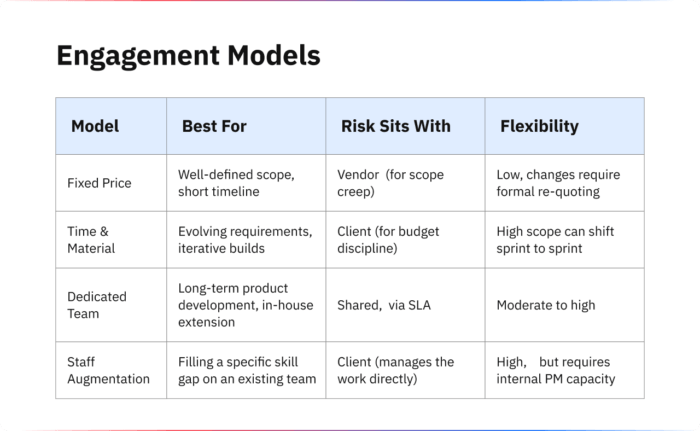
None of these is universally “better.” A three-month compliance tool with a locked scope fits a fixed-price model. A product you’ll be iterating on for the next three years fits a dedicated team.
The mistake most executives make is picking the model that feels cheapest today, without asking which one matches how the project will actually evolve.
A simple due-diligence process before you sign
Before any contract goes to legal, run the shortlist through four checks:
- Request a working reference call, not a written testimonial. Ask that vendor directly what broke during the engagement and how it got resolved. Every real project has at least one hiccup, and how a vendor handled it tells you more than the parts that went smoothly.
- Verify certifications directly, rather than trusting a logo on a website. CMMI and ISO certifications are publicly registered; a two-minute search confirms they’re current.
- Ask for a sample of documentation from a past project: architecture diagrams, a README, an onboarding guide for a new engineer. If the vendor can’t produce one, assume your project won’t get one either.
- Pilot before you commit long-term. A two-to-four-week paid trial sprint reveals more about a partner’s communication, code quality, delivery approach, and process discipline than multiple sales conversations. It also provides early insight into whether the team can successfully move from a pilot phase to production while delivering measurable business value.
What getting this wrong actually costs
Executives tend to model the cost of choosing a vendor as the contract value. That’s the wrong number. The real cost of a bad match shows up later: a mid-sized retailer that picked a low-bid vendor for an inventory management rebuild ended up re-tendering the entire project eight months in, after discovering the “team” on the call had rotated three times without notice and the documentation was effectively nonexistent.
The original contract was $90,000. The redo, plus the lost quarter of stalled operations, ran past $250,000.
That gap, between what a project was quoted at and what it actually costs once a mismatch surfaces, is the number worth protecting against, not the line item on the first invoice. Every criterion in the scorecard above exists to close that gap before it opens.
A note on cultural and working-style fit
Technical skill gets most of the attention in vendor selection, but working-style mismatches sink almost as many projects.
A team that communicates in exhaustive written detail suits a client who wants a paper trail for every decision. A team that prefers quick voice calls suits a client who wants speed over documentation.
Neither is wrong, but pairing the wrong style with your internal team’s habits creates friction that compounds over a twelve-month engagement.
Ask during the pilot sprint how the team defaults to communicating when something goes wrong, not just when things are going well; that default is what you’ll live with for the life of the contract.
Why scale and longevity still matter
There’s a reason enterprises and scaling startups continue to partner with established technology providers rather than relying solely on emerging freelance networks.
Years of delivery experience create institutional knowledge: an understanding of complex requirements, regulatory expectations, engineering standards, and governance practices that help organizations reduce execution risk and build confidence.
An established provider, for instance, may have spent decades building custom software, mobile applications, and AI-driven platforms for clients across many countries, working across engagement models from full outsourcing to a dedicated staff model and offshore teams.
That kind of runway, mature delivery processes such as CMMI Level 3, ISO 27001 security certification, and a bench large enough to scale a team from four engineers to forty without rushed hiring or restrictive contracts, is exactly the kind of operational depth this guide has been describing, not a coincidence of company size.
The point isn’t that bigger is automatically better. It’s that longevity, documented process, and a track record across multiple industries are themselves data points, and they’re worth weighing as heavily as the first proposal that lands in your inbox.
A partnership, not a purchase
Choosing a custom software development company is a decision about who you’re trusting with a piece of your business’s future, not a procurement exercise to close quickly. Run the scorecard, watch for the red flags, match the engagement model to how the project will actually evolve, and pilot before you commit.
The executives who treat this selection with the same rigor they’d apply to a key hire are the ones who aren’t back on the market for a new vendor a year from now.
If you’re currently evaluating partners for a custom build, a short paid pilot sprint or consultation with a shortlisted provider can pressure-test your scope, timeline, and engagement model before you sign anything.






 Independent





