
Streamlining healthcare operations at a lower cost: A guide to healthcare BPO services


This article is a submission by Select Voicecom, a Philippines-based call center and BPO company providing inbound, outbound, back-office, and AI-powered outsourcing solutions to businesses across the U.S., Australia, and other global markets
- Healthcare BPO enables providers to outsource administrative tasks such as appointment scheduling, billing, insurance verification, and data management.
- Outsourcing can help healthcare organizations reduce operating costs, improve efficiency, and expand administrative capacity without significantly increasing headcount.
- Choosing the right healthcare BPO provider requires evaluating industry experience, compliance standards, data security, scalability, and quality assurance.
- When implemented effectively, healthcare BPO allows medical professionals to spend more time focusing on patient care rather than administrative work.
Why healthcare organizations are turning to BPO
Healthcare organizations continue to face increasing administrative demands alongside rising labor costs and growing patient expectations. Managing appointments, insurance verification, billing, claims processing, and medical records requires significant time and resources that can divert attention from patient care.
To address these challenges, many hospitals, clinics, physician groups, and healthcare organizations are partnering with business process outsourcing (BPO) providers. Rather than replacing internal teams, healthcare BPO supplements existing operations by handling routine administrative work more efficiently.
The result is a more streamlined organization that can improve service levels while controlling operational costs.
What is healthcare BPO?
Healthcare business process outsourcing (Healthcare BPO) is the practice of delegating administrative, operational, or customer support functions to a specialized external service provider.
Unlike clinical outsourcing, healthcare BPO focuses on non-clinical activities that support day-to-day operations.
Commonly outsourced services include:
- Appointment scheduling
- Insurance eligibility verification
- Medical billing and coding support
- Claims processing
- Data entry and records management
- Patient follow-up and reminder calls
- Contact center support
- Revenue cycle support
These services help healthcare organizations improve efficiency without compromising patient care.
5 benefits of healthcare BPO services
1. Lower operating costs
Hiring and maintaining internal administrative teams requires ongoing investments in recruitment, salaries, training, office space, equipment, and management.
Outsourcing consolidates many of these expenses into a predictable operating cost while giving organizations access to experienced support professionals.
2. Increased administrative efficiency
Routine administrative work can consume valuable staff time.
Healthcare BPO providers handle repetitive processes using standardized workflows, allowing physicians, nurses, and internal staff to focus on higher-value responsibilities.
3. Improved patient access
Patients expect prompt responses when scheduling appointments, requesting information, or following up on insurance concerns.
Dedicated support teams can improve response times and provide extended service hours across multiple communication channels.
4. Flexible staffing
Healthcare demand often fluctuates due to seasonal illnesses, enrollment periods, or organizational growth.
Outsourcing enables providers to scale administrative support without lengthy hiring cycles or long-term staffing commitments.
5. Access to specialized expertise
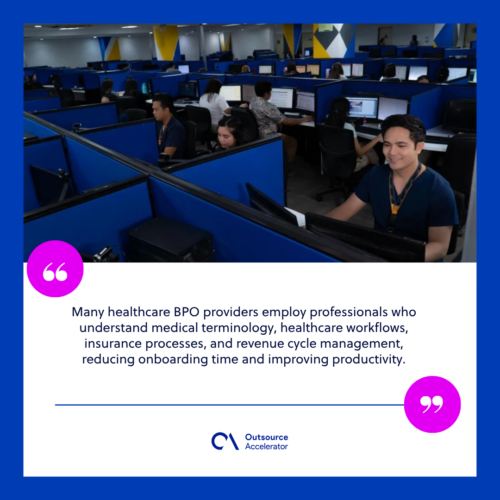
Many healthcare BPO providers employ professionals who understand medical terminology, healthcare workflows, insurance processes, and revenue cycle management, reducing onboarding time and improving productivity.
Common challenges and how to address them
Healthcare outsourcing requires careful planning. Organizations should evaluate potential risks before selecting a provider.
Data privacy and security
Healthcare organizations handle highly sensitive patient information.
Providers should demonstrate compliance with applicable regulations, implement strict access controls, encrypt sensitive information, and maintain comprehensive security policies.
Service quality
Consistent service depends on effective onboarding, documented workflows, ongoing coaching, and regular quality monitoring.
Organizations should establish performance expectations before launching an outsourcing program.
Technology integration
Successful partnerships require outsourced teams to work within existing scheduling systems, electronic health records, or practice management platforms.
Choosing providers with integration experience helps reduce implementation challenges.
Business continuity
Healthcare services cannot stop because of operational disruptions.
Organizations should review a provider’s disaster recovery plans, infrastructure redundancy, and business continuity procedures before signing an agreement.
How to choose the right healthcare BPO partner
Not every outsourcing provider has healthcare expertise. Before making a decision, organizations should evaluate several important areas.
Healthcare experience
Look for providers with proven experience supporting healthcare organizations and familiarity with medical workflows, insurance processes, and patient communications.
Compliance and security
Review certifications, compliance programs, employee training, and documented security procedures.
If protected health information (PHI) will be handled, ensure the provider supports HIPAA requirements and can execute a Business Associate Agreement (BAA) when necessary.
Quality assurance
Ask how agent performance is monitored and improved through coaching, audits, and quality assurance programs.
Technology compatibility
The provider should be able to integrate securely with your existing software platforms while minimizing operational disruption.
Reporting and performance metrics
Reliable providers offer transparent reporting that includes service levels, turnaround times, productivity metrics, and quality measurements.
Scalability
As patient volumes change, your outsourcing partner should be able to expand or reduce staffing without disrupting operations.
Building a healthier back office
Healthcare organizations continue to face growing administrative workloads alongside increasing financial pressure. Business process outsourcing offers a practical way to improve operational efficiency while allowing healthcare professionals to dedicate more time to patient care.
Whether outsourcing appointment scheduling, insurance verification, billing support, or patient communications, organizations should carefully evaluate providers based on healthcare expertise, security practices, compliance, quality assurance, and scalability.
When approached strategically, healthcare BPO can become an effective long-term solution for improving operational performance while controlling costs.






 Independent





