
The 5 most common knowledge process outsourcing (KPO) services


This article is a submission by Select Voicecom, a Philippines-based call center and BPO company providing inbound, outbound, back-office, and AI-powered outsourcing solutions to businesses across the U.S., Australia, and other global markets.
- Knowledge process outsourcing (KPO) enables businesses to delegate specialized, knowledge-intensive work to external experts.
- Unlike traditional business process outsourcing (BPO), KPO focuses on research, analysis, and decision support that require advanced expertise.
- Common KPO services include market research, financial analysis, legal support, healthcare research, and data analytics.
- By leveraging KPO, organizations can access specialized talent, improve decision-making, and support long-term business growth.
As businesses generate increasing volumes of data and operate in more competitive markets, making informed decisions has become more important than ever.
However, analyzing complex information requires specialized expertise that many organizations may not have readily available in-house.
Knowledge process outsourcing (KPO) has emerged as a strategic solution for businesses seeking access to highly skilled professionals who can provide research, analysis, and insights that support better business decisions.
Rather than focusing on routine operational tasks, KPO helps organizations address complex challenges through specialized knowledge and expertise.
What is knowledge process outsourcing?
Knowledge process outsourcing is the practice of delegating specialized, knowledge-based work to external professionals or service providers with expertise in a particular field.
Unlike traditional outsourcing models that emphasize repetitive processes, KPO focuses on activities that require critical thinking, industry knowledge, analytical skills, and professional judgment.
Examples of knowledge-based functions include:
- Market research
- Financial analysis
- Legal research
- Healthcare research
- Data analytics
- Business intelligence
- Engineering support
- Intellectual property research
- Investment research
- Risk analysis
Organizations often use KPO to supplement internal capabilities, accelerate projects, and gain access to expertise that may be difficult or costly to develop internally.
KPO vs. BPO: What’s the difference?
Although knowledge process outsourcing and business process outsourcing are closely related, they support different types of business functions.
Business process outsourcing (BPO) focuses primarily on standardized, process-driven activities such as:
- Customer service
- Technical support
- Data entry
- Appointment scheduling
- Payroll administration
- Back-office support
Knowledge process outsourcing (KPO), in contrast, involves specialized work that requires domain expertise and analytical thinking, including:
- Research and analysis
- Financial modeling
- Legal support
- Healthcare analytics
- Market intelligence
- Strategic reporting
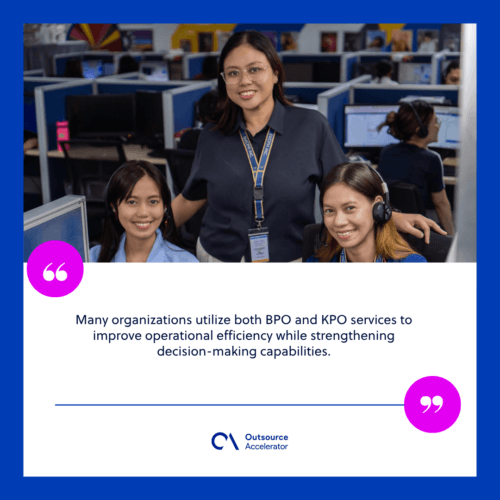
Many organizations utilize both BPO and KPO services to improve operational efficiency while strengthening decision-making capabilities.
Benefits of knowledge process outsourcing
Businesses adopt KPO for several strategic reasons beyond cost reduction.
Access to specialized expertise
KPO providers employ professionals with advanced qualifications and industry-specific knowledge, giving businesses access to expertise without the lengthy recruitment process.
Better decision-making
Research-backed insights help organizations evaluate opportunities, reduce uncertainty, and make more informed strategic decisions.
Improved operational efficiency
Delegating specialized research and analytical work allows internal teams to focus on core business activities while ensuring complex projects continue to move forward.
Greater cost efficiency
Organizations can access experienced professionals without making significant investments in hiring, training, technology, or additional infrastructure.
Scalability
KPO providers allow businesses to expand or reduce specialized support as project requirements change, providing greater operational flexibility.
5 common knowledge process outsourcing services
Although KPO covers a broad range of specialized functions, several services remain consistently in demand across industries.
1. Market research
Market research is one of the most widely outsourced KPO services.
Research teams help organizations analyze:
- Customer behavior
- Industry trends
- Competitive landscapes
- Market opportunities
- Emerging technologies
- Consumer preferences
These insights support product development, market expansion, and strategic planning.
2. Financial research and analysis
Financial institutions, investment firms, and corporate finance teams often outsource research-intensive financial functions.
Common services include:
- Financial modeling
- Investment research
- Risk assessment
- Market forecasting
- Industry analysis
- Competitive benchmarking
These services support more informed financial planning and business decision-making.
3. Legal research and support
Law firms and corporate legal departments frequently outsource research-intensive legal tasks that require accuracy and attention to detail.
Examples include:
- Legal research
- Contract review
- Document analysis
- Litigation support
- Compliance research
- Intellectual property research
Outsourcing these activities enables legal professionals to devote more time to strategic legal work.
4. Healthcare and clinical research support
Healthcare organizations rely on KPO providers to help manage large volumes of medical information and research data.
Services may include:
- Clinical research support
- Medical data analysis
- Healthcare reporting
- Research documentation
- Medical coding support
- Regulatory research
These services help healthcare organizations improve efficiency while supporting research initiatives.
5. Data analytics and business intelligence
As businesses collect increasing amounts of operational data, demand for advanced analytics continues to grow.
Common KPO services include:
- Data analytics
- Predictive modeling
- Business intelligence reporting
- Performance analysis
- Trend forecasting
- Dashboard development
These capabilities enable organizations to transform raw data into actionable business insights.
How to choose the right KPO provider
Selecting the right knowledge process outsourcing partner is an important strategic decision.
Businesses should evaluate providers based on several key factors.
Industry expertise
Look for providers with experience supporting organizations within your industry or business function.
Research and analytical capabilities
Assess the provider’s methodologies, technical expertise, and ability to deliver accurate, actionable insights.
Talent quality
Review the qualifications, certifications, and professional backgrounds of the specialists who will support your projects.

Data security
Ensure the provider follows appropriate information security practices and maintains strong data protection standards for sensitive business information.
Scalability
Choose a provider capable of adapting to evolving project requirements and supporting future business growth.
Frequently Asked Questions
What is knowledge process outsourcing?
Knowledge process outsourcing is the practice of delegating specialized research, analytical, and knowledge-intensive work to external professionals with expertise in specific subject areas.
What services are commonly included in KPO?
Typical KPO services include market research, financial analysis, legal research, healthcare research, business intelligence, engineering support, investment research, and data analytics.
How is KPO different from BPO?
Business process outsourcing focuses on routine operational functions, while knowledge process outsourcing supports complex activities requiring specialized knowledge, professional expertise, and analytical decision-making.
Which industries use KPO most frequently?
Financial services, healthcare, legal services, consulting, technology, pharmaceuticals, engineering, and market research organizations are among the industries that commonly utilize KPO services.
Why do companies outsource knowledge-intensive work?
Organizations use KPO to access specialized expertise, improve decision-making, increase operational efficiency, support innovation, and scale complex projects without expanding internal teams.
Why KPO matters now
Knowledge process outsourcing has evolved into an important strategic resource for organizations that rely on research, analytics, and specialized expertise to remain competitive. By partnering with experienced professionals, businesses can gain valuable insights, improve decision-making, and increase operational flexibility without building large internal specialist teams.
As industries become increasingly data-driven and knowledge-intensive, KPO continues to play an essential role in helping organizations solve complex business challenges and support sustainable long-term growth.






 Independent





