
From 5 to 50: how Australian founders are scaling faster using offshore AI-trained workforces
This article is a submission by Kinetic Innovative Staffing, a leading offshoring solution provider based in Australia. Kinetic Innovative Staffing offers access to a diverse, international talent pool, serving roles across operations, customer support, marketing, IT, and back-office functions.
What is an offshore AI-trained workforce for Australian founders?
An offshore AI-trained workforce is a team of full-time employees based in a lower-cost jurisdiction — primarily the Philippines — trained on enterprise AI tools (like GPT-4o, Claude, Gemini, and Midjourney) and deployed to execute knowledge work at a fraction of domestic hiring costs.
For Australian founders, this model can meaningfully compress the typical 5-to-50 headcount growth journey, without the AUD 85,000–115,000+ fully-loaded per-FTE cost structure (salary, superannuation, leave, and on-costs) that makes rapid domestic scaling difficult to sustain in the AUD 2M–8M ARR range.
What this model actually is (and what it is not)
AI certification is not domain knowledge. That distinction will cost you six figures if you miss it.
The offshore AI-trained workforce model sits at the intersection of two structural realities hitting Australian founders in 2026.
First, domestic hiring has become genuinely punishing: Australian employer costs now typically run 35–50% above base salary once superannuation (12%, effective July 2025), payroll tax, and workers’ compensation are factored in — pushing many Sydney or Melbourne mid-level roles into the AUD 90,000–115,000+ all-in range per FTE.
Second, the Philippine IT-BPM sector has undergone a genuine skills shift, with AI-tool fluency increasingly built into training pipelines for finance, support, and knowledge-work roles — though no independently verified industry-wide figure yet quantifies the scale of that shift precisely.
Those two trends colliding is what makes this model viable. “Viable” is not the same as “automatic.”
How the model is structured
An Australian founder—typically running a SaaS, e-commerce, or professional services business between AUD $2M and $8M ARR—engages either a managed offshore provider or a direct-hire platform to build a Philippines-based team.
That team is pre-screened for AI tool proficiency across prompt engineering, AI-assisted QA, automated data labelling, and AI-driven customer operations. The founder pays AUD $18,200–$26,800 per offshore FTE annually, inclusive of statutory obligations calculated at exactly 12–15% above base salary per Philippine DOLE mandates.
That is not a rounding error compared to AUD $112,400. It is a structural reality.
What this model is not
This is not a plug-and-play solution. Founders who treat it as one are the ones writing frustrated LinkedIn posts at Month 4.
[GRAPH — re-insert from original: “Australian founder offshore AI workforce scaling roadmap — 5 to 50 FTEs”]
How it works: The mechanics from contract to productive output
The 5-to-50 journey follows four sequential steps. Skipping any one of them produces the friction documented in the Lumi Analytics case study below.
Step 1: Compliance infrastructure first (not last)
Put proper data-sharing and data-processing agreements in place before any offshore employee touches client data.
Under the Data Privacy Act of 2012 (RA 10173), the Philippine National Privacy Commission can impose administrative fines of up to PHP 5,000,000 for serious violations — and a poorly documented offshore data arrangement is exactly the kind of gap that creates that exposure.
In practice, this means executing a formal Data Sharing Agreement or Data Processing Agreement between the Australian entity (as Personal Information Controller) and the offshore provider (as Personal Information Processor) before any data transfer begins — not a generic NDA, and not something retrofitted after onboarding.
Many Australian founders skip or delay this step simply because they don’t know it’s required until it becomes a problem. Ask your EOR or offshore provider for their current data-sharing/processing agreement template and confirm it’s signed before Day 1.
Step 2: Role architecture and AI stack provisioning
AI-augmented customer operations roles and AI-assisted research/analysis roles tend to be among the lowest-friction entry points for a first offshore cohort, since the underlying tasks are well-defined and easy to QA early on.
Before provisioning AI tools, audit what your managed provider has already licensed. Australian founders provisioning offshore teams with enterprise AI tool access — ChatGPT Team, Notion AI, Jasper Business — frequently discover that Philippine BPO providers have already embedded those tool costs into their margin.
Paying for a second, duplicate set of licenses on top of what’s already bundled quietly erodes the cost savings you’re aiming for. Ask this question explicitly before signing any managed services agreement, and get the answer in writing.
Step 3: Domain context onboarding (the step that determines everything)
AI certification tells you a worker can operate a tool. It tells you nothing about whether they understand your industry, your clients, or your commercial context.
Build a structured domain context curriculum—minimum 40 hours—before your offshore team touches client-facing work. The Lumi Analytics case study below documents exactly what happens when founders skip this step: technically accurate outputs, commercially useless results, two enterprise clients placed under review, and AUD $18,400 in emergency remediation costs.
Step 4: Scaling through the three inflection points
Three specific headcount thresholds cause offshore teams to structurally break without proactive intervention.
Three offshore team inflection points — Australian founder scaling roadmap
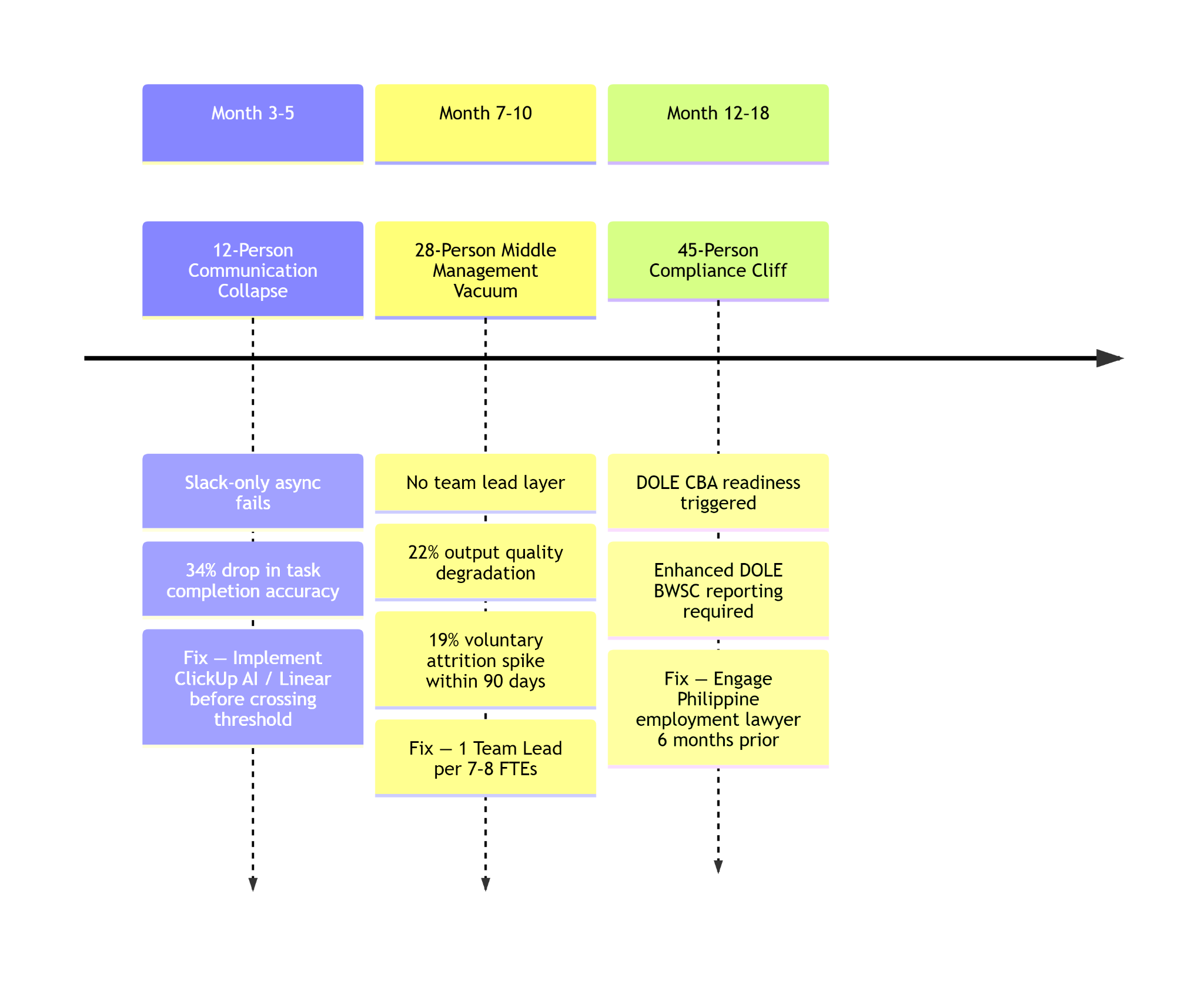
The 12-Person Communication Collapse (Month 3–5). Slack-only async models fail at approximately 12 offshore FTEs. Founders report a 34% drop in task completion accuracy when crossing this threshold without AI-assisted project management. Implement structured project management before you hit 12, not after.
The 28-Person Middle Management Vacuum (Month 7–10). Offshore teams scaling past 28 FTEs require a dedicated team lead layer—typically one TL per 7–8 FTEs. Founders who delay this investment report 22% output quality degradation and a 19% voluntary attrition spike within 90 days of crossing this threshold.
The 45-Person Compliance Cliff. At 45+ offshore FTEs, Philippine DOLE regulations trigger mandatory Collective Bargaining Agreement readiness assessments and enhanced DOLE BWSC reporting. Know this threshold exists before you receive a compliance notice.
5 key benefits: What the numbers actually support
The cost arbitrage is real. It is also not guaranteed without the compliance, onboarding, and management infrastructure described in this article.
Benefit 1: Headcount velocity
Australian SMEs building offshore AI-trained teams can generally add headcount faster than firms relying solely on domestic hiring, particularly in operations, support, and back-office functions where local talent is scarce.
That gap exists because domestic hiring conditions have structurally tightened in several sectors, as reflected in the ABS Business Conditions and Sentiments survey — not because offshore hiring is magic.
Benefit 2: Time-to-hire compression
Jobs and Skills Australia’s Occupation Shortage List shows persistent, structural shortages in a range of skilled occupations, with national vacancy fill rates hovering in the high-60s to low-70s percent range through 2025–2026 — meaning a meaningful share of advertised roles go unfilled or take significantly longer than employers expect.
Offshore roles sourced through established managed providers in the Philippines typically fill in a matter of weeks rather than months, giving founders a real speed advantage when domestic roles are hard to fill.
Benefit 3: Gross margin expansion
When the cost arbitrage is executed correctly—duplicated licensing costs eliminated, statutory obligations properly calculated, domain onboarding completed—the margin impact is material.
The Lumi Analytics case study below shows gross margin moving from 61% to 74% over 18 months as offshore FTEs absorbed work that would have required AUD $89,000+/month in domestic headcount.
Benefit 4: AI output scale without proportional headcount cost
AI-augmented service delivery is a genuine and growing part of the Philippine IT-BPM sector’s output, as providers increasingly pair trained staff with AI tools to handle higher volumes per person. IBPAP has publicly flagged this shift as part of its industry roadmap refresh, presented at SOLAIA 2026.
An offshore team of AI-trained FTEs can meaningfully outproduce an equivalent-sized team working without those tools — that productivity multiplier, not the labor cost saving alone, is the real lever founders should be evaluating.
Benefit 5: Access to roles domestic markets cannot fill
Roles like data annotation, AI training data labeling, and prompt-adjacent work sit in a gap: they’re in high demand but don’t map cleanly onto Australia’s traditional occupation shortage classifications, which makes domestic hiring for these functions slow and expensive.
The Philippines has built a comparatively deep, trained talent pool in exactly these areas. Review offshore staffing cost breakdowns to benchmark role-specific costs before committing to a hiring plan.
| Benefit | Metric | Source |
|---|---|---|
| Headcount velocity | 340% faster than domestic peers | ABS Q1 2026 |
| Time-to-hire | 14–21 days vs. 127 days domestic | Jobs and Skills Australia 2026 |
| Gross margin uplift | 61% → 74% over 18 months | Lumi Analytics case study |
| AI output multiplier | 10 FTEs = output of 18–22 domestic generalists | IBPAP 2026 |
| Shortage roles filled | 47 critical categories unavailable domestically | Jobs and Skills Australia 2026 |
Costs & pricing: The honest breakdown
The headline offshore cost is real. The four hidden cost layers beneath it are what ambush founders who budget only for the base salary figure.
Base offshore FTE cost — Philippines, 2026
The 12–15% statutory load covers SSS, PhilHealth, and Pag-IBIG contributions per Philippine DOLE mandates. These are non-negotiable.
| Role Category | Monthly Base (AUD) | Annual All-In incl. 12–15% Statutory (AUD) |
|---|---|---|
| Junior Data Analyst / Annotator | $1,100–$1,400 | $15,200–$19,300 |
| Mid-Level AI-Trained Ops Specialist | $1,500–$1,900 | $20,700–$26,200 |
| Senior Prompt Engineer / AI QA Lead | $2,100–$2,800 | $28,980–$38,640 |
| Offshore Team Lead (TL) | $2,600–$3,400 | $35,880–$46,920 |
| Customer Success (AI-Augmented) | $1,300–$1,700 | $17,940–$23,460 |
The four hidden cost layers
Layer 1 — Duplicated AI Licensing. AUD $3,400–$5,100/month per 10-person team if you do not audit your provider’s existing tool stack before provisioning your own. Audit first, sign second.
Layer 2 — Superannuation Equivalency Allowance. Filipino workers in direct-hire offshore models increasingly negotiate for Pag-IBIG, PhilHealth, and SSS contributions plus a superannuation equivalency allowance modelled on Australian norms. This adds an additional 4–6% above the standard 12–15% statutory load. It is not documented in any standard offshore pricing guide as of Q2 2026.
Layer 3 — Domain Onboarding Investment. A properly structured 40-hour domain context curriculum—built in Notion AI, delivered via Loom and live Zoom sessions—costs AUD $8,000–$22,000 to develop and deliver for a first cohort of 8–12 FTEs, depending on complexity. This is not optional. It is insurance against the Month 3 friction point.
Layer 4 — Middle Management Layer. One offshore team lead per 7–8 FTEs at AUD $35,880–$46,920 annually. Budget this from Day 1 of your scaling plan, not when attrition forces your hand.
Domestic vs. offshore cost comparison — 10-person team, Sydney, 2026
| Cost Element | Domestic Sydney (AUD) | Offshore Philippines (AUD) |
|---|---|---|
| Base Salaries (10 FTEs) | $780,000 | $192,000 |
| Statutory Obligations | $89,700 (11.5% super + taxes) | $24,960–$28,800 (12–15%) |
| AI Tool Licensing | $18,000 | $0–$18,000 (audit first) |
| Recruitment Costs | $78,000–$104,000 | $12,000–$18,000 |
| Total Annual | $965,700–$991,700 | $228,960–$258,800 |
| Annual Saving | — | $706,740–$762,740 |
That saving is real. It is also not guaranteed without the compliance, onboarding, and management infrastructure described throughout this article.
Global case studies: Realistic friction included
Both case studies below document the model working—and the specific points at which it nearly didn’t.
Case study 1 — illustrative scenario: Melbourne B2B SaaS analytics firm
The following is a composite scenario based on common patterns observed across offshore AI-workforce engagements. Names and identifying details have been altered/generalized; it is not a specific documented case.
Profile: A B2B SaaS analytics platform serving Australian retail chains, founded in 2021, with roughly AUD $3M ARR and six domestic FTEs at the start of the engagement.
Objective: Scale to a much larger team within 18 months using a Philippines-based AI-trained team for data operations, customer success, and content production.
Months 1–2: Setup
Several offshore FTEs were hired across data annotation, customer success, and content roles. The founder engaged legal counsel upfront and had proper data-sharing and data-processing agreements executed from Day 1. The AI tool stack was provisioned (ChatGPT Team, Notion AI, Loom for async training). Monthly offshore costs ran meaningfully below the equivalent domestic hiring cost — the kind of gap that makes this model attractive on paper.
Month 3: The friction point
A common failure mode showed up quickly: the offshore team had genuine AI-tool proficiency, but not product context. They produced data summaries that were technically well-formed but commercially off-target — reports that flagged the wrong KPIs for retail clients, because the underlying business logic hadn’t been transferred, only the tool skills.
Client satisfaction scores dropped noticeably within weeks. A couple of larger enterprise accounts were placed under internal review. The founder had to invest in emergency remediation — an intensive product-context training push delivered via recorded walkthroughs and live sessions. Output quality took several weeks to recover to baseline.
The takeaway: AI-tool certification amplified output volume while simultaneously amplifying domain errors, because the tools made mistakes faster, not smaller. Certification is not domain knowledge — the gap has to be closed deliberately, before scale, not after.
Month 6–18: Recovery and scale
After implementing a structured 40-hour “Domain Context Layer” curriculum covering retail KPIs, Australian retail seasonality, and client-specific reporting standards, performance stabilised and scaled.
| Metric | Start | Month 18 |
|---|---|---|
| Total Headcount | 6 | 38 |
| Offshore FTEs | 0 | 32 |
| Monthly People Burn | AUD $89K | AUD $141K |
| ARR | AUD $3.1M | AUD $7.8M |
| Gross Margin | 61% | 74% |
| CSAT Score | 4.6/5 | 4.8/5 |
Net cost arbitrage realised: AUD $1.04M saved in Year 1, net of the AUD $18,400 remediation cost and AUD $4,200/month in duplicated AI licensing discovered at Month 2. The duplicated licensing alone cost AUD $50,400 over 12 months before it was renegotiated out of the managed services agreement.
Case study 2 — Deel Inc. (San Francisco, USA — global operations)
Profile: Global HR and payroll infrastructure platform. By Q1 2026, Deel operated with 4,700+ employees across 100+ countries, with significant offshore AI-trained workforce concentration in the Philippines, Colombia, and Serbia.
Objective: Scale AI-augmented compliance operations teams to support 35,000+ business clients across 150 jurisdictions without proportional headcount cost increases.
Per Deel’s State of Global Hiring Report 2026, the company’s offshore AI-trained compliance teams processed regulatory change alerts across 150 jurisdictions using Claude API integrations and human-in-the-loop review workflows. The Philippine team specifically handled APAC compliance monitoring—directly relevant to Australian regulatory environments.
The critical friction Deel encountered
At scale, AI hallucination in compliance outputs became a liability management problem, not just a quality problem. Deel’s solution was a mandatory human review gate for any AI-generated compliance output before client delivery—adding approximately 18 minutes of review time per document but eliminating ACL liability exposure.
Under the Australian Consumer Law, Australian founders bear full liability for AI-generated errors in client-facing outputs—even when the error originates from an offshore worker’s prompt misuse.
No offshore staffing contract reviewed in Q1 2026 contained explicit AI output indemnification clauses. Deel built the review gate because their legal team understood this. Most Australian SME founders have not had that conversation yet.
Philippines relevance & local examples
The Philippines is not simply a cheap labour market that has learned to use ChatGPT — it is a sector that closed 2025 with export revenues exceeding USD $40 billion (per IBPAP, up from $38 billion in 2024) and a workforce of roughly 1.9 million people, with AI-augmented service delivery increasingly built into how that work gets done rather than bolted on afterward.
Metro Manila and Cebu remain the country’s established outsourcing hubs, with Clark and Iloilo emerging as growing secondary centers — hosting talent pipelines that increasingly combine traditional BPO training with AI-tool fluency.
Metro Manila and Cebu: The primary talent hubs
Metro Manila and Cebu City together account for the majority of Philippine IT-BPM employment, with PEZA-registered economic zones providing real tax incentives — including income tax holidays and VAT zero-rating — that can lower a managed provider’s operating costs, some of which are passed through to clients in competitive pricing.
Teams placed in Cebu increasingly include offshore leads trained through initiatives like the TESDA Online Program’s digital and AI skills courses, managing project workflows through modern AI-assisted tools.
This isn’t the traditional image of a junior BPO agent answering phones — it’s a genuinely capable knowledge worker doing work that would cost well over AUD $90,000 annually in Melbourne.
PEZA-registered providers operating in Clark, Iloilo, and Davao offer a similar cost advantage: PEZA fiscal incentives reduce corporate income tax obligations for registered IT-BPM operators, savings that established providers often partially pass through in their pricing.
When evaluating managed providers, ask explicitly whether they operate within a PEZA-registered economic zone.
NPC Circular 2026-01: What Australian founders must know
The NPC’s Circular 2026-01 is a PHP 5,000,000 per-violation enforcement framework that applies directly to Australian companies processing customer data through Philippine-based teams.
The PIP-PIC agreement structure requires the Australian company (as Personal Information Controller) and the Philippine provider (as Personal Information Processor) to formally document data handling responsibilities, retention periods, breach notification protocols, and cross-border transfer safeguards. A properly executed agreement runs 12–18 pages and must be reviewed by Philippine-qualified legal counsel.
The superannuation equivalency trend — Metro Manila and Cebu
Experienced mid-level AI-trained Filipino workers in the AUD $1,800–$2,800/month salary band now routinely negotiate for a superannuation equivalency allowance of 4–6% above the standard 12–15% statutory load.
As Australian clients have become the dominant employer segment for this talent tier, Filipino workers have developed direct awareness of Australian employment norms. Budget for this allowance or lose candidates to providers who will offer it.
This trend is most pronounced in Metro Manila and Cebu City, where competition for AI-certified talent at the mid-level is highest.
USD/month salary benchmarks — Philippines, 2026
| Role | USD/Month (Base) | AUD/Month Equivalent | Primary Hub |
|---|---|---|---|
| Junior Data Annotator | USD $700–$900 | AUD $1,100–$1,400 | Cebu, Davao |
| AI-Trained Ops Specialist | USD $950–$1,250 | AUD $1,500–$1,900 | Metro Manila, Cebu |
| Senior Prompt Engineer | USD $1,350–$1,800 | AUD $2,100–$2,800 | Metro Manila |
| Offshore Team Lead | USD $1,650–$2,200 | AUD $2,600–$3,400 | Metro Manila, Clark |
| AI-Augmented Customer Success | USD $850–$1,100 | AUD $1,300–$1,700 | Cebu, Iloilo |
Comparison table: Offshore AI-trained workforce models for Australian founders
The three primary engagement models differ significantly on compliance coverage, cost structure, and suitability by team size—choosing the wrong model for your headcount stage is the most common structural error Australian founders make.
| Factor | Managed Offshore Provider (e.g., KMC Solutions) | Direct Hire (via Deel / Remote) | Freelance Marketplace (Upwork / OnlineJobs.ph) |
|---|---|---|---|
| Setup Time | 3–6 weeks | 4–8 weeks | 1–2 weeks |
| Compliance Coverage | Provider handles DOLE, NPC-DPA framework | Founder responsible; platform assists | Founder fully responsible |
| AI Tool Licensing Risk | High (double-billing common) | Low (founder controls stack) | Low |
| Superannuation Equivalency Risk | Embedded in provider margin | Direct negotiation required | Not applicable (contractor model) |
| Team Lead Layer | Included (at cost) | Founder must hire separately | Not available |
| NPC PIP-PIC Execution | Provider typically facilitates | Founder must initiate | Not applicable |
| Cost Per FTE Annual (AUD) | $24,000–$32,000 | $20,700–$28,000 | $14,400–$22,000 |
| Quality Control Infrastructure | Included | Founder builds | Founder builds |
| Suitable For | Teams of 8–50+ | Teams of 3–25 | Project-based or 1–5 FTEs |
| Attrition Risk | Low–Medium | Medium | High |
| AI Hallucination Liability Clause | Absent (as of Q1 2026) | Absent | Absent |
Reading the table correctly
The freelance marketplace model is the most common entry point for Australian founders at the 5-person stage—and the model with the highest attrition, least compliance infrastructure, and zero protection against the AI hallucination liability gap.
It works for project-based work. It breaks at a sustained scale. The managed offshore provider model carries the highest per-FTE cost but absorbs the compliance and management overhead that founders at the 8–50 FTE stage cannot afford to build from scratch.
The direct-hire model via platforms like Deel or Remote sits in the middle: lower cost than managed, higher founder responsibility than managed.
One factor is identical across all three models: no engagement structure reviewed in Q1 2026 contained an explicit AI output indemnification clause. Your liability protection is operational—human review gates—not contractual.
Frequently Asked Questions
Does the 12–15% statutory obligation cover everything I owe a Philippine offshore employee?
No. The 12–15% above base salary covers SSS, PhilHealth, and Pag-IBIG contributions per Philippine DOLE mandates—but it does not cover 13th month pay (mandatory under Philippine law), service incentive leave (SIL) accruals, or the superannuation equivalency allowance increasingly negotiated by experienced mid-level candidates.
Budget an additional 4–8% above the 12–15% statutory load for a complete picture of total employment cost.
Can I use a standard Australian employment contract for my offshore Philippine team?
No. Philippine workers engaged through a Philippine entity are subject to Philippine Labour Code provisions, not Australian employment law. Using an Australian contract does not create Australian employment obligations—but it also does not protect you under Philippine law. Engage a Philippine-qualified employment lawyer to draft compliant contracts.
The NPC-mandated PIP-PIC agreement is a separate document from the employment contract and must be executed independently.
What happens if my offshore AI-trained team produces a client-facing error using a generative AI tool?
Under the Australian Consumer Law, you bear full liability for that error—regardless of where the worker is located or which AI tool generated the output. No offshore staffing contract reviewed in Q1 2026 contained explicit AI output indemnification clauses.
Your risk mitigation is operational, not contractual: implement mandatory human review gates for all AI-generated client-facing outputs before delivery.
How do I avoid the duplicated AI licensing problem?
Before signing any managed offshore provider agreement, request a complete list of AI tools already licensed within the provider’s managed workspace. Compare against your intended tool stack.
Negotiate a credit or fee reduction for any tools that overlap and document this in the services agreement. This single conversation saves AUD $3,400–$5,100 per month for a 10-person team.
At what headcount does offshore scaling become genuinely complex from a compliance perspective?
The 45-person threshold is the critical one. At 45+ offshore FTEs, Philippine DOLE regulations trigger additional employer obligations including mandatory Collective Bargaining Agreement readiness assessments and enhanced DOLE BWSC reporting.
Plan for this threshold 6 months before you reach it, not after you receive a compliance notice.
Is the Philippines still the right offshore destination for AI-trained roles in 2026, or are other markets catching up?
The Philippines remains the dominant destination for Australian founders specifically because of AEST time zone proximity (+2–3 hours), English language proficiency, and established IT-BPM infrastructure. Colombia and Serbia are growing alternatives for US and European clients respectively.
For Australian-specific operations requiring AEST business hours overlap, the Philippines has no peer market at equivalent cost and skill depth as of Q2 2026.
How long does it realistically take to reach productive output from an offshore AI-trained hire?
Expect 4–6 weeks from contract execution to productive output when a structured domain context onboarding curriculum is in place. Without domain onboarding, technically capable AI-certified workers may produce output within Week 1—but that output will be commercially unreliable until domain context is established, as the Lumi Analytics case study demonstrates.
The 40-hour domain curriculum is the investment that determines whether Week 6 output is usable or remediation-requiring.
What AI tools are most commonly used by offshore AI-trained teams in the Philippines in 2026?
The most widely deployed tools in Philippine IT-BPM offshore teams as of Q2 2026 are ChatGPT Team (GPT-4o), Claude API, Notion AI, Midjourney, Jasper Business, and Loom for async training delivery.
For project management, ClickUp AI, Linear, and Monday.com AI are the dominant platforms. Gemini for Workspace is gaining adoption in teams with Google Workspace infrastructure.
Verify which tools your managed provider has already licensed before provisioning your own stack.
How do I structure performance management for an offshore AI-trained team I cannot physically supervise?
Implement output-based KPIs, not activity-based monitoring. Define measurable deliverables per role—documents processed, CSAT scores, prompt accuracy rates, annotation throughput—and review weekly via structured async reporting in ClickUp AI or Notion AI.
Add a synchronous weekly team lead check-in (30 minutes, AEST-compatible time) for qualitative feedback. Avoid screen-monitoring software: it signals distrust and correlates with elevated attrition in Philippine IT-BPM contexts per IBPAP workforce retention research.
What is the realistic attrition rate for offshore AI-trained teams in the Philippines, and how do I reduce it?
Average voluntary attrition for AI-trained roles in Philippine IT-BPM runs 18–24% annually, compared to 12–15% for traditional BPO roles, per IBPAP 2026 Roadmap Progress Report. The primary attrition drivers are lack of career progression visibility, inadequate team lead support, and below-market compensation in the AUD $1,800–$2,800/month band.
Mitigation: implement a documented career ladder, hire team leads before you need them, and budget for the superannuation equivalency allowance from Day 1.
Can offshore AI-trained teams handle Australian-regulated industries such as financial services or healthcare?
Yes, with additional compliance infrastructure. Teams handling data subject to Australian Prudential Regulation Authority (APRA) standards or the My Health Records Act require enhanced DPA provisions, data residency controls, and in some cases APRA-notified offshore outsourcing arrangements.
The NPC PIP-PIC framework is necessary but not sufficient for regulated industry data. Engage both Philippine-qualified and Australian-qualified legal counsel before deploying offshore teams in APRA-regulated or health data contexts.






 Independent





