
Why the office-based offshore staffing model still wins in 2026


What is office-based offshore staffing, and why does it still win in 2026?
Office-based offshore staffing puts dedicated teams in a provider-run office in their home country, and it still wins in 2026 because it protects retention, culture, and reliable infrastructure in ways remote and EOR setups cannot.
- Teams work from a real office under local labour law, not from home or through a third-party EOR.
- Rules in the Philippines now allow far more remote work. Even so, office-based teams keep the edge on staff retention and dependable systems.
- Hybrid is fine for senior staff. However, fully remote and EOR-only setups strip out the things that make offshore work scale.
The offshore staffing industry is splitting along a line that cost spreadsheets often miss. It is the gap between providers that run real offices in-country and those that do not.
Remote-only Employer of Record (EOR) operators are winning on price. Meanwhile, the rules in the Philippines are shifting their way.
The CREATE MORE Act, signed in 2024, lets registered BPOs run up to 50% of their workforce from home without losing tax perks. In April 2026, the Fiscal Incentives Review Board briefly expanded that ceiling to 90% during a national energy crunch.
Still, permission is not the same as best practice. Rodney Frost, Australian CEO of IntegratedOS, has made the case for office-based teams for 20 years. His firm runs 420 dedicated offshore staff across the Philippines.
In the 592nd episode of the Outsource Accelerator Podcast, he calls the office-versus-no-office split the industry’s biggest fault line right now. For buyers weighing how to build an offshore team, the model you pick shapes the result.
What office-based offshore staffing really means
Office-based offshore staffing is the model where dedicated staff work from a provider’s physical office in the destination country. They are employed under local labour law, on the client’s tech stack, and under the client’s brand.
It sits apart from two other options:
- Fully remote offshore staffing, where workers are home-based with no shared office.
- Employer of Record (EOR) deals, where a third party handles legal employment but gives no infrastructure or daily oversight.
The difference matters more in 2026 than it did a few years back. Before, offshore mostly meant office-based by default. Since then, the model has split, and the cheapest versions are growing the fastest, even where the long-term numbers do not support them.
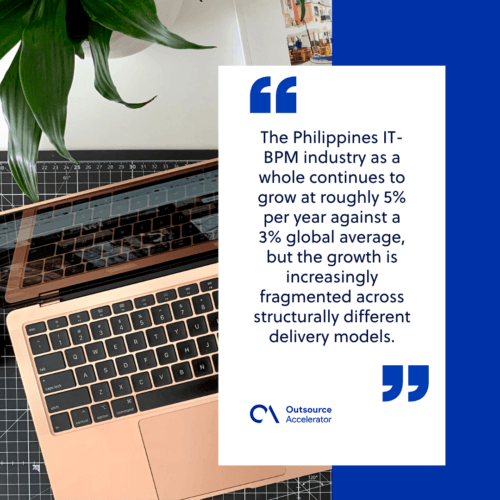
The Philippines IT-BPM sector still grows at roughly 5% per year, ahead of the global average near 3%. However, that growth now spreads across very different delivery models. Many buyers compare this with other hubs when outsourcing to the Philippines.
Why the office still matters for offshore teams
Rodney gives three reasons the office stays central to well-run offshore staffing in 2026.
Infrastructure
Outside major cities, infrastructure in the Philippines can be uneven. Internet, power, and workspace quality all vary from home to home. As a result, a provider-run office levels the playing field for the whole team.
Rodney puts the point plainly:
“Unfortunately, the infrastructure in the Philippines isn’t as good as what some people expect, so they may not have internet, they may not have power. Sometimes they may even get sucked into trying to work two jobs on two different machines.”
Culture and peer learning
The BPO workforce skews young. At IntegratedOS, the team averages under 27. Because of this, early-career staff learn faster when they sit near peers.
“They need to have relationships with their teammates. You can’t have a team when you’re sitting at home. The stuff you learn around the water cooler and how you learn from each other…”
Retention
Retention follows from the first two. IntegratedOS runs at 98% retention, well above the industry norm. Rodney ties that result directly to office culture and the activities around it. Strong remote team management helps, but the office does the heavy lifting.
“You don’t get 98% retention like we’ve got without having happy people. And a part of that is, activities we’re able to have, like we have weekly badminton and all that sort of stuff.
That all comes from getting the guys into the office and being a part of something, not just sitting at home being lonely and doing their work.”
The hidden costs of fully remote and EOR models
The case against fully remote and EOR is not about ideas. Instead, it is about operations. The model you choose drives outcomes well before the headline price does.
Here is how the three options compare:
| Dimension | Office-Based (Dedicated) | Fully Remote / EOR |
|---|---|---|
| Employment status | Full-time employees, in-country, under local labour law (DOLE) | Often contractor or EOR-mediated; legal accountability unclear |
| Infrastructure | Provider-owned office with backup internet and power | Home-based; reliability depends on each workspace |
| HR depth | In-country HR team for performance, training, escalations | Minimal local HR; often offshore admin only |
| Retention | High: Rodney reports 98% at IntegratedOS | Industry average notably lower; turnover often the failure point |
| Pricing structure | Transparent overhead recovery; visible margin | Opaque mark-up; no offshore visibility |
| Brand exposure if it goes wrong | Provider absorbs operational risk locally | Client absorbs reputational and legal exposure |
With EOR, the biggest risk is structural, not financial. Here is how Rodney frames it:
“I’m seeing that the risk to the industry at the moment is these EOR companies. I know of at least half a dozen where they don’t even have ownership in the Philippines.
They live in Singapore. They fly over, they set up an entity, they handle the recruitment part, the team member’s sitting at home… The EOR is no care and no responsibility, and someone gets sucked into them because the cost is low.”
So the problem is not cost alone. Rodney’s worry is that bad EOR experiences will tar the whole industry, including providers that do invest in offices, HR, and systems.
When hybrid is the limit for offshore teams
Hybrid is fine. Fully remote is not. The line sits where work culture forms and holds.
Hybrid works for senior, settled staff with a known workflow and a track record. For example, many IntegratedOS team members work two or three days a week in-office and the rest from home. The office still stays the centre of gravity for the culture. This balance mirrors the wider shift to hybrid work.
However, it does not work for new hires and younger workers. Early-career staff need to learn behaviour, escalation, and craft from peers nearby, not from Slack alone. It also breaks down for technical training, where informal observation matters most.
The habits that keep hybrid healthy are concrete:
- Weekly in-person team activities
- Mandatory office days for training and reviews
- In-person quarterly events that include the client
- Branded inclusion (shirts, hats, town halls) that makes the team feel part of the parent company
5 things to look for in an office-based offshore staffing provider
These points turn the case into a simple checklist buyers can use.
1. In-country ownership and a real legal entity
The provider should be set up locally, with named owners, a registered office, and accountability under local labour law. EORs with Singapore-only or Hong Kong-only registration are the most common red flag. A clear staff leasing structure helps you see who truly employs the team.
2. A physical office with reliable power and internet
Look for a real building with backup power, redundant internet, and proper workstations. Ask to see it on a video call, and ideally in person. Without this, the offshore promise breaks at the first outage.
3. Local HR depth and labour-law compliance
The Philippines’ Department of Labor and Employment (DOLE) sets the rules. So the provider needs a real local HR function for disputes, performance, and benefits. Without it, the client sits directly in the legal firing line.
4. Cultural anchors
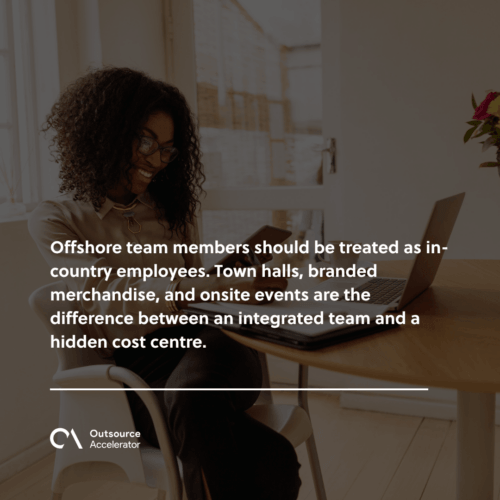
Offshore staff should be treated like in-country employees. Town halls, branded merchandise, and onsite events are the difference between an integrated team and a hidden cost centre.
5. Transparent pricing tied to real overhead
Avoid vague “all-in” rates. The strongest providers open their books to clients. IntegratedOS, for example, caps net profit at 10% and currently runs at around 3%, because transparency is the trust mechanism.
“A lot of people think that we’re selling dedicated teams over in the Philippines, but we’re actually selling trust. They need to know that they can trust a critical part of their business, core part of their business, to be done overseas.”
FAQs
Is hybrid OK for offshore teams, or does it need to be full-office?
Hybrid works well for senior, settled staff. However, new hires and younger workers should default to the office. Technical training and quarterly reviews should always be in person.
How do I tell if an offshore provider really has an office?
Ask for a live video tour. Then request the local legal entity registration, and check the in-country HR headcount. Any deal of more than a few seats should be backed by a visible operations and HR function locally.
Does work-from-home work for senior offshore roles?
Yes, generally, for senior individual contributors with strong workflow autonomy. Still, even senior staff should anchor to the office for team events, reviews, and training. Pure WFH risks the brand and culture connection.
How does EOR cost compare to an office-based provider per seat?
Headline EOR rates can be 20% to 40% lower. However, the comparison misleads. Office-based pricing already includes infrastructure, HR, training, retention activities, and brand alignment. Those things prevent the EOR’s hidden costs: turnover, legal exposure, and brand damage.
Which model is best for a first offshore hire?
For a first hire, an office-based or hybrid provider is usually safest. It gives you local HR support, reliable systems, and a culture that keeps your new team member engaged. As a result, you lower the risk while you learn how offshore works.






 Independent






