
Where to find a low-cost clipping path service

Where can you find a low-cost clipping path service?
The lowest-cost clipping path services come from offshore providers in countries like Bangladesh, India, and the Philippines, who edit product images at scale without the overhead of an in-house design team.
- A clipping path service traces the outline of a subject so the background can be removed or replaced.
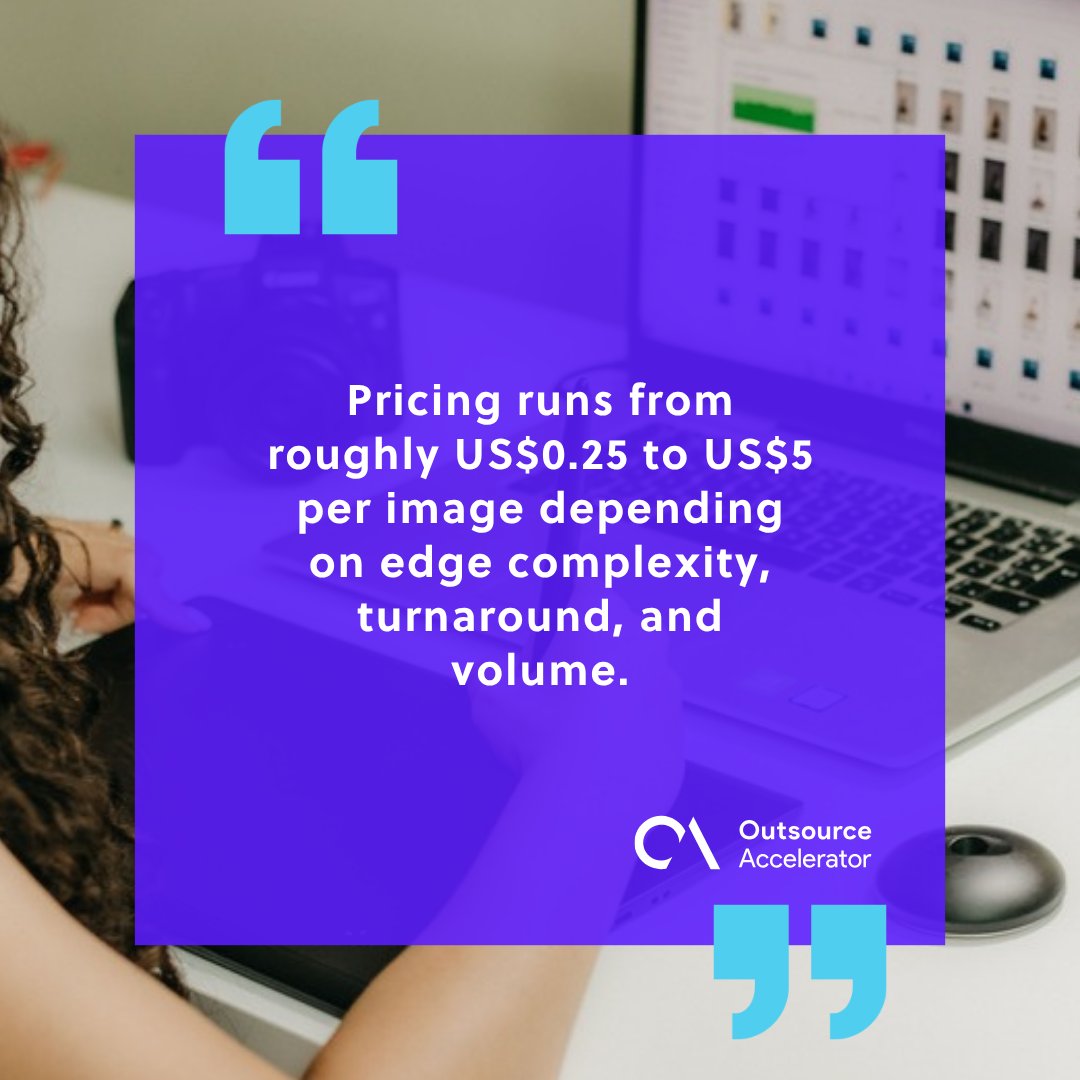
- Pricing runs from roughly US$0.25 to US$5 per image, based on edge complexity, turnaround, and volume.
- Vet a provider on edge quality, revision policy, and bulk turnaround before you commit to a large catalog.
A clipping path service is a specialized image-editing job. It isolates a subject from its background by drawing a precise vector outline around it. Online retailers, photographers, and agencies lean on these services to produce clean, consistent product shots. Modern catalogs demand them at high volume. The work is repetitive and detail-heavy. For that reason, many companies hand it to an external team rather than tie up an in-house designer. Finding a low-cost clipping path service comes down to three things: what the work involves, what a fair rate looks like, and which markets price it well.
What a clipping path service actually does
The term covers more than a single background cutout. So the scope affects what you pay.
A basic path follows a simple, smooth-edged object such as a phone or a box. Complex paths handle products with holes, straps, or overlapping parts. Each of those needs its own outline. The trickiest jobs involve soft edges like hair, fur, or fabric. Here, a clipping path is paired with masking to keep the detail intact. The output is usually a layered file with a saved path or transparent background. As a result, it is ready to drop onto any color or scene.
Most providers bundle related tasks into the same order:
- Background removal and replacement
- Color correction and white-balance fixes
- Shadow creation (natural, reflection, or drop)
- Ghost mannequin editing for apparel
- Spot retouching and dust removal
The visual payoff matters more than it sounds. Online stores now take a steadily rising share of all retail. In fact, that share is forecast to climb toward nearly a quarter of global retail sales by 2027. On a screen, the photo is the product. So a clean cutout becomes a direct conversion lever, not a cosmetic nicety. Clean product images are a core part of e-commerce outsourcing for the same reason. Inconsistent edges, mismatched backgrounds, or stray pixels read as careless. Because of this, they quietly erode trust at the exact moment a shopper decides to buy.
Why companies outsource clipping path work
The decision usually rests on math and capacity rather than skill.
A trained in-house retoucher in a Western market costs a salary, software licenses, and management time. For a brand pushing hundreds of new SKUs a month, that headcount sits idle between shoots and overloaded during them. An external provider absorbs that swing, because editing is its core business. In addition, it spreads the fixed cost of skilled editors across many clients rather than one. These are the same benefits of outsourcing that drive firms to send other back-office work offshore.
Volume is the second driver. Demand for this work tracks the broader editing sector. Independent analysts size the image editing software market in the billions of dollars worldwide, and it is still climbing. Retailers in that environment need throughput. So offshore teams are built to scale up or down without the friction of hiring.
Clipping path work also slots neatly into a wider graphic design outsourcing arrangement. So a brand can route cutouts, banners, and catalog layouts through the same partner instead of juggling several. Many buyers treat it as one piece of their overall graphic design workflow.
3 markets that offer low-cost clipping path services
A handful of countries dominate this niche. Still, each one carries a slightly different trade-off.
1. Bangladesh
Bangladesh is the recognized hub for clipping path work. In fact, many global studios route bulk catalogs through teams based in Dhaka. Rates are among the lowest available. The talent pool is deep too, because the specialty grew up there. The main consideration is time-zone overlap with North American clients. However, a well-run studio manages that with overnight delivery cycles.
2. India
India offers a broad creative-services market with strong English and mature project management. Editing often sits alongside other tasks a skilled Indian virtual assistant can cover. So it suits firms that want one vendor for several functions rather than a single-task shop. The depth of the wider IT and design sector helps too. As a result, scaling a team rarely runs into a talent ceiling. Buyers can review a broader guide to outsourcing to India before they choose a partner.
3. The Philippines
The Philippines pairs competitive pricing with a service culture geared toward Western clients. Its business hours also suit the US and Australia. It tends to cost a little more than Bangladesh. Even so, it appeals to companies that value smooth communication over the absolute lowest rate. This is especially true on accounts where brief changes and quick revisions are frequent. For more context, see OA’s guide to outsourcing to the Philippines.
How to vet a low-cost clipping path service
Cheap work that needs redoing is not cheap. So the screening process should focus on quality and reliability.
Ask for a free trial on your own images rather than a polished portfolio sample. Edge precision is the clearest signal of skill, especially on hair and transparent objects. Next, confirm the revision policy in writing. A low headline price means little if every correction carries a fee. Check how files are delivered and named too. A bulk catalog falls apart fast without consistent naming and folder structure.
Turnaround commitments deserve scrutiny as well. A provider promising a 24-hour return on 500 images should explain its team size and quality-check steps. The cautionary tale across the sector is clear. For example, low-cost commodity outsourcing rarely survives without genuine value behind it. So weigh price against consistency rather than chasing the lowest per-image quote.
Clipping path service pricing compared by sourcing model
The table below sets the common options side by side, so the trade-offs are easy to read.
| Sourcing model | Typical cost per image | Turnaround | Best for |
|---|---|---|---|
| In-house designer | US$8 to US$20 (loaded) | Same day | Small, infrequent batches |
| Freelance marketplace | US$2 to US$8 | 1 to 3 days | Occasional projects |
| Offshore clipping path firm | US$0.25 to US$2 | 12 to 48 hours | High-volume catalogs |
Frequently asked questions about clipping path services
A few practical questions come up repeatedly when companies start sourcing this work.
How much does a clipping path service cost per image?
Simple cutouts often start near US$0.25 to US$0.50 per image from offshore providers. Meanwhile, complex multi-path or hair-masking jobs can reach US$3 to US$5. Volume discounts are standard once orders pass a few hundred images.
Is a clipping path the same as image masking?
No. A clipping path uses a hard vector outline and works best on solid, defined edges. By contrast, masking handles soft or fine detail such as hair and fur. Many orders use both techniques on the same image.
How fast can a clipping path service deliver bulk orders?
Established offshore teams routinely turn around hundreds of images within 24 to 48 hours. They do this by splitting work across editors. So confirm the schedule and quality-check process in advance for large catalogs.
Will AI replace manual clipping path services?
AI tools handle straightforward cutouts well, and they are improving fast. Still, complex edges, reflective surfaces, and brand-critical hero shots benefit from manual editing. For that reason, most providers now blend both approaches.






 Independent






