
How to build an offshore team in the Philippines


This article is a submission by KMC Solutions, a BPO services and workspace solutions provider. KMC Solutions helps companies build high-performing offshore and nearshore teams through Employer of Record, recruitment, HR, payroll, compliance, IT, and flexible workspace solutions in the Philippines and Colombia.
Building an offshore team in the Philippines is one of the most practical ways for companies to scale efficiently, access specialized talent, and improve operational flexibility.
An offshore team is a dedicated group of professionals based in another country that works as an extension of your business. Unlike traditional outsourcing models, offshore teams can be integrated into your systems, culture, and daily operations.
This gives companies more control while benefiting from lower operating costs and a broader talent pool.
For years, the Philippines has built a strong reputation in global services, customer support, finance, technology, and back-office operations.
With a highly educated workforce, strong English proficiency, and a business culture aligned with Western markets, the country remains a practical choice for companies looking to build high-performing offshore teams.
What is offshore team building?
Offshore team building is the process of hiring and managing employees located in another country to support your core business functions. These professionals may work across customer service, software development, finance, HR, marketing, design, operations, or technical support.
Rather than relying only on local hiring, many companies now use offshore hiring as part of a broader workforce strategy. It allows businesses to tap into wider talent markets while maintaining quality, productivity, and operational control.
This model is especially useful for growing companies that need to hire quickly, reduce hiring pressure in expensive markets, or build support capabilities across different time zones.
Offshore teams can function as fully embedded departments, dedicated support units, or hybrid teams working alongside in-house staff.
When done correctly, offshore hiring is not simply about cost savings. It is about creating a stronger operating model with access to more talent, more flexibility, and more resilience.
Why the Philippines?
The Philippines has become one of the strongest offshore hiring destinations in the world because of its talent quality, communication skills, cost efficiency, and mature outsourcing ecosystem.
English is widely spoken across the country and used in education, business, and professional settings. This reduces communication barriers and supports smoother collaboration with companies in the United States, Australia, the United Kingdom, and other English-speaking markets.
The country also produces skilled graduates in business, IT, healthcare, engineering, finance, and creative fields every year. Many Filipino professionals have experience working with international clients, remote teams, and multinational companies.
Competitive labor costs are another major advantage. Companies can often build teams in the Philippines at significantly lower costs compared with Western markets while still maintaining strong quality standards.
Filipino professionals are also known for adaptability, service orientation, and familiarity with Western business culture. This helps offshore teams integrate faster into existing company systems, workflows, and team dynamics.

The Philippines also has a mature outsourcing ecosystem built over decades. Global companies have long operated teams in the country across BPO, technology, finance, ecommerce, and shared services, creating a strong support network for recruitment, payroll, compliance, HR, workspace, and IT infrastructure.
Key steps to building an offshore team in the Philippines
Define your team structure and roles
Start by identifying the roles you need and how they connect to your business priorities.
Common offshore roles include customer service representatives, software developers, accountants, graphic designers, marketing specialists, HR support staff, and data analysts.
Clarify reporting lines and KPIs
Before hiring begins, define who each team member reports to, what success looks like, what KPIs will be used, what level of experience is required, and what working hours are expected. A clear structure improves hiring speed and long-term performance.
Understand legal and compliance requirements.
Hiring in the Philippines requires compliance with local labor laws, tax rules, statutory benefits, employment contracts, and payroll regulations.
Employers must also account for government contributions such as SSS, PhilHealth, and Pag-IBIG, as well as mandatory requirements like 13th month pay, holiday pay, overtime, and other labor standards.
Choose the right hiring model
Companies generally have three options: set up their own legal entity, use a staffing or outsourcing provider, or work with an Employer of Record partner. Many international companies choose the Employer of Record model because it allows them to legally hire employees in the Philippines without setting up a local entity.
Use the right recruitment channels
To reach qualified Filipino talent, companies can use platforms such as JobStreet, Kalibrr, LinkedIn, specialist recruiters, employee referrals, and university networks.
Build a structured screening process
A strong hiring process should include interviews, skills testing, role-specific assessments, and clear evaluation criteria. This helps improve the quality of hire and reduces hiring risks.
Set up communication and management tools
Offshore teams need clear systems for collaboration, visibility, and accountability. Common tools include Slack for communication, Zoom for meetings, Trello or Asana for task tracking, and Google Workspace for shared documents.
Create clear workflows
Tools alone are not enough. Companies need defined responsibilities, communication standards, documentation habits, and regular check-ins to keep offshore and in-house teams aligned.
Prioritize onboarding and training
The first 30 to 90 days are critical. Offshore hires should receive structured onboarding, system access, clear expectations, product and process training, team introductions, and regular manager check-ins.
Treat offshore hires like core employees
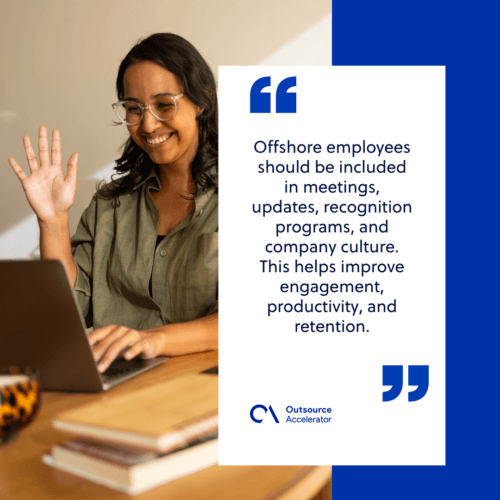
Offshore employees should be included in meetings, updates, recognition programs, and company culture. This helps improve engagement, productivity, and retention.
Common challenges when building an offshore team
Building an offshore team can come with challenges, but most are manageable with the right structure.
- Time zone differences can be addressed by setting overlapping working hours for meetings, collaboration, and feedback. Non-overlapping hours can be used for focused work.
- Communication gaps can be reduced through clear documentation, concise written updates, and agreed communication standards.
- Cultural misalignment can be managed by training both local and offshore teams on communication styles, expectations, company values, and ways of working.
- Inconsistent management is another common challenge. Offshore teams need strong leadership, feedback loops, accountability, and career development, just like any local team.
When these areas are managed properly, offshore teams can become a productive and integrated part of the business.
Cost analysis of building an offshore team in the Philippines
Costs vary depending on role, experience level, location, and hiring model. General annual salary estimates may include entry-level roles at around USD 3,000 to USD 6,000, mid-level roles at USD 6,000 to USD 12,000, and senior roles at USD 12,000 to USD 20,000 or more.
Companies should also consider additional costs such as recruitment fees, equipment, payroll administration, benefits, office space if required, and software licenses.
Compared with markets like the United States, Australia, or parts of Western Europe, the Philippines often provides strong value while maintaining quality talent access.
The advantage is not only lower cost but also the ability to build dedicated teams with the skills, structure, and support needed for long-term operations.
Best practices for managing offshore teams
Successful offshore teams are built through management discipline, not geography.
- Companies should set clear expectations by defining KPIs, timelines, ownership, and communication standards. This helps employees understand what success looks like from the start.
- Transparency is also important. Shared dashboards, weekly updates, regular check-ins, and performance reviews help keep offshore and in-house teams aligned.
- Teams should focus on outcomes rather than online presence. Productivity should be measured by results, quality of work, and contribution to business goals.
- Culture should also be part of the operating model. Offshore employees should be included in company meetings, recognition programs, team updates, and important business communications.
As the team grows, companies should build leadership layers by developing local supervisors and managers. This improves accountability, communication, and scalability.
Retention should also be treated as a business priority. Career growth, training, recognition, and strong management often matter as much as compensation.
Offshore employees are more likely to stay when they feel supported, included, and connected to the company’s long-term goals.
The Philippine offshore advantage
Building an offshore team in the Philippines can help companies scale faster, improve hiring flexibility, and access high-quality talent across many business functions. The country offers a strong combination of skill, communication strength, business compatibility, and cost efficiency.
Success depends on getting the fundamentals right: defining roles clearly, hiring through the right channels, staying compliant, onboarding properly, and managing with intention.
For companies looking to build a reliable workforce, the Philippines remains one of the strongest options available today.
Start building your remote team with the right structure and long-term mindset.
Frequently Asked Questions
How much does it cost to hire an offshore team in the Philippines?
Costs depend on role type, experience level, and hiring model. Entry-level hires may start around USD 3,000 annually, while experienced professionals can exceed USD 20,000 annually, depending on specialization and seniority. Additional costs may include recruitment, payroll, benefits, tools, equipment, and workspace.
What are the benefits of building an offshore team in the Philippines?
The key benefits include cost efficiency, access to skilled professionals, strong English communication, cultural compatibility, and a mature outsourcing ecosystem.
What roles can I hire in the Philippines?
Common roles include customer support, software engineering, finance, accounting, HR, design, marketing, operations, data analysis, technical support, and administrative support.
Is it legal to hire employees in the Philippines without a local entity?
Yes. Many international companies use an Employer of Record partner to legally hire employees in the Philippines without opening a local company
How long does it take to build an offshore team?
Timelines vary by role, seniority, and hiring model, but many companies can begin hiring within weeks when working with the right partner.






 Independent





