
How AI can solve complex business problems: The path forward


How can AI solve complex business problems?
AI solves complex business problems by processing huge data sets, spotting patterns, and making fast predictions that help leaders act sooner and smarter.
- It automates slow manual work. As a result, teams focus on high-value tasks.
- It forecasts trends and risks. So companies plan ahead instead of reacting.
- It personalises customer experiences at scale, which lifts loyalty and sales.
Across industries, businesses face hard problems that old solutions cannot fix. For example, they must manage massive data sets and predict market shifts in real time. These hurdles need smart systems that process information and decide faster than any human team.
Artificial intelligence has become the most powerful tool for these challenges. Using AI to solve business problems lets firms handle data-heavy tasks, predict trends with strong accuracy, and surface insights that support better decisions.
According to IDC’s 2025 CEO Priorities research, 66% of CEOs report measurable gains from generative AI. In particular, they point to better efficiency and happier customers.
The path forward is clear. First, learn which challenges AI can address. Next, match the right tool to each problem. Finally, build solutions that create a lasting edge. Firms that master this approach are ready to thrive in a fast-paced market. Many pair in-house teams with AI outsourcing partners to move faster.
Identifying the business problems AI can solve
Common business problems AI can address
Business problems AI can solve span nearly every aspect of modern operations. For instance, it cuts waste and costs. It also speeds up decisions and lifts customer satisfaction.
The biggest challenges AI tackles include huge data volumes, repetitive manual work, and weak forecasts. As a result, teams gain time and accuracy.
Inefficiency is one of the largest areas where AI creates fast impact. Manual tasks that eat hours of staff time can be automated. So teams move to strategic work instead. High costs often come from wasted resources or poor demand forecasting, and AI excels at optimisation here.
Key business challenges that AI addresses well include:
- Data overload, where firms struggle to pull insight from huge information volumes
- Resource optimization challenges in scheduling, inventory, and capacity planning
- Quality control issues that need constant monitoring and fast response to anomalies
- Customer service bottlenecks that cause long waits and uneven support
- Fraud detection and security threats that need real-time analysis of risky patterns
To get the most from AI, many businesses choose to hire AI developers who can build tailored solutions. These experts design systems that fit existing operations. In addition, they handle industry rules and compliance needs.
AI solutions for operational efficiency
AI transforms operational efficiency in three ways. First, it automates repetitive tasks. Next, it streamlines complex workflows. Finally, it cuts human error in key processes.
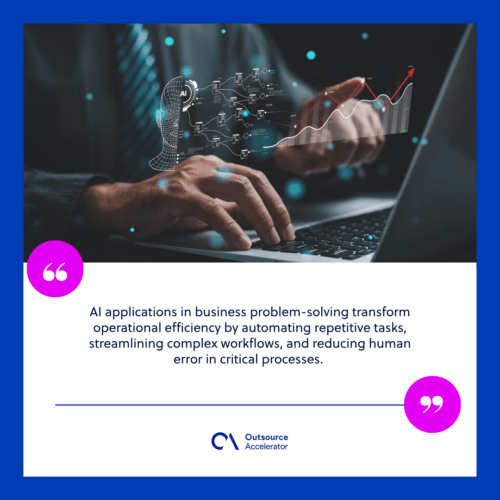
As a result, businesses do more work with fewer resources, yet keep quality high. Automation offers the quickest win. For example, it handles data entry, document processing, and routine analysis without breaks. Meanwhile, AI finds bottlenecks and coordinates many processes at once for better resource use.
AI in data analysis and decision-making
Using AI for data analysis turns raw information into insights that drive better choices. AI-powered systems can read structured and unstructured data at the same time. So they catch patterns that human analysts might miss.
Decision support tools can weigh many scenarios, assess risks, and suggest the best action. They base this on past data and predictive models. In addition, real-time analysis lets firms react right away to change. As a result, they can prevent problems before operations take a hit. A strong business intelligence strategy makes these insights easier to act on.
How AI applications are revolutionizing business problem-solving
Here are some ways that AI applications are streamlining work.
AI-powered predictive analytics
With predictive analytics, businesses can forecast trends and customer behaviour. As a result, they navigate demand with precision that was once out of reach. In turn, planning shifts from reactive to proactive. So firms seize chances before rivals even notice them. Many teams use dedicated predictive analytics tools to get there faster.
Market trend prediction reads past data, current conditions, and outside factors. So it forecasts where the market is heading. These predictions help firms adjust plans, use resources well, and spot threats early.
Customer behaviour analytics map buying patterns and predict lifetime value. As a result, they guide smarter choices in marketing, product design, and support. For example, AI can show which customers will buy, when, and why.
Demand forecasting powered by AI helps firms set the right inventory and schedules. It accounts for seasons, promotions, events, and trends. Because of this, it cuts waste while keeping supply in line with demand.
Personalization and customer experience
Business problems AI can solve in customer experience include:
- Delivering personalized interactions at scale
- Optimizing customer journeys
- Creating engagement strategies that increase satisfaction and loyalty
In short, AI lets firms treat each customer as an individual. At the same time, it keeps operations efficient across large customer bases.
Personalization engines read customer data to deliver tailored products, content, and offers. For instance, they use buying history, browsing, and engagement to shape each interaction.
Customer journey optimization uses AI to study how customers interact with businesses across touchpoints. So it finds friction and chances to improve. As a result, firms reduce effort and lift conversion and satisfaction.
Marketing optimization helps firms send the right message at the right time, through the best channel. AI can test approaches, measure results, and adjust campaigns on its own. In turn, engagement and conversion climb. These gains build on wider work in AI in customer service.
Risk management and fraud prevention
Risk management and fraud prevention are key AI uses where old rule-based systems fall short. AI can read complex patterns, spot anomalies, and flag threats in real time. It also adapts to new fraud tricks and fresh risks.
Fraud detection systems powered by AI study transactions, user behaviour, and context. So they flag activity that may be fraud. These systems learn from past cases. As a result, they keep improving over time.
Risk assessment applications use AI to weigh threats across credit, operations, and markets. They process many data sources at once. In turn, they build full risk profiles that guide decisions and mitigation.
Compliance monitoring uses AI to keep operations within the rules. For example, it watches transactions, messages, and processes without pause. So it flags possible violations and alerts the right people. Meanwhile, real-time threat detection lets firms respond fast to incidents before they cause harm.
Embracing AI for business transformation
Using AI to solve business problems will keep growing as a tool for competitiveness and innovation. As the tech gets stronger and easier to reach, firms that adopt it can solve harder challenges. In addition, they open new paths to growth and market leadership.
The future of AI goes beyond single apps. Instead, it builds integrated systems that transform whole processes. So firms that invest in full AI strategies gain a lasting edge through efficiency, better decisions, and stronger customer experiences. Simple AI tools for business are a practical place to start.
Over time, AI will tackle problems that seem unsolvable today. As a result, it can unlock breakthroughs in product development, service, and operations. Companies that explore AI solutions now will build the skills and infrastructure to capitalise later.
To succeed, firms must choose which problems to solve first. They must also ensure smooth integration with current systems. Beyond the setup, they need the internal skills and culture to keep innovating. In the end, the firms that thrive will treat AI not as an add-on, but as a core capability that helps them serve customers better and run more efficiently than ever.
Frequently asked questions about using AI to solve business problems
What business problems can AI solve?
AI can ease data overload, cut manual work, and sharpen forecasts. It also improves customer service, fraud detection, and resource planning. As a result, it fits many parts of a modern business.
Do small companies benefit from AI?
Yes. Many affordable tools now exist. For example, a small firm can use AI for support chat, demand forecasts, or marketing. So the benefits are not limited to large enterprises.
How does AI improve decision-making?
AI reads huge data sets and spots patterns people may miss. Then it weighs scenarios and suggests the best action. In turn, leaders decide faster and with more confidence.
Do businesses need to hire AI developers?
Often, yes, for custom work. Skilled developers design systems that fit your operations and rules. However, many firms also start with ready-made tools before building their own.
Where should a company start with AI?
Start small. First, pick one clear problem with good data, such as support or forecasting. Next, measure the results. Finally, scale what works across the business.






 Independent






