
Healthcare staffing shortages? Here’s how outsourcing can help


How can outsourcing help with healthcare staffing shortages?
Outsourcing helps with healthcare staffing shortages by giving providers fast access to skilled clinical and non-clinical talent, so teams can fill gaps, cut costs, and protect patient care.
- It opens large talent pools that in-house hiring cannot reach alone.
- It shifts recruiting, training, and compliance work to specialists.
- It lets facilities scale staffing up or down as demand changes.
At a glance
- Healthcare across the globe is experiencing critical workforce shortages, from nurses to administrative staff.
- Key causes include burnout, aging populations, and training bottlenecks.
- Outsourcing can expand talent pools, reduce costs, and improve operational efficiency.
- Specialized partners like Connext Global Solutions provide tailored staffing support across healthcare functions.
- Effective outsourcing eases pressure on core teams, allowing facilities to focus on quality patient care.
The healthcare staffing shortage
The World Health Organization predicts a shortage of 11 million health workers by 2030. For providers, this gap hits daily operations hard. As a result, staffing shortages lead to:
- Longer patient wait times
- Increased overtime and labor costs
- Revenue cycle inefficiencies
- Higher turnover and burnout
- Compliance and documentation backlogs
From large hospital systems to independent physician groups, these gaps affect both patient care and finances. So the problem is more than a staffing issue. It raises costs and wears down existing teams. Often, providers lean on overtime and temporary labor, which strains budgets further. For many, healthcare outsourcing has become a practical way to ease that pressure.
Why is there a shortage of healthcare workers?
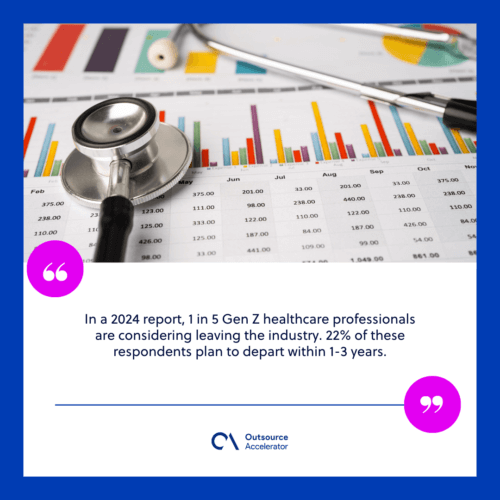
In a 2024 report, 1 in 5 Gen Z healthcare professionals are considering leaving the industry. In fact, 22% of these respondents plan to depart within 1 to 3 years.
Several linked factors drive these growing staffing challenges:
- Burnout and turnover. Long hours, high stress, and emotional labor push many healthcare workers to leave or rethink their careers. As a result, turnover stays high.
- Aging workforce and population needs. An aging population needs more care. Meanwhile, many experienced workers are retiring, which shrinks the talent pool.
- Training and education barriers. Heavy training needs and long onboarding slow entry into the workforce. So the supply of qualified candidates stays tight.
- Administrative burden. Staff spend hours on non-clinical tasks like scheduling, billing, and eligibility checks. This cuts the time left for direct patient care.
How outsourcing can help with healthcare staffing shortages
Outsourcing offers a flexible, scalable solution. It helps facilities close staffing gaps while keeping care quality high. There are many healthcare roles you can start outsourcing today. Here is how it works.
1. Expanded talent access
Outsourcing partners keep large networks of skilled clinical and non-clinical staff. So providers can fill roles faster and find better-fit candidates than in-house hiring alone. For example, many teams add healthcare virtual assistants to cover admin work quickly.
2. Cost efficiency
Recruiting, training, and retaining staff in-house can be costly. Outsourcing lowers overhead instead. It shifts much of that work to specialists who source, screen, and manage talent more efficiently.
3. Reduced administrative burden
Staffing partners take on key but time-heavy tasks. These include credentialing, compliance checks, and workforce management, freeing healthcare teams to focus on patient care.
4. Flexibility and scalability
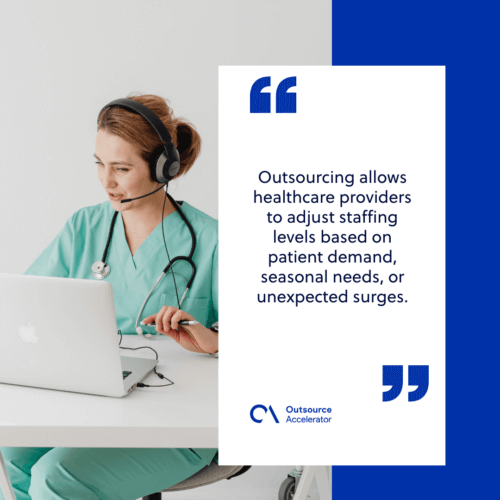
Outsourcing lets providers adjust staffing levels based on patient demand, seasonal needs, or sudden surges. So they avoid the risk and delay of permanent hiring cycles. In addition, offshore healthcare support can extend coverage across time zones.
5. Compliance and risk management
Professional staffing firms stay up to date with licensing, regulations, and standards. They make sure every outsourced professional meets the rules. As a result, legal and operational risks drop.
Healthcare staffing with Connext
Connext Global Solutions is an outsourcing company that builds custom remote teams. It helps healthcare organizations overcome staffing shortages and improve outcomes.
Its approach includes recruiting for key healthcare functions. These cover revenue cycle management, patient scheduling, medical records support, credentialing, and bilingual customer service. For billing-heavy needs, many providers also build offshore revenue cycle teams. Here is what Connext brings to healthcare staffing:
- Scalable offshore teams. Build dedicated support tailored to your needs with worldwide talent.
- Embedded integration. Outsourced staff work as extensions of your internal team, keeping quality and continuity.
- Compliance and expertise. Every professional is vetted and matched to deliver immediate impact.
- Support across roles. From medical billing and credentialing specialists to virtual nurses and support analysts, Connext covers many critical functions.
Working with a partner like Connext lets providers support core clinical teams and improve the patient experience. So they can respond to staffing challenges without lowering service quality.
Visit their website to learn more.
Frequently Asked Questions (FAQs)
What roles can outsourcing fill in healthcare?
Outsourcing can support both clinical and administrative roles. For example, it covers medical billing, patient coordination, credentialing, EMR support, and customer service.
Is outsourcing compliant with healthcare regulations?
Yes. Reputable staffing partners manage credentialing, licensing, and compliance needs. As a result, they reduce risk for healthcare providers.
How quickly can outsourcing fill staffing gaps?
Outsourcing vendors usually fill roles faster than traditional hiring. They do this by using larger talent pools and streamlined recruitment systems.
Does outsourcing improve patient care?
Yes. By freeing in-house teams from admin work and closing staffing gaps, outsourcing helps providers keep care consistent and high in quality.
Key takeaways
- Strategic healthcare staffing solutions must address both workforce gaps and operational inefficiencies.
- Outsourcing non-clinical roles improves provider productivity without increasing clinical headcount.
- Scalable remote teams allow healthcare organizations to grow without fixed labor risk.
- Compliance, data security, and workflow integration are critical when selecting a healthcare staffing partner.
- Partnering with Connext Global Solutions enables providers to build sustainable, cost-effective workforce models.






 Independent






