
Pros and cons of being a remote employee: A guide for companies

What are the pros and cons of being a remote employee?
The main pros of being a remote employee are freedom, no commute, work-life balance, wider job access, and deep focus; the main cons are isolation, blurred boundaries, and being overlooked for growth.
- Pros: more control over time, lower costs, and higher focus.
- Cons: loneliness, “always on” pressure, and fewer visible career paths. At the company level, this remote shift has a name, homeshoring, where firms move call and support work into employees’ homes.
- Good management closes the gap between the two.
Why understanding your remote employee matters
The corporate world is no longer confined to the four walls of an office. The shift to remote work is not just a passing trend. Instead, it is a change in how we define “work.”
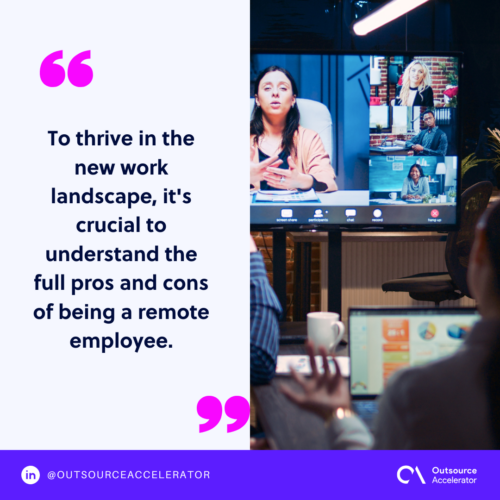
To thrive in this new landscape, you need to understand the full pros and cons of being a remote employee. In short, you have to see the job from your employee’s point of view.
It is easy to focus on productivity metrics and deliverables. However, long-term success rests on the human side of remote work.
Think of your remote employee as a superhero with a secret identity. They work hard, yet their world differs from the one in the office. For example, they balance deadlines with family life and build connections through a screen. So if you ignore their experience, you risk disengagement and high turnover.
Remote Employee CEO and Co-Founder Ruffy Galang knows the value that talent brings. “We understand that our employees are our greatest asset,” he explains. “We create a culture where they feel valued and motivated to succeed by investing in their work environment and professional growth.”
This article walks through the most common pros and cons of being a remote employee. By learning their motivations and challenges, you can build a culture of trust and support. As a result, your company becomes the place everyone wants to work.
The pros for the remote employee: What attracts the best talent?
Remote work is not just a perk. In fact, it is a powerful magnet for top talent, and it is here to stay. The pros and cons of being a remote employee matter to today’s workforce. The pros, meanwhile, are a huge draw. You can see more in these benefits of remote work.
Here are five reasons the best people choose the remote life.
1. The freedom to live life
This is the big one. Remote work gives people back their time. There are no soul-crushing commutes and no rigid 9-to-5 schedules.
So employees can shape their day around their life. For example, they can take their kids to school or hit the gym in the afternoon. This control has been linked to a real reduction in employee burnout and better mental well-being.
2. The commute is a non-issue
Let’s be real. Commutes drain time, money, and sanity. Working remotely puts those hours and dollars back into your employees’ lives. In addition, the savings on gas, tolls, and transport add up fast.
3. A real work-life balance
Forget the old idea of work-life balance as a tightrope act. Remote work allows a more fluid blend. So employees can be there for key moments without missing a beat at work.
Gallup found that 93% of remote employees preferred at least a hybrid setup. Also, 76% cite improved work-life balance as a top benefit. As a result, this flexibility cuts stress and builds a happier, healthier team. For more on this, see our guide to work-life balance.
4. A world of opportunity
For employees, remote work breaks down geographical barriers. They are no longer stuck with jobs within 30 miles of home. So they can find a role that truly fits their skills, wherever the company sits.
5. Laser-focused productivity
The constant noise of an open-plan office can kill productivity. Remote employees get to design their own workspace, free from distractions. This allows for deep work, the kind of focus that leads to better output. Strong focus also feeds employee engagement over time.
The cons for the remote employee: Managing the challenges of distance
Remote life has perks, but it also has hurdles. Companies that ignore the pros and cons of being a remote employee can lose great talent. Some of these challenges also show up in the common disadvantages of telecommuting.
Here are three challenges your remote employees are likely facing.
1. The “lonely island” effect
Remote staff miss the chats at the coffee machine and casual lunches. So this can lead to a sense of isolation. It can be hard to feel connected to onsite workers and company culture. Without effort, they can feel cut off from the mainland.
2. The lines get blurry
The great benefit of working from home can also be its biggest pitfall. With no split between “work” and “home,” the two blend together. As a result, employees may feel pressure to be “always on.” This fast track to burnout is a serious risk.

3. “Out of sight, out of mind”
In some companies, remote staff get overlooked for promotions and key projects. They may also miss out on mentorship. So without a fair system for advancement, remote workers can feel forgotten. In turn, this leads to frustration and a search for new roles.
How companies can support remote employees
To build a productive remote setup, you must do more than hand out a laptop and a login. Instead, be intentional about the virtual workplace. The goal is to keep staff connected, productive, and motivated. Understanding the pros and cons of being a remote employee is the first step. Here is how you can make a real difference.
- Provide the right tools: Give them the best tech for communication and teamwork. Beyond video calls, consider tools for messaging, project tracking, and shared workspaces.
- Instant messaging platforms
- Project tracking boards
- Knowledge base software
- Cloud storage services
- Real-time collaborative editors
- Be crystal clear: Set clear expectations about communication, availability, and project goals. After all, ambiguity is the enemy of a remote workforce.
- Foster real connection: Be intentional about team building. So create chances for colleagues to connect and build rapport.
- Schedule short, informal virtual “coffee breaks” focused on personal updates and hobbies.
- Take time to celebrate birthdays, work anniversaries, and life events.
- Organize virtual activities like game nights, trivia, or a shared lunch.
- Create a non-work channel so people can connect on a human level.
- Encourage disconnecting: Promote balance by asking staff to sign off at the end of the day and take their time off. Thoughtful remote employee perks can support this too.
- Create pathways for growth: Build mentorship programs and clear career plans. As a result, remote employees know they are valued and seen.
Partner with Remote Employee to simplify the process
Navigating remote work across borders can be hard for businesses. That is where Remote Employee steps in. They connect companies with skilled offshore professionals who fit right into your operations.
They understand the pros and cons of being a remote employee. So they build their services around them.
From recruitment to onboarding and ongoing HR support, Remote Employee handles the heavy lifting. This lets you focus on growing your business. Their approach means you are not just hiring talent. Instead, you are building dedicated, well-supported remote workers who deliver results.
Maybe you want to expand your team, cut costs, or access special skills. Either way, Remote Employee offers the infrastructure and experience to make remote hiring simple. By partnering with them, your remote employees get the support they need. So they can give you their best work, every day.
Frequently asked questions about the pros and cons of being a remote employee
Is being a remote employee better than working in an office?
It depends on the person and the role. Remote work wins on flexibility, focus, and no commute. However, office work can feel more social and offer easier access to managers.
What is the biggest downside of being a remote employee?
Blurred boundaries are the most common problem. Work and home blend into one space. So clear sign-off times and a set workspace help staff protect their rest.
How can managers reduce isolation for remote staff?
Schedule regular social time and casual chats, not just task meetings. In addition, create a non-work channel for the team. Small, steady contact keeps people feeling part of the group.
Do remote employees get fewer promotions?
They can, if a company has no fair system for growth. The fix is clear career paths and formal mentorship. That way, remote workers stay visible and valued.






 Independent






