
The role of VPNs in enabling secure collaboration for global teams

How do VPNs help global teams collaborate securely?
A VPN for global teams creates a secure, encrypted tunnel that protects data, hides IP addresses, and lets remote staff reach company resources safely from anywhere.
- A VPN encrypts traffic so hackers cannot read emails, files, or customer data.
- It gives remote workers safe access to internal apps and cloud tools.
- It also supports privacy rules like GDPR and HIPAA across borders.
Today’s connected world pushes businesses to rely on global teams for output and new ideas. Remote work and cross-border teamwork are now the norm. Because of this, secure communication and data sharing matter more than ever.
Cyber threats, unauthorized access, and compliance rules are all real risks. So companies need strong security measures. One of the best tools for this job is a Virtual Private Network (VPN). A VPN gives internet traffic a secure, encrypted tunnel. As a result, teams can work remotely without exposing sensitive data.
For global teams, a VPN does two things at once. It protects against cyber threats, and it enables smooth access to company resources from any location. This article explains the role of VPNs in secure global work. It also covers the security benefits and how to pick the right VPN.
VPNs and their purpose
A Virtual Private Network (VPN) is mainly a security tool. It lets users reach online resources safely. To do this, it encrypts internet traffic and masks the user’s IP address.
Businesses use VPNs to protect corporate data and enable secure remote access. In addition, VPNs help block unauthorized intrusions. They work by routing traffic through a secure server. So sensitive company data moves in a protected space.
This matters most for global teams spread across many locations. A VPN cuts the risks tied to unsecured public networks. Whether staff work from home, travel, or reach region-locked content, a VPN keeps things safe. Meanwhile, it also supports privacy and compliance with global data rules. Strong data security is a must when work crosses borders.
Security benefits of VPNs for global teams
For global teams, a VPN offers many security gains. Together, they enable safe, smooth collaboration. Below are some of the key benefits.
1. Data encryption for secure communication
A VPN encrypts all data between team members and company servers. So it is nearly impossible for hackers to read or steal that data. As a result, emails, files, and customer records stay safe. This holds true even on public Wi-Fi in airports, cafes, or coworking spaces.
2. Protection against cyber threats
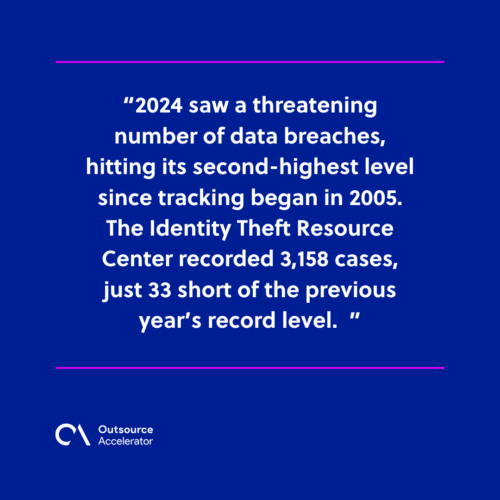
Data breaches have climbed in recent years. In 2024, the Identity Theft Resource Center recorded 3,158 cases. That was just 33 short of the prior record.
Sadly, cybercriminals often target remote and global teams. They exploit weak connections to launch phishing, ransomware, and breaches. A VPN acts as a barrier and hides online traffic from prying eyes. This is a big help for firms that handle financial, legal, or IP data. For more depth, review these cybersecurity best practices.
3. Secure remote access to business resources
With a VPN, remote staff can reach company apps, databases, and cloud storage safely. It feels as if they sit in the office. So sensitive files and internal chats stay in a controlled space. This blocks outside parties from getting in. Many firms link VPNs with their cloud setup to enhance security across global teams.
4. Bypassing geographic restrictions
Many services and resources are locked by region. For example, some cloud tools, servers, and apps only open in set areas. A VPN lets teams connect through a server in an approved country. As a result, they get steady access to key apps and platforms.
5. Compliance with data privacy regulations
Firms that work in many countries must follow various data laws. Common ones include the GDPR (General Data Protection Regulation) in Europe and HIPAA (Health Insurance Portability and Accountability Act) in the United States. A VPN helps by encrypting customer and staff data. Because of this, it lowers the risk of violations and heavy fines.
6. Enhanced privacy and anonymity
Some global teams work in regions with strict censorship or surveillance. There, a VPN adds privacy by masking real IP addresses. So third parties, like ISPs and agencies, cannot track online activity. As a result, staff can work freely without fear of data tracking.
7. Reduced risk of Man-in-the-Middle (MitM) attacks
A Man-in-the-Middle attack happens when criminals intercept a chat between two parties. They then steal data or change information. Microsoft’s Digital Crimes Unit found 240 fraudulent websites that used a related method, the Adversary-in-the-Middle attack.
VPNs use strong encryption to stop these attacks. So business communications stay private and unchanged. This matters most during virtual meetings or shared document work. Firms should also plan for ransomware protection alongside a VPN.
Choosing the right VPN for business collaboration
Picking the right VPN takes care. You should weigh security, speed, and ease of use.
1. Security features: Look for strong protocols like AES-256 and secure tunneling. Extra layers such as multi-factor authentication (MFA) and a kill switch also help.
2. Speed and performance: A good VPN should be fast. It must support video calls, file transfers, and cloud applications without much lag. So global teams stay productive.
3. Compatibility with business tools: Make sure the VPN runs on many systems. It should also work with your existing apps, such as cloud storage and project tools.
4. Logging policy: Choose a provider with a strict no-log policy. That means they do not track or store your activity.
5. Customer support and reliability: A strong provider offers 24/7 support. So you can fix any issue fast. Good remote team management also keeps these tools in use day to day.
Adopt a VPN for global team success
Remote work and cyber risks are both growing at once. So businesses must put safe digital collaboration first. VPNs are key for protecting private data and enabling remote access. In addition, they help firms meet industry rules.
With a VPN, your global workforce can work safely from any location. As a result, teams keep output high without giving up security. Leaders can then scale their global teams with confidence.
The right VPN also protects digital assets. It boosts cybersecurity and strengthens collaboration across regions. Because of this, it drives long-term success.
When it comes to securing remote collaboration for a global workforce, PureVPN for Teams stands out as a top-tier solution.
PureVPN is built for businesses. It offers strong security, smooth connectivity, and enterprise-grade features. So it is a great fit for global teams. Here is why PureVPN works for your organization:
- Bank-grade AES-256 encryption for maximum security
- Dedicated IP and business-friendly features like private VPN servers
- Global server network for seamless access with 6,500+ servers in 70+ countries
- Secure remote access to business networks
- Compliance with global data privacy laws
- High-speed performance for collaboration
- Easy management with centralized control
- 24/7 dedicated business support
For businesses that want to future-proof their global operations, PureVPN is the smart choice.
Frequently asked questions
What is a VPN for global teams?
It is a secure network tool for staff in many countries. It encrypts traffic and hides IP addresses. So remote workers can reach company resources safely.
Do global teams really need a business VPN?
Yes, a business VPN adds a strong layer of security. It guards data on public and home networks. As a result, it lowers the risk of breaches and fines.
Does a VPN slow down connection speed?
A VPN can add slight lag due to encryption. Still, a quality business VPN keeps speeds high. So video calls and file transfers stay smooth.
Can a VPN help with data privacy compliance?
Yes, a VPN encrypts customer and staff data. This supports rules like GDPR and HIPAA. Because of this, it helps cut the risk of violations.
What should you look for in a business VPN?
Look for AES-256 encryption, fast speeds, and wide device support. A strict no-log policy and 24/7 support also matter. First, list your needs, then match a provider to them.






 Independent






