
RPO services: Building successful teams with effective recruitment

What are RPO services, and how do they work?
RPO services let a company outsource all or part of its hiring to a specialist provider that handles sourcing, screening, interviews, and onboarding as an extension of the in-house team.
- RPO covers the full hiring cycle, or just the stages you choose.
- Providers work as a seamless part of your HR team.
- The result is faster hiring, better candidates, and lower costs.
Recruitment Process Outsourcing (RPO) lets companies hand their hiring to a third-party provider. Still, RPO services go well beyond simple hiring help. In fact, they build a clear, strategic way to find and hire talent.
This approach aligns hiring with your talent acquisition goals. So the provider handles everything from sourcing and screening to onboarding. As a result, the whole process runs faster and works better.
In this article, we explain what RPO services are. Next, we show how they work in practice. Then we cover the benefits. Finally, we look at how Clark Staff’s RPO services help firms build strong teams.
What are RPO services?
RPO services mean outsourcing the entire recruitment process, or parts of it, to a specialist provider. In practice, RPO services cover many stages of hiring, such as:
- Sourcing qualified candidates
- Managing job postings
- Screening and interviewing candidates
- Extending job offers and negotiating terms
- Onboarding new employees
Unlike a traditional staffing agency, RPO providers act as a seamless extension of your HR department. For a clear view of the difference, compare staffing versus recruiting.
They tailor their work to match your hiring needs. In turn, the process fits your culture, values, and goals. As a result, you make better hires and build a stronger, more united team.
RPO services in practice: 5 steps to building effective teams
Building strong teams through RPO services takes a few clear steps. Here is how RPO works in practice.
1. Identify recruitment needs
First, assess your current and future hiring needs. For example, you review workforce gaps and skill needs. Then you define the kind of candidate who fits both the job and the culture.
2. Create a customized recruitment strategy
Next, RPO providers build a hiring plan that fits your goals. This may include sharp job descriptions and a targeted outreach plan. In addition, they use special tools for sourcing candidates. A strong talent acquisition strategy guides this stage.
3. Source and screen candidates
Then providers use smart tech and data-led methods. So they find top talent from many sources. For instance, they tap job boards, social media, and internal databases. Careful candidate sourcing keeps the pipeline full.
4. Interview and hire
After the first screen, the RPO provider works with your HR team. Together, they set up interviews and run assessments. As a result, the hiring process stays smooth and efficient.
5. Onboard and support
Once a candidate is hired, the provider helps with onboarding. So the new hire settles into the team with ease. In addition, they keep offering support by reviewing strategies and adjusting as needs change.
Benefits of RPO services in recruitment
RPO services offer many benefits beyond filling open roles. In fact, these gains can greatly improve how you build high-performing teams:
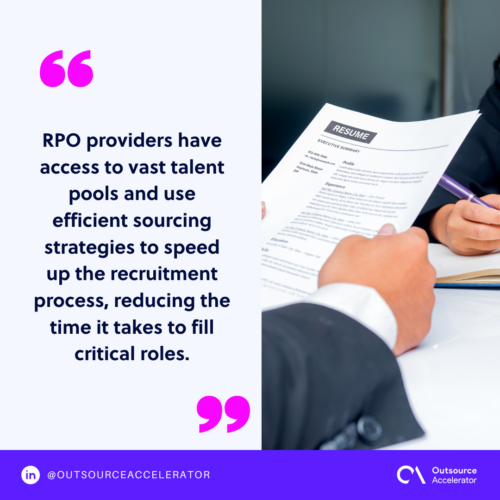
- Faster time-to-hire: providers tap large talent pools and smart sourcing, so they cut the time it takes to fill key roles.
- Improved candidate quality: thorough screening helps with finding better hires who fit the role and the culture.
- Cost efficiency: RPO streamlines hiring and cuts waste, so you save on ads, interview time, and other costs. For more, see these RPO cost savings.
- Scalability and flexibility: you can scale hiring up or down with growth. Whether you fill one role or a whole team, providers adapt fast.
- Enhanced employer branding: providers align hiring with your values, so the candidate experience improves and your brand grows stronger.
Many firms also pair RPO with offshore recruitment to reach wider talent pools at lower cost.
Clark Staff’s RPO answer
Clark Staff offers tailored RPO solutions that help firms build strong teams. In short, they optimize your hiring from end to end. With years of experience, Clark Staff keeps the process fast and efficient. As a result, firms scale their teams without losing quality.
The firm also offers flexible RPO packages for different needs. For example, you can choose full-cycle recruitment or support for one stage. So you pay only for what your business needs.
By partnering with Clark Staff for RPO services, you can focus on your core work. Meanwhile, experts handle the hiring. Contact Clark Staff today for stronger teams, better results, and long-term success!
RPO services FAQs
What is the difference between RPO and a staffing agency?
A staffing agency fills roles on a transactional basis. RPO, by contrast, works as a long-term extension of your HR team. So RPO shapes your whole hiring process, not just single placements.
How much do RPO services cost?
Cost depends on scope, hiring volume, and the model you choose. Some providers charge per hire, while others bill a monthly fee. For this reason, ask for a clear quote based on your needs.
What are the main types of RPO?
There are three common types. First, full-cycle RPO covers the entire process. Next, selective RPO handles only chosen stages. Finally, on-demand RPO adds short-term support during hiring spikes.
Is RPO only for large companies?
No. Large firms use RPO for volume hiring, yet smaller firms gain too. For example, a growing company can scale hiring fast without a big in-house team. So RPO fits many sizes.
How does RPO improve quality of hire?
Providers use data, screening, and clear role profiles. As a result, they match people to both the job and the culture. In turn, new hires tend to stay longer and perform better.






 Independent






