
Optimizing candidate journey: Attract and retain top talents


What is the candidate journey?
The candidate journey is the full set of steps a person goes through when they apply for a job, from first hearing about the role to their first day at work.
- It covers every touchpoint between a job seeker and your company.
- Each stage shapes how candidates see your brand.
- So a smooth candidate journey helps you attract and keep top talent.
When you want to attract top talent, the candidate journey matters a great deal. It shapes how people feel about your company at each step. As a result, mapping it well helps you hire better and faster.
In this article, we look at what makes a candidate journey. You will also learn how to improve it for stronger hiring results.
Defining the candidate journey
The candidate journey is also called the recruitment or hiring journey. It refers to the set of steps a person goes through when looking for work.
It covers every touchpoint a person has with your company. For example, it starts from the first awareness of the job opportunity and runs through to onboarding.
First, you need to know each stage. Then you can see how they shape a candidate’s view of your firm. By improving these steps, you create a smooth experience that guides their choice. For many teams, strong talent acquisition starts right here.
Stages of the candidate journey
The candidate journey usually breaks down into these key stages.
Awareness
First, candidates learn that a job exists. This can happen through:
- Job boards
- Advertisements
- Social media
- Company career pages
- Word-of-mouth referrals
Next, they gather details about possible employers. So they start to form first impressions.
Consideration
Here, job seekers weigh different roles. Meanwhile, they check if each company fits their own goals.
For example, they often research factors like:
- Company reputation
- Company culture and values
- Benefits
- Career growth opportunities
Application
Once candidates find a good role, they send in their application. So this stage may include an online form, a resume, a cover letter, and short tests.
Interview and selection
Those who pass the application stage get invited for interviews. These can be in person, by phone, or by video.
In addition, candidates may go through several rounds. This helps employers determine their fit for the role. Meanwhile, employers run checks, such as reference checks. A good hiring manager keeps this stage fair and clear.
Offer and acceptance
Next, employers share the outcome with each candidate. They either make a job offer or say the person was not chosen.
When there is an offer, the new hire may want to talk about salary, benefits, and other terms.
Onboarding
Once the candidate accepts, onboarding begins. This step helps the new hire settle into the company, its rules, and its culture.
So the goal is a smooth start. As a result, the new team member becomes productive faster. Strong onboarding practices make this step much easier.
Importance of a candidate-centric approach
A candidate-centric approach is key in today’s tight job market. It means you focus on the needs of job seekers at every step. Because of this, you win more trust from strong candidates.
Here are a few reasons why candidate needs should come first.
Attracting top talent
Candidates have many job options today. So a positive candidate journey is vital to attract top talent.
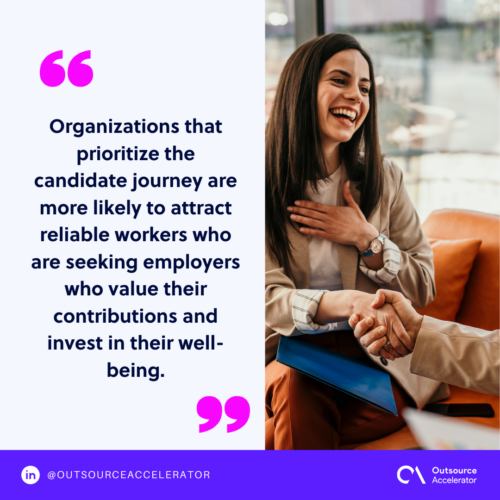
Firms that value the candidate journey tend to draw reliable workers. In addition, these workers want employers who respect their time and support their growth.
Enhancing the employer brand
A better candidate journey lifts your employer brand. As a result, job seekers form a positive view of your company.
For example, happy candidates share their stories with friends and family. This buzz then draws even more qualified people to your firm.
Reduces time-to-fill
Candidates who enjoy the process are more likely to accept offers. So this cuts the time and cost needed to fill roles.
In addition, it builds a warm pool of past applicants. Because of this, you can reach out to them again later. Many teams also pair this with recruitment outsourcing to move even faster.
Increases employee engagement
A candidate-centric process makes people feel respected and supported. As a result, they report higher satisfaction and stronger engagement. They also accept offers more often.
How to enhance the candidate journey
Want to boost your candidate journey? Try these simple strategies.
Improve employer branding
First, build a strong employer brand that shows your values, culture, and benefits. Share testimonials, wins, and clear selling points. So candidates get a positive first impression.
Streamline the application process
Next, cut any extra steps or barriers in your application. For example, you can:
- Reduce the length of application forms
- Optimize mobile compatibility
- Enable easy uploading of documents
A smooth, easy process improves the candidate journey. As a result, more people finish and submit their application.
Personalize communication
Tailor your communication to each candidate’s needs. This shows real interest in their application.
For example, send personal emails and timely updates. Also, answer any questions fast. So candidates feel valued and stay engaged.
Provide a positive interview experience
Keep the interview process clear, fair, and respectful of time. First, explain the format and share details in advance.
Next, prepare interviewers to ask useful questions. Then give feedback afterward. As a result, a professional interview leaves a strong impression, whatever the outcome.

Gather feedback
Finally, ask candidates about their experience with your process. Use short surveys or feedback forms to collect insights.
These notes show your strengths and weak spots in the candidate journey. Because of this, you can keep improving over time. You can also borrow prompts from these candidate experience survey questions.
A positive candidate journey improves hiring and strengthens your employer brand. In the end, it supports the long-term success of your company.
Frequently asked questions
What are the main stages of the candidate journey?
The main stages are awareness, consideration, application, interview and selection, offer and acceptance, and onboarding. Each stage shapes how a candidate sees your company.
How is candidate experience different from the candidate journey?
The candidate journey is the full path a person takes to get hired. Meanwhile, candidate experience is how they feel at each step along that path.
How can small teams improve the candidate journey on a budget?
Start with quick wins, such as faster replies and a shorter application form. These low-cost fixes often make the biggest difference.
How do you measure the candidate journey?
Track metrics like time-to-fill, offer acceptance rate, and drop-off at each stage. In addition, short candidate surveys add useful context.
Does a better candidate journey reduce hiring costs?
Yes. A smooth journey lifts offer acceptance and speeds up hiring. As a result, you spend less time and money per hire.






 Independent






