
Agile recruiting process explained


What is agile recruiting?
Agile recruiting is a hiring method that borrows from agile software development to fill roles faster and with less waste. It breaks the hiring process into short, focused cycles. So teams move quickly without losing quality.
- It cuts the time it takes to hire the right person.
- It gives recruiters more flexibility to adjust as they go.
- It relies on fast feedback and clear, shared goals.
The job market has grown more competitive in recent years. As a result, firms must rethink how they attract and keep new candidates. So many now turn to agile recruiting to speed things up and find the right talent fast.
The method builds on the agile development model. Software teams use this model to work in shorter time frames with faster, leaner steps. It lets them finish tasks in small chunks and in less time. So it cuts setbacks and lifts efficiency. The same idea works well for hiring.
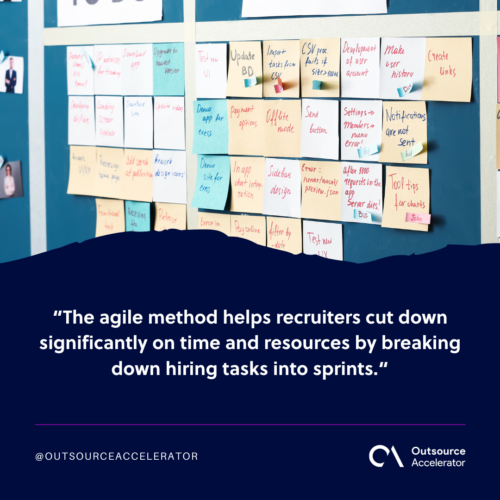
In practice, agile recruiting helps teams save time and resources by breaking hiring into sprints. A sprint is a set block of time for a set task. As a result, teams can finish complex work quickly. This approach also pairs well with wider talent acquisition plans.
Benefits of agile recruiting
Many firms have adopted agile recruiting for its clear gains. So here are the main ones.
Reduces time to hire
Every business knows how long it takes to find the right person. However, the agile method cuts the time needed to hire and finish related tasks.
From interviews to the final call, teams can decide faster. As a result, they narrow the list to the best candidates and drop the rest. This speed also helps firms that use offshore recruitment to reach a wider talent pool.
Increased flexibility
The agile method lets recruiters adjust their workflows with ease. They are not stuck to a rigid schedule that causes delays or bottlenecks.
Instead, they manage their own time and rank tasks by priority. So the process stays organized and efficient.
Real-time feedback
Traditional hiring makes you wait until the end to judge fit. However, agile recruiting lets you give and get feedback the moment a resume lands.
As a result, you save a lot of time. You skip unqualified candidates and focus on the strong ones instead.
Improved productivity
The beauty of agile recruiting is fast, efficient work that keeps quality high. Teams get quick feedback, talk more clearly, and focus on one task at a time.
In addition, all of this can run on a recruitment software or platform. There, team members can view candidate profiles and track their tasks in one place.

How to implement agile recruiting
Agile recruiting looks simple on paper. Still, it takes real planning and effort. So here are the basic steps to set it up.
Create a recruitment team
A good team is key to agile hiring. Some recruiters use the Scrum framework, which runs in sprints and suits small teams. A Scrum team usually includes:
- Scrum master
- Project owner
- Recruitment team
Make sure each member has a clear role. As a result, the whole process runs more smoothly.
Set goals and KPIs
Clear goals and KPIs guide your strategy. In addition, they help you measure success and efficiency. Some common KPIs include:
- Cost per hire
- Time to hire
- Candidates submitted to the hiring manager vs. candidates shortlisted for an interview
- Candidates interviewed vs. candidates who received an offer
Break down projects into sprints
Here, you build a structure for hiring. First, decide which tasks fit into each time frame before you move on. Ideally, the agile method runs week by week. So each goal should wrap up within its week. For example, sprint recruiting can look like this:
- Week 1: Candidate outreach and screening
- Week 2: Shortlisting candidates after feedback from the hiring manager
- Week 3: Interview stage (either by phone or video call)
- Week 4: Finalizing the job offer
Be mindful of progress
As the weeks pass, log your progress so the team sees where things stand. One easy way is to map progress on a board or layout.
For example, you can split the board into hiring stages. Then fill each stage with notes, names, or other details that show current status.
Evaluate metrics
Track your metrics through the whole process. This gives you hard data on things like successful candidates and hiring rates.
As a result, your team knows what works and what does not. So you can make data-driven choices for next time. Firms that use recruitment process outsourcing often apply the same agile metrics with an external partner.
Agile recruiting tips to remember
You can set up agile recruiting with the right mindset and habits. So here are some quick tips:
- Be remote-ready – Remote work is now common, so your agile method must work well in remote settings.
- Stay flexible – You never know when you must rethink a step, so stay open to changes.
- Communication is key – Keep open contact with your team for a smooth, clear, and hassle-free process.
These habits also help when you blend internal hiring with recruitment outsourcing or wider talent sourcing.
Perfecting the agile recruitment process
Agile recruiting makes hiring easier and faster for firms around the world. It is not a hard process. However, things can still go wrong if you do not prepare well.
With the right planning and communication, your hiring will change for the better. So start small, track your results, and refine each sprint as you go.
Frequently asked questions
How is agile recruiting different from traditional recruiting?
Traditional hiring runs in one long, linear flow. Agile recruiting breaks it into short sprints with fast feedback. As a result, teams adjust quickly and fill roles sooner.
What team roles does agile recruiting need?
Most agile teams use a Scrum setup. This includes a Scrum master, a project owner, and the recruitment team. Each role has clear duties, so the process stays focused and organized.
Does agile recruiting work for remote teams?
Yes, it works well remotely. Shared boards and recruitment software keep everyone aligned. So a remote team can run sprints just as smoothly as an office-based one.
How long is a typical recruiting sprint?
Many teams run one-week sprints, with a fresh goal each week. Still, the exact length depends on the role and the volume of candidates. In practice, shorter sprints keep momentum high.
Which metrics matter most in agile recruiting?
Time to hire and cost per hire are core metrics. Teams also track candidate flow through each stage. As a result, they can spot bottlenecks and fix them fast.






 Independent






