
Notable reshoring statistics and its impact to businesses in 2026


What do the latest reshoring statistics tell us?
Reshoring statistics show a strong, steady rise, with U.S. firms and investors announcing about 244,000 reshoring and foreign direct investment jobs in 2024 alone.
- More than 2 million such jobs have been announced since 2010.
- Most CEOs now plan, start, or complete reshoring moves.
- Rising costs, supply risks, and policy support drive the trend.
Reshoring statistics have drawn a lot of attention in recent years. As global trade shifted and supply chains wobbled, many firms rethought where they work. So they now see reshoring as a real option for their operations. The outlook looks bright too. In this article, you will learn the notable reshoring statistics and see their impact on business.
Reshoring statistics at a glance
Reshoring means bringing manufacturing and other work back to the home market. So it moves tasks away from offshore outsourcing. For a long time, offshoring helped firms add value. However, rising costs and shifting customer needs changed the picture. As a result, more firms now turn to reshoring to secure their operations. If you are new to the topic, our guide to how reshoring works covers the basics.
Mentions about reshoring in global firms rose sharply. In fact, talk among S&P 500 firms jumped 128% in one recent year. For a time, it even outpaced the buzz about AI. Governments in developed nations back this move too. For example, the CHIPS and Science Act in the U.S. aims to grow the local semiconductor industry to match China.
Why businesses reshore their functions
Firms reshore for many reasons. These range from changing customer tastes to shifts in offshore markets. It also helps to understand how offshoring and outsourcing differ before you decide.
Changing customer preferences
One key reason is changing customer taste. Today, buyers want products that are green, local, and ethical. In recent years, support for locally-made products from small brands has grown fast. So reshoring lets firms match these demands. As a result, it also lifts their brand image.
Changes in offshore destination’s landscape
Another factor is the shifting map of offshore markets. Market forces, politics, and the economy all play a part. For example, many U.S. firms reshored during the ongoing Russia-Ukraine conflicts. Some also pulled work from China as labor costs rose. So reshoring lets firms cut risk and gain more control over supply chains. If cost is your worry, weigh the pros and cons of offshore outsourcing first.
Reducing risks
Reshoring also helps firms reduce risk. Offshore work brings many challenges. For example, it adds legal and political complexity. So bringing work back in-house cuts these risks. As a result, firms gain better quality control and faster response to demand.
Contributing to economic strength
Reshoring plays a big role in a nation’s economy. By bringing back work, firms create job opportunities. In turn, they boost local production and spark innovation. As a result, the whole economy grows stronger and more competitive.
Common functions for reshoring
Reshoring covers many business functions. Still, let us focus on the three most common areas.
Manufacturing
Manufacturing is the best-known function for reshoring. More firms now see the gains of local production. For example, they get better quality control and shorter lead times. In addition, closer plants mean faster response and more custom work.
Support services
Reshoring is not just for factories. Support services also move back home. For example, customer service, IT help, and tech support all reshore. So firms gain clearer talk and better cultural fit. As a result, service quality often improves.
Supply chain management
Supply chains grow more complex each year. So many firms now reshore their supply chain management tasks. As a result, they gain better visibility and control over suppliers. In turn, this cuts lead times and keeps goods flowing.
Countries involved in reshoring
Reshoring is a global trend. In fact, several countries now bring work back home. Here are four notable examples.
USA
The United States has seen a big rise in reshoring. Rising labor costs abroad drive much of this shift. Shaky supply chains and the need to back the local economy help too. So the U.S. offers a skilled workforce and a large consumer market. As a result, it is an attractive place for reshoring.
UK
The United Kingdom shows a similar trend. Brexit changed trade ties with the European Union. So many UK firms rethought their offshore plans. For example, BT notably reshored their customer service to fix client concerns. As a result, firms aim to secure supply chains and back the local economy.
Australia
In Australia, reshoring keeps gaining pace. More manufacturers now plan to bring services home. The country sits close to the Asia-Pacific region. It also offers a skilled labor pool and modern tech. So reshoring helps Australian firms meet local demand. As a result, they rely less on overseas suppliers.
Canada
Canada is slowly embracing reshoring too. Demand is weaker there. Still, the government sees the machinery sector as a bright spot. The country offers a stable business setting and a skilled workforce. So it holds real promise for future reshoring.
Reshoring statistics that matter in 2026
Several reshoring statistics show the trend’s scale and its promise for firms. Here are the key figures.
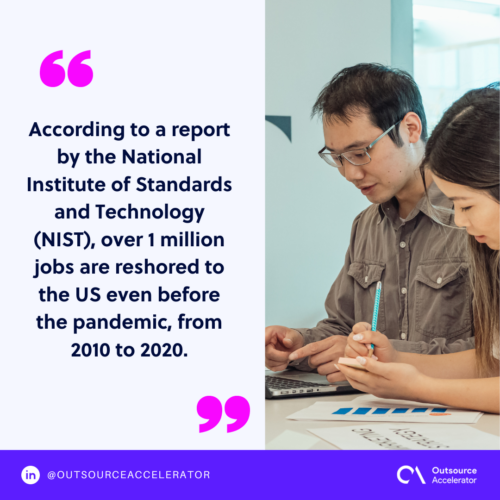
Over 1 million jobs were reshored in the US from 2010 to 2020.
A report by the National Institute of Standards and Technology (NIST) found that over 1 million jobs came back to the U.S. from 2010 to 2020. Since then, the pace has picked up. In fact, the Reshoring Initiative reports about 244,000 reshoring and foreign direct investment jobs announced in 2024. As a result, the total now tops 2 million jobs since 2010. Lean supply chains and closer customers drive much of this growth.
96% of CEOs surveyed consider reshoring their operations.
Kearney’s Reshoring Index found that 96% of CEOs now weigh reshoring. Some have started the process. Others have already finished it. This figure rose sharply from 78% a couple of years earlier. So the high interest shows growing faith in the gains of reshoring.
50% of manufacturing executives find it difficult to fill up job vacancies.
The same Kearney report shared a key challenge. Half of reshored manufacturers still struggle to fill roles, even basic ones. So this talent gap is real. As a result, firms must invest in training and smart hiring to close it.
Automation is seen as a way for businesses to facilitate reshoring.
Automation is another way to fill talent gaps. It also helps build smart factories where work returns. So firms can lift output and cut labor costs. In fact, the shift toward smart manufacturing makes reshoring far more viable. As a result, automation stays central to reshoring plans.
It “may take a long time” for manufacturers to adjust to reshoring fully.
Experts warn that reshoring is not instant. In fact, they say it may take a long time for firms to adjust. Supply risks, new plants, and staff retention all slow the shift. However, the long-term gains make the move worthwhile.
How reshoring can benefit you
Reshoring offers several clear gains. Here are the main ones. For a fuller picture, compare it with nearshoring as a middle path.
Greater control over quality
Reshoring lets you keep tighter control over quality. Close plants allow regular checks and quick feedback. As a result, you can fix issues fast.
Faster response times
Reshoring helps you react to demand faster. Local plants mean quicker production and delivery. So you meet customer needs with less delay.
Support for the local economy
Reshoring also feeds your country’s growth. It creates jobs and sparks innovation. So you help your community and strengthen the local business base. Reshoring is not without its challenges. Still, with careful planning and the right partners, firms can thrive in the reshoring era.
Frequently asked questions about reshoring statistics
What is reshoring?
Reshoring means bringing work back to the home market. So it reverses past offshoring moves. For example, a firm may return a factory or a support team.
How many jobs has reshoring created in the U.S.?
More than 2 million reshoring and FDI jobs have been announced since 2010. In 2024 alone, firms announced about 244,000 such jobs. As a result, the trend keeps building each year.
Why are companies reshoring now?
Firms reshore to cut risk and gain control. Rising costs abroad and supply shocks push the shift. In addition, buyers now favor local, ethical products.
What is the biggest challenge in reshoring?
Finding skilled workers is the top challenge. Half of reshored manufacturers struggle to fill roles. So many firms lean on training and automation to cope.
Key takeaways
- Reshoring statistics show steady, strong growth across major economies.
- More than 2 million reshoring and FDI jobs have been announced since 2010.
- Most CEOs now plan, start, or complete a reshoring move.
- Talent gaps remain, so automation and training are key.






 Independent





