
Co-employment vs. Joint employment: Differences explained


What is the difference between co-employment vs. joint employment?
In co-employment vs. joint employment, co-employment splits duties between a primary employer and a client, while joint employment gives two or more employers shared control over the same worker.
- Co-employment has one primary employer, often a staffing agency or PEO, that handles admin tasks.
- Joint employment means two or more employers share direct control and legal duties.
- The best fit depends on your goals, your structure, and the level of shared risk.
Today’s workplace keeps changing fast. New tech and new work types drive this shift. One big factor is the rise of the gig economy. Digital platforms now link workers with short-term or project-based jobs. As a result, more people value flexible employment models, such as co-employment and joint employment. This guide covers co-employment vs. joint employment. It explains what each means, how they differ, and what they mean for you.
What is co-employment?
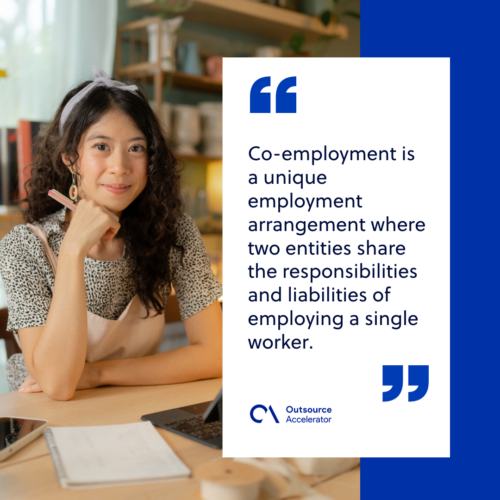
Co-employment is a setup where two entities share the duties of employing one worker. In this model, a primary employer handles some parts of the job. This is often a staffing agency or a professional employer organization (PEO). These parts include the following.
- Payroll
- Benefits administration
- HR management
Meanwhile, the second employer keeps control of daily work. This is usually the client or worksite. So each side owns a clear part of the role. For a deeper look, see our full guide to co-employment and its benefits and risks.
What is joint employment?
Joint employment is different. Here, two or more employers share control over a worker. Each employer has a direct link with that worker. Together, they set the terms and conditions of employment. Joint employment can arise in many settings, such as these.
- Franchisor-franchisee relationships
- Subcontractor arrangements
- Project collaboration
Because control is shared, the model needs close teamwork. For a related comparison, see how a subcontractor differs from an employee.
Co-employment vs. Joint employment: Key differences
We have covered each model on its own. So now let’s compare the two side by side. The table below shows the main differences.
| Co-employment vs. Joint employment | |
| Co-employment | Joint employment |
| Involves a primary employer | Involves two or more employers |
| Maintains direct control | All employers share control and authority |
| Arises from a contractual relationship | Involves immediate employment relationship |
| Involves a clear division of responsibilities | Employers may be subject to legal obligations |
Co-employment
Let’s look at how duties work in co-employment.
Involves a primary employer
In co-employment, the primary employer sits at the center. This employer runs the admin side of the job. That includes payroll processing and benefits. As a result, it acts as a bridge between the worker and the client. Many firms use a staffing agency to fill this role.
Maintains direct control
Co-employment keeps the client in charge of daily work. So the client oversees tasks, duties, and the work setting. Meanwhile, shared control lets each side add its own strengths. This creates a balanced bond. In short, the client leads where it matters most: the daily operations.
Arises from a contractual relationship
Co-employment is not a casual deal. Instead, a written contract sets it up. This contractual relationship spells out the terms and specifics. As a result, both sides start on a solid, clear footing.
Involves a clear division of responsibilities
A key perk of co-employment is a clear split of duties. The primary employer takes the admin load. Because of this, the client can focus on the daily work. So each side plays to its strengths.
Joint employment
Joint employment relies on close teamwork. Two or more employers share control over one worker. Let’s look at what defines this model.
Involves two or more employers
Joint employment brings in two or more employers. This often happens when firms work on a shared project. It also fits related industries and joint efforts. So the model calls for strong coordination.
Employers’ shared control and authority
Under joint employment, all employers share control. As a result, this guards against power imbalances. No single employer can decide alone. This helps prevent abuse and keeps things fair. So each employer’s view counts in key choices.
Involves immediate employment relationship
Joint employment also means direct ties with the worker. So the model needs a united approach to managing people. The worker may get guidance from many sources. Because of this, employers must sync up often. That way, the worker gets clear, aligned direction.
Employers may be subject to legal obligations
In joint employment, the legal side gets more complex. All employers may share certain legal obligations. This shared duty covers many areas, such as these.
- Wage and hour compliance
- Workplace safety
- Adherence to anti-discrimination laws
So if one employer fails to meet its duties, the others may share the blame.
Co-employment vs. Joint employment: Which is better?
So which model fits you best? There is no single right answer. Each model has clear perks and trade-offs. As a result, your choice should match your goals and setup. For more options, compare the top EOR and PEO providers. You can also review the difference between EOR and BPO before you decide.
Frequently asked questions
What is the main difference in co-employment vs. joint employment?
Co-employment uses one primary employer that handles admin tasks. Joint employment gives two or more employers shared control. So the key gap is how control and duties get split.
Is co-employment the same as using a PEO?
Co-employment often involves a PEO or staffing agency. The PEO manages payroll, benefits, and HR tasks. Meanwhile, the client keeps control of the daily work.
Who is liable in joint employment?
In joint employment, all employers may share legal duties. This covers wages, safety, and anti-discrimination rules. So if one employer fails, the others may share the risk.
Which model is right for my business?
It depends on your goals and how much control you want. Co-employment suits firms that want to offload admin work. Joint employment fits shared projects with close teamwork.
Key takeaways
- Co-employment splits duties between a primary employer and a client.
- Joint employment gives two or more employers shared control and shared legal duties.
- Co-employment often uses a staffing agency or PEO for admin tasks.
- Joint employment needs close coordination among all employers.
- Your best choice depends on your goals, structure, and risk comfort.






 Independent





