
Understanding AI optimization

What is AI optimization and why does it matter?
AI optimization is the use of AI tools and algorithms to make business systems and processes work better, faster, and at lower cost.
- It uses machine learning and data analysis to improve how work gets done.
- It cuts errors, raises efficiency, and supports smarter decisions.
- It works best when skilled people guide the tools, not replace them.
Today, AI is a cornerstone for businesses that want to thrive in tough markets.
But what exactly is AI optimization, and why does it matter for your success?
What is AI optimization?
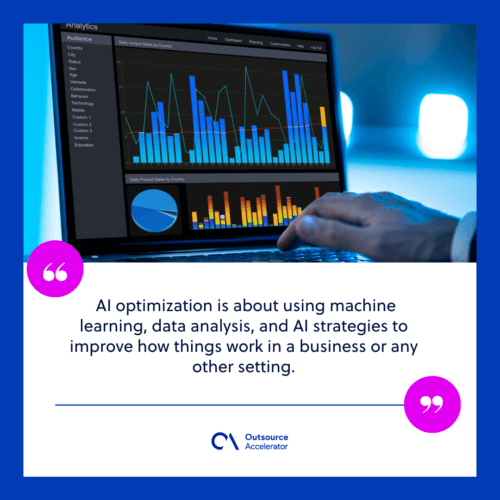
AI optimization, or artificial intelligence optimization, means using AI algorithms and tools to improve systems and processes.
In short, it uses machine learning, data analysis, and AI strategy to improve how a business runs.
So the goal is simple. It aims to make operations smoother, get better results, and help a business grow. In fact, many AI tools for business now make this easier than ever.
5 Benefits of AI optimization
AI optimization offers many benefits across industries and uses. Here are some of the key advantages.
Enhanced accuracy and precision
First, AI optimization boosts accuracy and precision across business functions.
For example, AI systems study large datasets and learn from patterns. As a result, they cut errors and deliver more reliable outcomes.
Personalization and customer satisfaction
Next, AI optimization helps businesses personalize customer experiences. It does this by learning individual preferences and behaviors.
So this tailored approach builds stronger connections. In turn, it lifts satisfaction and loyalty.
Innovation and development
AI optimization also fuels innovation. For instance, it helps businesses uncover insights, spot new opportunities, and build fresh solutions.
As a result, it acts as a catalyst. It pushes boundaries and opens up new ground.
Cost reduction
Through automation and smarter use of resources, AI optimization cuts costs. So businesses run more economically and sustainably by streamlining work and reducing waste. Many firms get there with practical automation solutions.
Improved efficiency
Finally, AI-driven optimization lifts efficiency across operations, from production to customer service. As a result, tasks that once took a lot of time and effort now get done quickly and accurately. This is clear in how AI in customer service boosts CX.
BPO AI optimization strategies
In the 471st episode of the Outsource Accelerator Podcast, Dom Procter, the CEO of Outsourced Staff, shared his company’s AI optimization strategies.
So here are some strategies BPO companies might use.
Outsourcing and automation
Dom explained how his company improves business processes with outsourcing and automation.
“Whenever I talk with a new client or an existing client, what we do is we look at [and tell them] we’ve got a cost-effective resource in the Philippines, but can we still automate that process?”
Can we use a tool that can transfer the data versus a human transferring that data? Can we use AI now?”
One key example is using AI-powered support systems like Zendesk.
“Zendesk or whatever it is that you’re using reply. It’s already drafted that response for you. The key here is that someone’s reading that before it’s going out. So that’s where we look at AI optimization,” he explained.
Because of this, a human stays in the loop. In short, the tool drafts, but a person still checks before anything goes out. This same balance drives the future of outsourcing.
Proper training and collaboration
The Outsourced Staff CEO also stressed training and collaboration between human copywriters and AI. For him, a structured approach matters most.
“For example, we’ve got another niche business called AIO writers. And what we do there is train SEO copywriters.
They’ve been writing for SEO for the last five to ten years, and then we teach them how to use AI properly. Exactly what you said [Derek], you put rubbish in, you get rubbish out,” Dom said.
He also warned about relying on untrained writers for AI content.
“If you have a structure and can feed and chain prompt AI and give it what it needs to produce good content, then you’ll get so much.
Once you’ve got those results, the human element comes in. So I have seen a lot of people taking untrained writers, throwing them at GPT, and saying, write this content.
It’s good, but I can tell GPT wrote it versus a trained copywriter.”
Dom imagines a time when AI could work on its own. Still, he warns against trusting AI alone, since different systems have quirks and styles.
So he favors mixing AI with human input. That way, the results feel more useful and more effective.
Further, Dom suggested training virtual assistants to become AI assistants.
“[Having] a virtual assistant to become an AI assistant is much more beneficial than just letting AI do everything.
Get your VA, and we’ll train them. We’ll make sure that they know how to use it. It could be GPT, it could be mid-journey, it could be Jasper, it could be relevant, it could be one of the many tools out there, but you’ve still got to know how to drive that tool properly to get good results.”
Future trends in AI optimization
The future of AI optimization holds exciting trends. In fact, these trends are set to shape many industries. Here are a few to watch.
Explainable AI
The future of AI optimization leans on explainable AI. In short, it makes AI models more open and easier to understand.
As a result, it builds trust and clarity. This is vital in sensitive fields like healthcare, finance, and AI in modern accounting.
AI for sustainability
AI optimization can also help with sustainability. For example, it uses data and algorithms to improve resource use and reduce environmental impact.
Edge AI and IoT integration
Finally, combining Edge AI and the Internet of Things (IoT) will boost real-time data processing. So decisions get faster, and user experiences improve.
Frequently asked questions
What is the difference between AI optimization and automation?
Automation runs a task without human effort. AI optimization goes further. It uses AI to improve how a whole process works, often by learning from data over time. So automation is one tool inside a broader AI optimization strategy.
Which business tasks benefit most from AI optimization?
Data-heavy and repetitive tasks benefit most. For example, customer support replies, reporting, data entry, and demand forecasting. In these areas, AI handles the volume while people review the output and make the final call.
Do I still need people if I use AI optimization?
Yes. AI works best with human oversight. As Dom Procter notes, someone should read AI drafts before they go out. So the smart move is to train staff and virtual assistants to drive the tools well.
Is AI optimization only for big companies?
No. Small and midsize firms can start with simple tools, like AI-assisted support or automated reporting. Because many tools are now affordable, even lean teams can see real gains in speed and accuracy.
How do I start with AI optimization?
First, map your slow or repetitive processes. Next, pick one area to test, such as customer replies. Then choose the right tool, train your team, and measure the results before you scale.






 Independent






