
Exploring edge computing: Comparisons, benefits, and challenges

What is edge computing, and why does it matter?
Edge computing processes data close to where it is created, instead of sending it all to a distant cloud. This cuts delay, saves bandwidth, and speeds up decisions. Here is the quick version:
- It keeps data near the source, so results come back faster.
- It sends only what is needed, which lowers bandwidth costs.
- It suits data-heavy fields like IoT, where speed is vital.
Data processing is one of the biggest challenges in tech today. Sensors, devices, and machines now create a huge amount of data. Because of this, that volume keeps growing fast. So companies need a fresh approach to handle it.
Edge computing is one answer that many firms now explore. It uses small clusters of processors near where data is captured. As a result, information does not get lost across many servers. For context, these data processing services show how much effort raw data can take.
What is edge computing?
Edge computing tackles problems like latency and limited bandwidth. It does this by rethinking how data is processed and stored. The idea is simple. You move the work closer to the data.
The “edge” is the area between the cloud and your end devices. Here, data can be processed, stored, and sent before delivery. End devices include industrial gear like sensors, cameras, and other network appliances. These tools generate the data you later analyze. Many of them run on the Internet of Things.
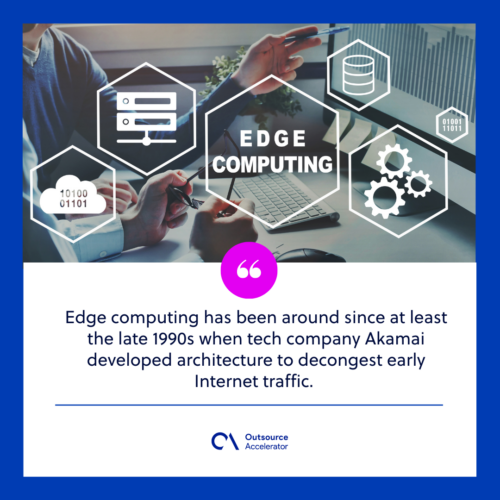
Edge computing has been around since at least the late 1990s. Back then, tech company Akamai built an architecture to ease early internet traffic. Today, edge computing is gaining ground fast. More companies see its value, especially in fields with high-volume IoT use. In fact, analysts expect the edge computing market to keep growing at over 20% a year through the mid-2030s.
How does edge computing work?
The idea behind edge computing is simple. Instead of sending all data to a central cloud, you bring the work closer to the source. As a result, this reduces two things:
- Latency (or lag): by keeping data as “on-site” as possible.
- Bandwidth costs: by only sending what is needed.
As soon as data is collected, it can be analyzed right away. So businesses make decisions faster. They gain better access to real-time data. Teams that build these systems often lean on IoT software development to connect the devices.
Cloud vs. Fog vs. Edge computing
Cloud, fog, and edge computing are three different models. Cloud computing is the most well known. Still, the other two have real strengths for certain jobs.
Cloud computing
Cloud computing gives devices shared resources on demand. It opens access to a shared pool of computing power. Best of all, it needs little management or provider help. In short, cloud computing shares resources at scale, much like a public utility.
Fog computing
Fog computing is an extension of cloud computing. It treats the cloud as a virtual layer between the internet and edge devices. As a result, it brings better performance, reliability, and cost control.
Edge computing
Edge computing is different from the other two. It processes data at the edge nodes, not in a central cloud. So the main gains are lower latency and faster decisions.
Benefits of edge computing
Here are the main advantages of using edge computing.
Data sovereignty
Data sovereignty is a sensitive topic. Governments worldwide hold firm views on where citizen data is stored and processed. For example, the EU has the General Data Protection Regulation (GDPR). It requires personal data to sit on physical servers inside its borders. This may seem like a hassle for businesses. Still, it is a plus for edge computing. Data inside borders sits closer to the processors. As a result, it localizes and speeds up business information.
Heightened security
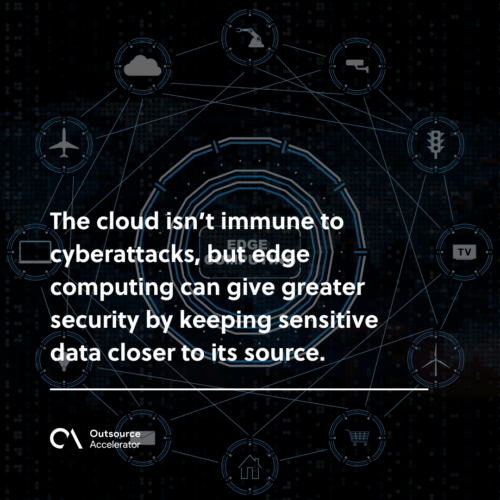
The cloud is not immune to cyberattacks. Edge computing can add security by keeping sensitive data near its source. In addition, edge devices can be encrypted for extra protection. By moving away from the cloud, you also move away from some breach risks there.
Reduced IT costs
Edge computing trims IT infrastructure. It lowers your reliance on big data centers. With fewer data centers, you spend less on power and upkeep. Lower bandwidth and storage needs cut costs too. To see the scale involved, look at these leading data center companies.
More efficient performance
Data centers often sit far from where data is made, even in the cloud. Sending data back and forth over long distances is costly. It also slows down response times. Processing data near the source gives faster access to real-time information.
Edge computing tunes performance to location and other factors. These include available bandwidth and device limits. So by running fewer and more local tasks, edge computing boosts overall efficiency.
Added functionalities
Edge computing also unlocks new features, namely:
- Artificial intelligence integration. As AI grows, companies build modules with AI functionality built in. New AI chipsets now run on edge devices. So they begin to move work off the cloud. Many of these models rely on machine learning to improve over time.
- Sensor data processing. Sensors and other data-collecting gear can sit at the edge. As a result, they gain reliability and efficiency.
Challenges of edge computing
Edge computing is still a fairly new technology. Because of this, it faces a few challenges.
Limited capability
The biggest challenge is raw power. Edge computing is less powerful than central cloud servers. Edge devices are usually smaller. So they lack the processing power or memory that some apps need. The main fix so far is to use many edge devices. Still, that can raise costs and add complexity next to a traditional server farm.
Network bandwidth
Network bandwidth is another big challenge. It adds latency and makes large distributed systems hard to manage. The limited power of edge devices makes this worse. Fiber optic cables can only carry so much data. So the more devices you connect, the slower the data moves. In the end, some data still gets sent back to the cloud.
Distributed computing
Edge devices carry limited power, memory, and battery life. As a result, they are not built for heavy tasks. Edge computing must rely on distribution to streamline the work. It sends only the relevant data for processing. Overall, edge computing is an exciting field to watch. In many cases, it offers a strong alternative to cloud computing.
Frequently asked questions
Is edge computing replacing cloud computing?
No. Edge computing works alongside the cloud, not against it. The edge handles fast, local tasks. The cloud still handles heavy processing and long-term storage. Most companies use both together.
What industries benefit most from edge computing?
Fields with lots of real-time data gain the most. These include manufacturing, healthcare, retail, and logistics. Self-driving vehicles and smart factories also depend on it, since every millisecond counts.
Does edge computing improve security?
It can. Keeping data near its source means less travel across networks. As a result, there are fewer chances for interception. Still, each edge device must be secured and encrypted, since more devices mean more entry points.
What is the main drawback of edge computing?
Limited power is the biggest one. Edge devices are small, so they struggle with heavy workloads. Running many devices can also raise costs and add complexity to your setup.
How does edge computing relate to IoT?
The two work closely together. IoT devices create huge amounts of data at the source. Edge computing processes that data nearby, so results come back fast without flooding the cloud.






 Independent






