
Surprising work-from-home statistics of 2026


What do the latest work from home statistics tell us?
The latest work from home statistics show that remote and hybrid work has settled in as a permanent feature of the global economy, with roughly a fifth of the workforce still working from home and hybrid emerging as the dominant model.
- About 22% of US workers now do their jobs from home at least part of the week, a rate that has held steady for several years.
- Among remote-capable roles, hybrid setups lead, followed by fully remote work, with a smaller share fully on-site.
- Most employees prefer flexibility, and many say they would leave a job that revoked remote options.
Remote work moved from an emergency measure to a lasting practice, and businesses have adjusted accordingly. It proved that many functions can happen outside the office without hurting work productivity or driving up costs. As a result, employee expectations shifted toward more time with family and better control over the workday.
Work from home statistics: navigating the new normal
Working from home changed how global companies view the workplace. Employers learned that they do not need a fixed office to keep teams productive. Because of this, companies grew more comfortable with remote arrangements.
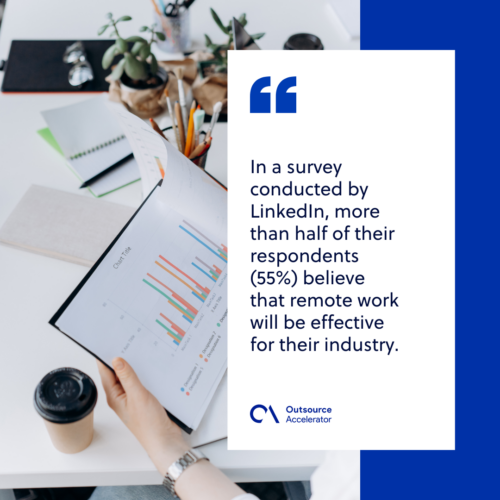
For example, in a survey conducted by LinkedIn, more than half of respondents (55%) believed remote work would be effective for their industry.
This confidence runs higher in digital fields such as software and media. However, more conservative industries such as healthcare and retail remain divided on the idea.
Employees have seen the benefits too. A survey by FlexJobs found that 58% of workers want a fully remote setup while 39% prefer a hybrid model. Many are willing to quit once employers revoke remote work.
Philippine work from home statistics and trends
As a popular destination for outsourced and freelance workers, the Philippines understood remote work well before it became mainstream elsewhere.
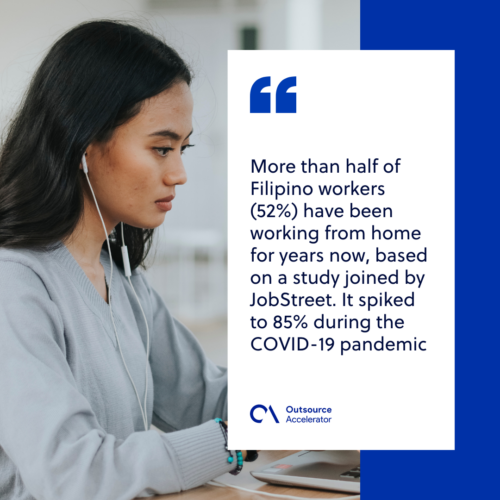
For instance, more than half of Filipino workers (52%) had been working from home for years, based on a study joined by JobStreet. That share spiked to 85% at the peak of flexible work arrangements. Even so, roughly half (49%) still prefer to stay remote.
The Philippines, along with its Southeast Asian neighbors, continues to favor remote working over the long term.
Benefits and challenges of work from home for Filipinos
Filipinos gain several advantages from working at home.
- Less travel time. Filipinos spend hours commuting to and from work. Working from home removes that burden, since a computer and internet connection are enough.
- Better productivity. Workers, especially in creative and design roles, focus more on their tasks when they save time on stressful commutes.
- Work-life balance. Most importantly, Filipinos can care for their families better because they are around more often.
However, remote work in the Philippines carries challenges felt by employees worldwide. The country still ranks among the slower internet markets, based on Ookla’s 2020 assessment. An unstable connection makes real-time collaboration difficult.
In addition, remote work can strain mental health. With work happening at home, the line between work and life often blurs, which pushes employees toward longer hours and burnout. Many remote workers also report Zoom fatigue from constant video calls.
Remote work as the new normal
Working from home can cut both ways, even for an offshoring hub like the Philippines. Studies show mixed reactions about how remote work should be done.
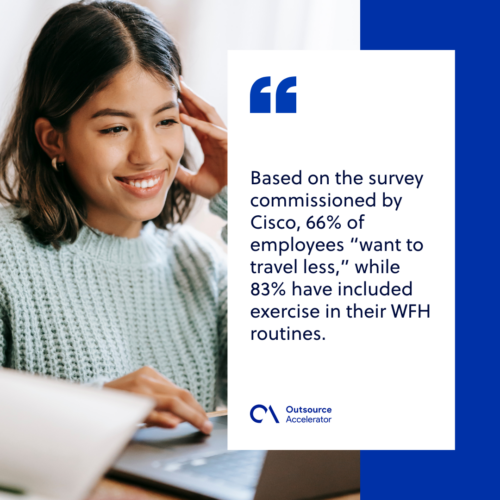
For example, in a survey commissioned by Cisco, 66% of employees wanted to travel less, while 83% added exercise to their work-from-home routines. Meanwhile, a separate survey by JLL Construction found that only 38% of its 3,300 respondents felt productive at home.
Work from home statistics in the BPO industry
As an essential industry, Philippine BPOs adopted a flexible work setup at scale, and industry leaders now plan for a more remote-friendly future.
Many outsourcing firms reported productivity gains of up to 40% while working from home. Absences fell at a similar rate because employees could care for their families better. At the same time, providers saved as much as 20% on utilities and other expenses.
These gains pushed the sector to implement a 70-30 hybrid work model as a business continuity strategy. Regulators were also urged to rethink the off-site work cap on economic-zone companies, and the rules have since eased to allow far more remote deployment.
Global work from home statistics you need to know
Companies worldwide continue to rethink how they operate, and employee expectations keep shifting toward flexibility. Owl Labs’ State of Remote Work found that one in three US employees would quit if they could no longer work remotely. As a result, businesses had to rethink their workspaces to retain talent.
In Europe, meanwhile, many companies lean toward hybrid work and policies such as core working hours and a four-day workweek. These figures show that working from home is here to stay.
Working from home and employment
Remote work became a key way for companies to reach talent in new places. In Europe, more than half (56%) of surveyed leaders realized that wider access to talent and better productivity would make them more profitable.
Hiring remote employees also means businesses no longer have to limit their search to their own city or country. Not every business fits remote work, though. Global Workplace Analytics estimated that around 56% of US companies are compatible with remote work.
Other advantages of working from home
Beyond savings and a wider talent pool, remote work brings other benefits.
Good for the environment
Per the US Environmental Protection Agency (EPA), transportation is the largest source of US greenhouse gas emissions. Working from home reduces cars on the road and, in turn, those emissions.
Better employment opportunities
Remote hiring can reduce bias against applicants. Because employers focus on skills and competency, discrimination based on gender, race, and other factors becomes less likely.
Fewer traffic jams
Traffic congestion costs the global economy hundreds of billions of dollars each year. Working from home eases those jams gradually. For example, TomTom recorded hundreds of cities reducing congestion as remote work expanded, which prevented further losses.
Remote and hybrid companies today
Global companies, especially tech firms, have committed to remote or hybrid models. The examples below show how the shift played out.
Google moved toward a flexible workweek instead of a full return to the office, and it has since rolled out measures to make flexible working great for its teams.
Dropbox
Dropbox was among the first to go virtual first, making remote work its default. The company also launched Dropbox Studios, where teams gather when they need to collaborate in person.
Spotify
Spotify introduced its “Work from Anywhere” program. Recognizing that one desk does not fit all, it lets employees work from home, in the office, or a mix of both.
HubSpot
HubSpot was remote friendly early on. To adapt further, it released a new vision for work with three options:
- Work in the office three or more days a week
- Flexible work
- Full work from home
Salesforce
Salesforce shifted to three options as well: office based, remote, and flex work. It continues to build out its Success from Anywhere program, which encourages teams to collaborate in an office when it helps.
Is working from home becoming permanent?
Working from home is here to stay. Many businesses expect WFH setups to triple compared with pre-remote levels, given that a large share of jobs can be done at home.
These work from home statistics highlight both the advantages and the challenges of the model. Remote and hybrid work succeed only when companies plan and act on them carefully.
Firms that cannot go fully remote still have another option: outsourcing functions to trusted third-party firms such as Remote Employee. Through this route, they hire remote staff co-managed by reliable providers that ensure quality service.
Frequently asked questions about work from home statistics
What percentage of people work from home?
Recent work from home statistics show that about 22% of US workers do their jobs from home at least part of the week. Among remote-capable roles, hybrid arrangements are the most common, followed by fully remote and then fully on-site.
Is remote work more or less productive?
Results are mixed. Many companies report productivity gains, and some Philippine BPOs saw improvements of up to 40%. However, surveys also find that a share of workers feel less productive at home, often because of distractions or blurred boundaries.
Do employees prefer remote or hybrid work?
Most prefer flexibility. Surveys consistently show strong demand for hybrid work, and many employees say they would leave a job that removed their remote options entirely.
What are the main challenges of working from home?
Common challenges include unstable internet, isolation, and difficulty separating work from personal life. As a result, some remote workers experience longer hours, burnout, and video-call fatigue.
How common is remote work in the Philippines?
Remote and hybrid work remain common in the Philippines, especially across the BPO and IT sectors. Many firms now offer work-from-home or hybrid setups to attract and keep staff.
Is remote work still growing?
Fully remote roles have leveled off since the pandemic peak, but hybrid work keeps expanding. So flexible work looks set to stay part of the long-term norm.
Key takeaways
- Work from home statistics confirm that remote and hybrid work is now a permanent part of the global economy.
- Roughly a fifth of US workers still work from home, with hybrid emerging as the leading model.
- Benefits include lower costs, a wider talent pool, and environmental gains, while challenges include burnout and blurred boundaries.
- Major companies such as Google, Dropbox, Spotify, HubSpot, and Salesforce have committed to flexible models.
- Firms that cannot go fully remote can outsource functions to trusted providers instead.






 Independent





