
US President Joe Biden’s policy on outsourcing

What was US President Joe Biden’s policy on outsourcing?
US President Joe Biden’s outsourcing and offshoring policies aimed to tax offshoring, reward US-based jobs, and rebuild American supply chains.
- Biden proposed an offshoring tax penalty plus a “Made in America” tax credit.
- He pushed “Buy American” rules to steer federal spending toward US goods.
- Analysts feared short-term risk for the Philippine BPO sector, but saw longer-term gains.
What were US President Joe Biden’s plans and policies on outsourcing and offshoring? And how did they affect the US economy and the business process outsourcing (BPO) sector?
Back in 2020, Americans decided: Joe Biden is the United States’ next president. Some celebrated, and others did not. Meanwhile, many looked at the global economic effects of his win.
President Joe Biden’s outsourcing and offshoring policies
During the 2020 campaign, Biden attacked then-President Donald Trump’s record on offshoring. In September that year, Biden’s campaign released his administration’s plans to fix America’s outsourcing policies.
The plan had two “bold steps,” namely:
- Set up a Biden Offshoring Tax Penalty and a Biden “Made in America” Tax Credit, and close the Trump offshoring loopholes; and
- Sign a series of executive actions so the federal government uses taxpayer dollars to Buy American and support US supply chains.
In practice, this meant:
- The Offshoring Tax Penalty set a 28% corporate tax rate plus a 10% Offshoring Penalty surtax. This surtax would apply to overseas call centers or firms whose market is in the United States.
- The Biden-Harris policy would reward those who invest in the United States.
Joe Biden versus Donald Trump on outsourcing and offshoring
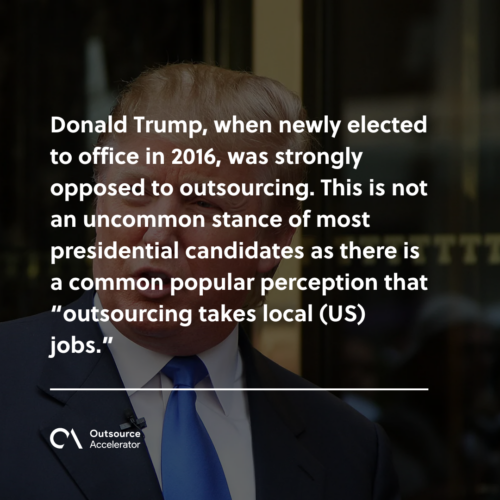
Donald Trump, newly elected in 2016, strongly opposed outsourcing. This is a common stance for candidates. After all, many voters believe that “outsourcing takes local (US) jobs.”
As a Republican, Trump vowed to “bring back jobs” and to “make America Great again.” During his four-year term, his trade approach rested on one belief. That is, he felt other countries treated the United States unfairly.
Over that time, he weakened trade alliances and raised tariffs. As a result, he set off an almost all-out trade war with China.
In short, he hurt global trade. However, he did not directly curb outsourcing as he had promised.
From the start, Trump threatened to penalize US firms that outsource. He also planned higher taxes to back this up.
Yet nothing major came of it. In fact, Biden later vowed to undo parts of Donald Trump’s 2017 tax cut legislation. He argued it reduced the push for firms to bring jobs back to the US. To see the wider pattern, look at how many US companies still outsource their operations.
In a campaign speech on 9 September 2020, Biden went on the offensive. He targeted what he saw as President Donald Trump’s broken promises on reducing US outsourcing and offshoring.
Biden said of Trump: “Offshoring, outsourcing, Buy American. These are areas where Donald Trump’s record has not been remotely matched by reality.”
After his win, Biden promised to be more conciliatory than Trump. So he aimed to unite the country and ease its cultural and political split.
He was also more seasoned in diplomacy. As a result, he was likely to repair global trade and relations rather than break them.
It seemed Biden wanted a more harmonious global economy. However, that did not make him a fan of outsourcing. Far from it.
Notably, Biden did not talk about outsourcing much in his 2020 campaign. Still, he knew the topic well.
In fact, Biden was more outspoken on outsourcing as Barack Obama’s vice president from 2008 to 2016. So it was clear he was no fan.
The United States and the Philippine offshoring industry
Many American firms outsource part of their work to business process outsourcing (BPO) companies in the Philippines.
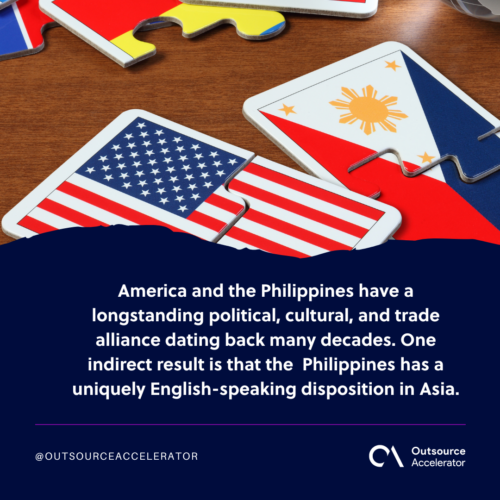
America and the Philippines share a long political, cultural, and trade tie that spans decades. As a result, the Philippines has a uniquely English-speaking character in Asia.
Despite their Southeast Asian look, most Filipinos speak American English. They do business in English too. In addition, they embrace American culture, from Netflix and YouTube to the NBA and pizza.
American firms began sending backend work to the Philippines about 30 years ago. Since then, the BPO industry has bloomed. Today it employs 1.3 million highly educated white-collar workers. These range from call center agents and bookkeepers to engineers, telehealth staff, data scientists, and developers. For more, see how the Philippine BPO industry keeps growing.
These policies were likely to hurt the Philippine outsourcing industry in the short to medium term.
At the time, American firms were working hard to cut costs and find efficiencies just to survive. So they needed all the help they could get.
If cheap offshore staffing were taken away, their path to recovery would get harder. In short, banning or over-taxing outsourcing could force firms to close. As a result, the economy would weaken further, which only adds to America’s problems.
Many hoped the Biden-Harris team saw the downsides of an “America only” trade stance. After all, the world runs better as one large market with few taxes, tariffs, and barriers. That beats many small, isolated silos. This is a key reason the Philippines remains a top outsourcing destination.
Fairer trade helps the world and its people. So we can only hope leaders see the harm of abruptly “ending” outsourcing. In the end, US companies, workers, and communities benefit greatly from it.
Joe Biden on the Philippines
Asia broadly is seen to benefit from Joe Biden’s presidency. That is because his win eased Trump’s “trade war” threats and posturing.
For the Philippines, RCBC chief economist Michael Ricafort saw a clear upside. He said the country could gain from Biden’s push for more US government spending. His preference for renewable power was also seen to help the Philippines.
In a BusinessWorld interview, economist George Manzano of the University of Asia and the Pacific agreed. He said “Mr. Biden’s multilateralist foreign policy approach could lead to increased US participation in global institutions such as the World Trade Organization.”
Most experts also believed Biden would take a softer stance on US trade tensions with China. The trade war had hurt nearby partners, including the Philippines. Under Biden, economists expected that this friction may heal soon under his policies.
President Biden on business process outsourcing (BPO)
Despite the anti-outsourcing headlines, analysts felt Biden’s other policies could help the BPO sector. In fact, business leaders were upbeat about his win. After all, he was stronger on immigration and global ties.
In the Philippines, local political and industry leaders seemed pleased with the result. Industry officials like Steven Yu, president of the Mandaue Chamber of Commerce and Industry, expect more positive development in the country’s BPO industry under Biden.
Cebu City, a fast-growing BPO, offshoring and IT hub, was hopeful too. Yu said Biden’s presidency “will benefit our [information technology-business process outsourcing] industries as the US opens its arms to the world from the closed-door policy of the Trump administration… This will be credit-positive and help boost the world markets. Since Cebu has a major IT-BPM industry, we will benefit from any friendly policy towards BPMs.”
Joe Biden on Indian call centers
Biden did not hide his disdain for outsourcing. As vice president in 2012, he mocked an Indian call center accent while talking about “hundreds of thousands” of call center jobs going overseas. The topic still shapes how US companies outsource to India today.
At 11-second mark: Joe Biden mocks Indian call center accent in 2012
His public gaffe recalled an earlier one in 2006. Then he was recorded saying: “In Delaware, the largest growth in population is Indian-Americans moving from India. You cannot go to a 7-Eleven or a Dunkin’ Donuts unless you have a slight Indian accent. I’m not joking.”
In short, he was no supporter of the loss of US jobs to India.
President Joe Biden outsourcing quotes
Here are some public quotes from President Joe Biden on outsourcing.
“Offshoring, outsourcing, Buy American. These are areas where Donald Trump’s record has not been remotely matched by the reality”. So said President Joe Biden in a presidential campaign speech on September 9, 2020.
“After years of hearing the word outsourcing, our children are going to hear a new word as much as we heard outsourcing. It’s called insourcing.”. For example, President Biden said this about the 430,000 manufacturing jobs created in the U.S. since 2010, on March 29, 2012.
“It’s one thing for the local company to outsource a call service, but for the state government to outsource a call service that’s set up to answer questions for people in the state about a problem they have with the government, to outsource that, denying folks in Massachusetts the jobs that are attendant to that?”. In addition, President Biden made this point on offshoring and outsourcing jobs on March 29, 2012.
“[Outsourcing is] not bad if you’re running a company like that. Your job is to make money for your investors. It’s a different job than the president.”. Finally, President Biden said this in a 2012 speech reported by BuzzFeed News.
Frequently asked questions
What was Joe Biden’s main outsourcing policy?
Biden proposed an offshoring tax penalty and a “Made in America” tax credit. He also pushed “Buy American” rules for federal spending.
How would Biden’s offshoring tax penalty work?
It set a 28% corporate tax rate plus a 10% surtax on offshored jobs. The surtax targeted firms serving the US market from overseas.
Did Biden’s policies hurt the Philippine BPO industry?
Analysts saw short-term risk from higher offshoring taxes. However, many expected long-term gains from softer trade tensions.
How did Biden differ from Trump on outsourcing?
Both opposed outsourcing, but their styles differed. Biden favored diplomacy and multilateral trade, while Trump leaned on tariffs.
Why do US companies outsource to the Philippines?
The Philippines offers skilled, English-speaking workers at lower cost. Strong US ties also make it a natural partner.
Key takeaways
- Biden’s plan taxed offshoring and rewarded US-based investment.
- “Buy American” rules aimed to steer federal spending toward US goods.
- The policies posed short-term risk to Philippine BPO firms.
- Softer trade tensions with China were seen as a longer-term gain.
- Biden long opposed outsourcing, dating back to his years as vice president.






 Independent





