
Telco outsourced billing and collections


Why do telcos outsource billing and collections?
Telcos outsource billing and collections to lower risk, cut costs, speed up payments, and give customers better support.
- It moves sensitive payment work to trained specialists with secure systems.
- It reduces collection time and cost while it lifts collection rates.
- It lets your in-house team focus on core telecom work.
Billing and collections may be the riskiest part of any business. It is even more critical in telecom since it handles customers’ bank details. It also covers other personal financial data.
You lower these risks a great deal when you acquire outsourced billing and collections services from a third party. As a result, telco outsourced billing and collections has become a clear trend across the industry.
Benefits of outsourced billing and collections services
Below are some of the main benefits of outsourcing this work.
Faster resolution to payment disputes
Payment disputes happen often in telecom. So the key is to resolve them fast, with both the company and its customers satisfied.
A third-party provider helps you reach that outcome. For example, you gain access to a team of customer service specialists when you outsource telecom billing and collection.
Reduced collections cost
Billing and collection cost a lot to run in-house. For one, it takes staff a lot of time to finish just one billing and payment cycle. As a result, you may pay for overtime and meal costs too. An outsourced team helps you avoid these extra expenses.

Reduced delinquency rates
Your team may struggle to lower delinquency rates. However, most outsourced billing and collections firms are skilled at this task. Delinquencies often rise from credit card use on utility bills.
The best providers use the latest billing and collection techniques and software. So they keep delinquency rates to a minimum. Strong receivables management plays a big role here.
Reduced collection time
As noted above, one collection cycle can eat up a lot of staff time. As a result, your team may neglect its main tasks over time. Debt collection also brings stress, which can be hard to handle.
An outsourced billing and collections service cuts collection time. In addition, it lets your team focus on their core strengths.
Increased collection rates
Less collection time and lower cost lead to better collection rates. Third-party providers often use a call center model. So specialists take set call volumes each day. More calls mean more chances for customers to pay on time or clear arrears.
Increased productivity and revenue
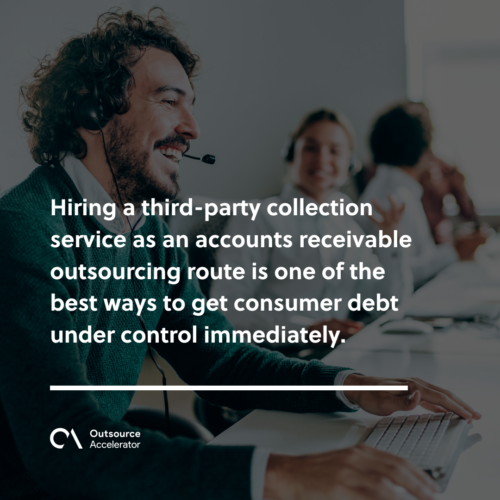
A third-party service is a smart accounts receivable outsourcing route. As a result, it is one of the best ways to get consumer debt under control fast. Your outsourced team needs no large direct expenses from you. So these savings can lift your productivity and your bottom line.
Improved customer service and reduced end-customer complaints
Outsourced call center agents are well trained in customer service. For example, they know how to handle customer complaints with care.
With a solid system in place, these agents can pull up a customer’s data on the spot. This includes personal details, payment history, and other key records. So they can answer any query fast. As a result, your telco firm sees fewer complaints and higher satisfaction.
Outsourced billing and collections process
A telecom’s outsourced billing and collection process has two parts: inbound and outbound. An outsourcing firm can support both with skilled call center specialists.
Inbound collections
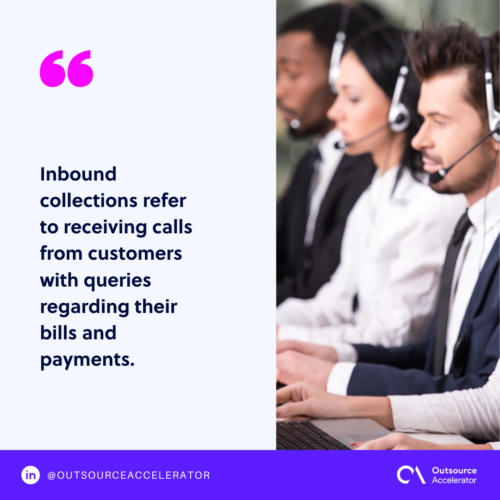
Inbound collections means taking calls from customers about their bills and payments. Most of the time, outbound agents direct customers to inbound agents. Next, inbound agents settle the customer’s financial obligations to the company.
Outbound collections
Outbound collections is the opposite of the inbound process. Here, outbound agents reach out to customers to collect payments. This is a tricky task. You want to collect without making customers feel bad.
In the end, you can spare your in-house team a lot of stress. Just choose outsourced billing and collections services. To weigh the wider case, see whether outsourcing your billing and collections is more efficient. You can also explore outsourced debt collection for tougher accounts.
Outsourced billing and collections: How to choose the right firm
Have you decided to outsource collections and billing? The next step is to find the right firm for your needs.
Hire experts in the field who are goal-oriented and self-driven. Also, choose those who can lower communication barriers. When you outsource offshore, pick a firm with a risk management system. So you can be sure your goals are met.
Good accounts receivable best practices are a strong sign of a capable partner. To find the best provider, here is a list of the top 40 call centers in the Philippines. You can also read this guide to outsourcing in telecommunications.
Frequently asked questions
What is telco outsourced billing and collections?
It is when a telecom firm hires a third party to handle its billing and debt collection. The provider manages invoices, payments, and follow-ups. As a result, the telco lowers cost and risk.
Is it safe to outsource telecom billing and collections?
Yes, with the right partner. Trusted firms use secure systems and strong risk controls. So they protect sensitive customer payment data.
How does outsourcing improve collection rates?
Providers use trained agents, call center systems, and modern software. So they reach more customers and cut delinquency. This lifts on-time payments and clears arrears faster.
What is the difference between inbound and outbound collections?
Inbound agents take calls from customers about bills. Outbound agents call customers to collect payments. Most telco programs use both for full coverage.
How do I choose a billing and collections partner?
Look for proven expertise, clear communication, and strong risk controls. In addition, check their systems and client track record before you sign.
Key takeaways
- Telco outsourced billing and collections lowers risk and cuts cost.
- Providers speed up disputes, reduce delinquency, and lift collection rates.
- The process covers both inbound and outbound collections.
- Trained agents improve customer service and reduce complaints.
- Choose a firm with expertise, secure systems, and strong risk controls.






 Independent





