
Technology trends every business should track this year

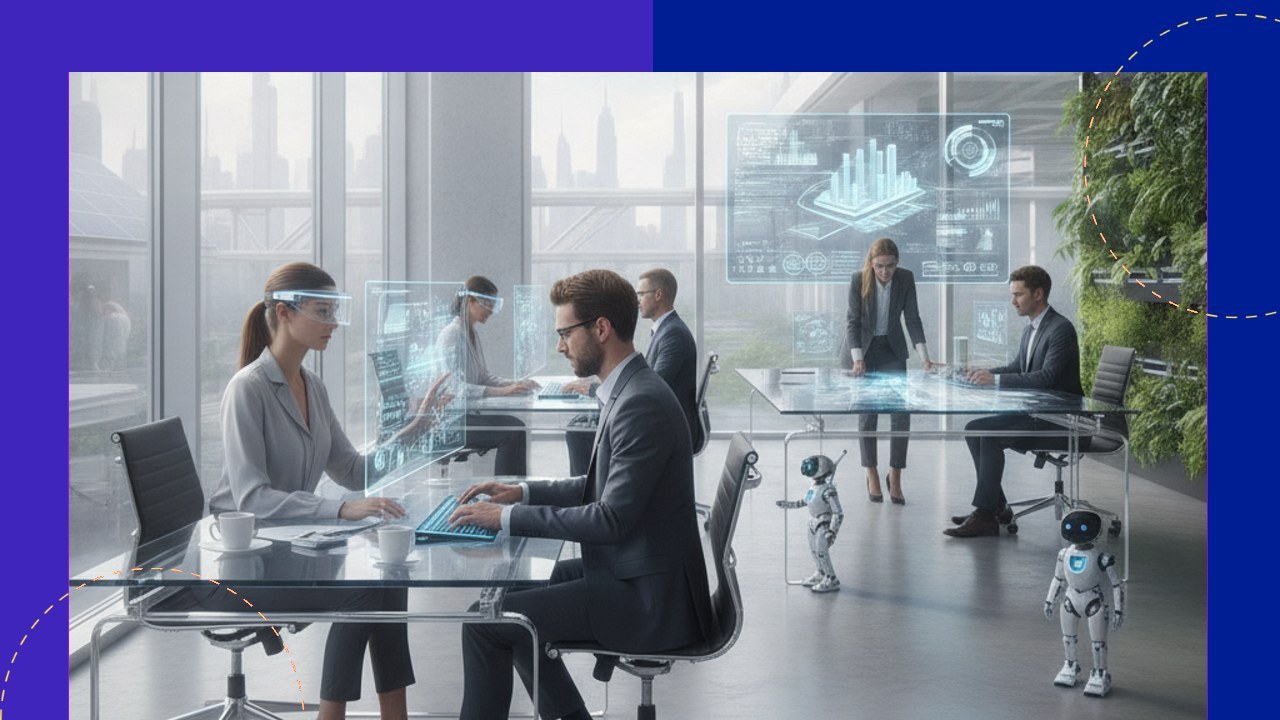
- The biggest technology trends right now cluster around AI, automation, cloud, and security — and they are changing how companies buy and deliver services.
- Worldwide IT spending is forecast to climb past $6 trillion in 2026, with AI driving most of the growth.
- Providers that build these capabilities into their offer win larger contracts; buyers that ignore them overpay for outdated work.
- Treat trends as buying signals, not headlines — match each one to a concrete operational decision.
Keeping pace with technology trends is no longer a job for the IT department alone. The tools that decide which firms grow and which stall now sit at the center of finance, customer service, marketing, and operations.
For outsourcing providers and the companies that hire them, the same shifts shape pricing, scope, and quality on every contract.
This guide breaks down the technology trends with real commercial weight in 2026, what each one means in practice, and how to act on it without chasing hype.
Why technology trends matter for outsourcing decisions
The link between technology trends and outsourcing is direct: when a capability becomes standard, buyers expect it built into the price.
A provider that automates a workflow can charge less and deliver faster than one running the same task by hand. Gartner forecasts worldwide IT spending will grow 13.5% in 2026 to reach $6.31 trillion, with AI absorbing the largest share of that increase.
That spending is a proxy for where competitive pressure is heading.
For buyers, the lesson is to ask vendors how they use these tools rather than whether they have heard of them. For providers, it is to make the investment before clients demand it.
5 technology trends shaping business in 2026
These are the trends with the clearest effect on cost, headcount, and service quality. We have ranked them by how quickly they are changing day-to-day operations.
1. Generative and agentic AI move into core workflows
AI has shifted from pilots to production, and the change is uneven but real.
McKinsey reports that organizations are moving past one-off experiments toward AI agents that handle multistep tasks with limited supervision. In outsourced work, that means drafting, data entry, and first-line support increasingly run with AI in the loop.
A support agent might draft three replies for a human to approve; a finance team might let a model code invoices and flag only the exceptions.
The practical question is governance: who checks the output, who owns the error, and how the provider proves accuracy when a client audits the work. Buyers who skip those questions inherit the risk by default.
2. Intelligent automation replaces manual back-office work
Rule-based automation has merged with AI to handle judgment-heavy tasks that scripts alone could not.
Invoice matching, claims triage, and onboarding now run on hybrid systems. This is where many providers compete on price, so buyers should expect automation savings to show up in quotes. Our breakdown of RPA trends and innovations covers how far this has progressed.
3. Cloud and edge reshape where work happens
Cloud is mature, but the frontier has moved to distributed and edge computing.
Processing data closer to where it is created cuts latency for customer-facing tools and lowers bandwidth costs. A retailer running inventory checks in-store, or a call center routing voice traffic regionally, sees the difference in response times measured in milliseconds.
For distributed teams, cloud-native platforms are what make remote delivery viable at all, since a contact center in Manila and a developer in Poland work from the same systems.
The decision is no longer whether to use the cloud but how to architect across regions and providers, and how to keep data residency rules intact when work crosses borders.
4. Cybersecurity becomes a buying requirement, not a feature
As more work moves off premises, security shifts from a checkbox to a contract term.
Buyers now routinely require certifications such as ISO 27001 and, in regulated sectors, HIPAA compliance before signing. Providers without them lose deals on procurement grounds alone.
Zero-trust architecture and continuous monitoring have become the baseline expectation rather than a premium add-on.
5. Data analytics turns operations into decisions
The volume of operational data has outpaced most companies’ ability to use it.
Analytics and business intelligence tools close that gap by turning service logs, transaction records, and customer signals into forecasts.
For outsourcing relationships, shared dashboards make performance visible and disputes rarer, because both sides read the same numbers on resolution time, error rate, and volume.
A provider that surfaces a rising backlog before the client notices keeps the account; one that reports late loses trust. The firms that win here treat reporting as a product, not an afterthought, and build the data feed into the contract from day one.
How major technology trends compare on cost and effort
The trends differ sharply in how fast they pay back and how hard they are to adopt. The table below sketches the trade-offs for a mid-sized firm.
| Trend | Adoption effort | Time to payback | Best first use case |
|---|---|---|---|
| Generative and agentic AI | Medium | Short | Drafting, support triage |
| Intelligent automation | Medium | Short to medium | Back-office processing |
| Cloud and edge | High | Medium | Distributed delivery |
| Cybersecurity | Medium | Long (risk-based) | Compliance, client trust |
| Data analytics | Medium | Medium | Performance reporting |
How to act on technology trends without overspending
Adopting a trend because it is trending is how budgets get wasted. The better approach ties each move to a measurable problem.
Start with one workflow that is slow, error-prone, or expensive, and test a single tool against it. Measure the result before scaling. Smaller firms in particular should pick their battles — our guide to small business technology trends shows where limited budgets go furthest.
And read the broader BPO trends for 2026 to see how providers are repricing services around these shifts.
Frequently asked questions about technology trends
Below are the questions buyers and providers ask most when planning around technology trends.
Which technology trends matter most for outsourcing?
AI, intelligent automation, and cybersecurity have the most direct effect, because they change what a provider can deliver and what a buyer should expect in the price.
Do small businesses need to follow technology trends?
Yes, but selectively. A small firm rarely needs every trend at once; it needs the one or two that fix its most expensive problem first.
How do I tell a real trend from hype?
Look for evidence of adoption and payback, not announcements. If buyers are writing a capability into contracts, it is real.
How often should a company review its technology stack?
A light review once or twice a year is enough for most firms, with a deeper assessment when a major contract or product launch is on the table.
Key takeaways
Technology trends are most useful when read as commercial signals rather than novelty.
– AI, automation, cloud, cybersecurity, and analytics are the trends with real budget impact in 2026.
– IT spending growth shows where competitive pressure is concentrating — follow the money, not the buzzwords.
– Buyers should make capability a contract question; providers should invest before clients demand it.
– Adopt against a measured problem, prove the payback, then scale.






 Independent





