
Ensuring revenue integrity for healthcare in 2026


What is revenue integrity in healthcare?
Revenue integrity is the accurate capture, documentation, coding, and billing of care, so a healthcare organization is paid correctly and stays compliant.
- It makes sure every billable service is recorded and billed right.
- It keeps billing in line with rules like HIPAA and CMS.
- It protects cash flow and cuts revenue leakage.
Revenue integrity matters a lot in healthcare. It shapes the financial health and staying power of care providers. Revenue from patient care is a key funding source. So it lets organizations invest in resources, improve care, and keep running.
Revenue integrity supports the wider mission of healthcare. As a result, providers can boost financial performance, cut revenue leakage, and meet the rules. In this article, we cover the meaning of healthcare revenue integrity, its key parts, common issues, and best practices. So join us as we explore the strategies to thrive today.
What is revenue integrity?
Revenue integrity means the steady and accurate capture, documentation, coding, and billing of care. It covers the steps used to make sure revenue from patient care is:
- Maximized
- Compliant with regulatory rules
- Reflective of the services given
It often runs through a full revenue integrity program. This program oversees revenue cycle work to guard the organization’s finances. As a result, it drives sound money habits and a culture of accountability.
Strong revenue integrity practices help providers stay stable and sustainable. So by making it a priority, they lift overall financial performance. Many providers also lean on healthcare BPO support to keep these tasks on track.
Key components of revenue integrity
Revenue integrity in healthcare rests on several key parts. Each one is vital for accurate, compliant billing.
Charge capture
Charge capture means recording charges for the care you give. It makes sure every billable service is found, noted, and billed right. Accurate charge capture is core to revenue integrity. Because of this, any missed or wrong charge can cause leakage and compliance issues. So providers need strong systems to capture charges well.
Documentation and coding
Accurate, full records of patient visits are essential. They back the care given and justify the charges. Clinical documentation improvement work lifts the quality of these records. As a result, records show the true scope of patient care.
Coding, meanwhile, means assigning appropriate codes to the noted services. So proper coding helps billing and reimbursement run right. It also keeps you in line with coding rules. In short, you need trained coders and ongoing education to keep this accurate. Many teams outsource medical coding services to fill skill gaps.
Compliance and regulatory requirements
Compliance with the rules is critical to revenue integrity. Providers must follow many regulations. These include the Health Insurance Portability and Accountability Act (HIPAA) and Centers for Medicare and Medicaid Services (CMS) guidelines. Non-compliance can result in fines, legal issues, and harm to your name. So it helps to build strong compliance programs, run regular audits, and track new rules.
Technology and automation
Revenue cycle management software, automation tools, and electronic health record (EHR) systems can streamline work. As a result, they cut manual errors and lift efficiency. These tools help with charge capture, coding checks, claims, and denial management. So the right technology can strengthen revenue integrity and improve results.
Revenue integrity audits and reviews
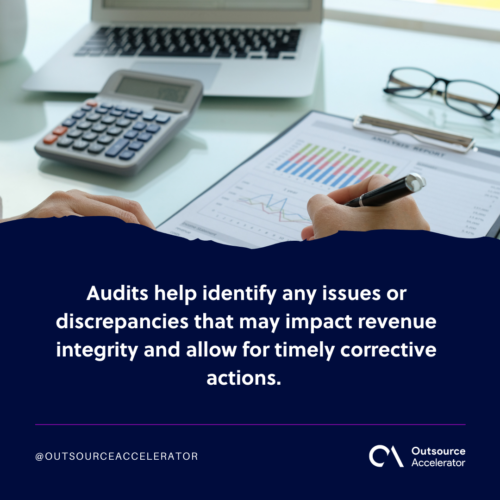
These reviews check billing and coding, records, compliance, and overall revenue cycle management. So audits help you spot issues that hurt revenue integrity. As a result, you can act in time to fix them. Both internal and external audits help providers address problems early. Revenue integrity specialists can also run periodic reviews. For deeper support, some engage revenue cycle consulting partners.
Training and education
Full training for providers, coders, and revenue cycle staff is crucial. Training should focus on:
- Accurate documentation practices
- Compliant coding
- Regulatory requirements
- Best practices in revenue cycle management
Ongoing education keeps staff current on industry shifts and new rules. As a result, well-trained people support revenue integrity better.
Data analytics and reporting
Data tools and regular reports also support revenue integrity. So data analysis helps you spot trends and areas of leakage. Key performance indicators (KPIs) show financial performance and gaps. Data-driven insights enable smart choices and proactive steps.
Common issues with revenue integrity
Revenue integrity is core to financial management in healthcare. However, providers often hit common challenges that get in the way. These include the following:
- Inaccurate charge capture: Missed or wrong charges lead to leakage and compliance risk.
- Documentation and coding errors: Undercoding or overcoding can cause revenue loss, audits, or penalties.
- Weak compliance with rules: Failing the rules can bring fines, legal issues, and harm to your name.
- Inefficient denial management: Poor handling of claim denials delays or blocks payments. So it hurts cash flow.
- Insufficient training: A lack of training leads to errors in records, coding, and billing.
- Ineffective utilization review: Weak review can cause overuse or underuse of services.
- Inconsistent revenue cycle processes: Fragmented steps cause delays and higher admin cost.
- Lack of data analytics: Too little use of data hides leakage and compliance risk.
- Weak internal controls: Loose controls invite fraud, billing errors, and leakage.
- Changes in reimbursement policies: Frequent rule changes challenge revenue integrity. So teams must adapt fast.
- Fragmented systems and interoperability gaps: Systems that do not connect cause data errors.
- Insufficient monitoring and auditing: Weak checks let errors and leakage go unseen.
- Poor clinical and financial alignment: Weak teamwork leads to coding gaps.
- Inaccurate contract management: Poor contracts cause underpayment or overpayment.
- Weak charge description master (CDM) upkeep: An outdated CDM causes coding errors and leakage.
Best practices for achieving revenue integrity
Here are proven strategies to reach revenue integrity in your practice.
Implement robust charge capture processes
Set clear steps to capture charges fully and correctly. So all billable services get recorded well. As a result, you cut the risk of revenue leakage.
Promote accurate documentation and coding
Ask specialists to give full, compliant records. So coding and billing stay accurate. In addition, offer ongoing training for providers and coders to keep them current.
Conduct regular compliance audits
Run routine audits to find compliance gaps early. Then fix any issues fast and put controls in place.
Employ technology solutions
Invest in revenue cycle software to automate and streamline work. As a result, you cut manual errors and lift efficiency. So use technology for charge capture, coding checks, and claims.
Foster collaboration between clinical and financial teams
Build clear communication between clinical and financial staff. So documentation, coding, and billing stay aligned. Regular meetings and sessions also improve teamwork toward revenue integrity.
Stay updated with regulatory changes
Keep current on reimbursement policies, coding rules, and regulations. Next, set up ways to share updates. Then provide ongoing training for your staff.
Establish strong internal controls
Put strong controls in place, such as split duties and dual checks. So you can prevent fraud and cut risk. Regularly review and improve these controls.
Utilize data analytics and reporting
Leverage data analytics tools to track KPIs and spot trends. As a result, you can address leakage and compliance risk early. So generate regular reports for review.
Enhance contract management processes
Keep contracts with payers and vendors accurate and current. So you secure fair rates and cut underpayments. Then review contracts to find room for improvement.
Invest in staff education and training
Provide full training for providers, coders, and revenue cycle staff. In addition, offer ongoing education on industry changes and best practices. Some providers also use healthcare claims outsourcing to lighten this load.
Foster a culture of accountability and transparency
Revenue integrity needs a culture of responsibility. So people own their actions, and errors get raised openly. Encourage staff to report concerns or possible compliance issues.
Engage revenue integrity specialists
Consider hiring revenue integrity specialists or consultants. So they can offer skill in revenue cycle work, compliance, and process improvement. As a result, you gain useful guidance to optimize revenue integrity.
Continuously evaluate and improve processes
Finally, review your revenue cycle often and measure performance. Then seek room to improve. So a culture of continuous quality improvement keeps revenue integrity strong.
Frequently asked questions about revenue integrity
Why is revenue integrity important in healthcare?
It protects the money that funds patient care. So it keeps providers stable and compliant. As a result, they can invest in staff, tools, and better care.
What causes revenue leakage?
Missed charges, coding errors, and weak denial management are common causes. Because of this, providers lose revenue they earned. So strong charge capture and audits help stop it.
How does technology support revenue integrity?
Software automates charge capture, coding checks, and claims. As a result, it cuts manual errors and speeds up work. So teams can focus on complex cases.
Who manages revenue integrity?
A revenue integrity program leads the work. Often, specialists, coders, and revenue cycle staff share the load. In addition, some providers bring in outside consultants.
How do audits improve revenue integrity?
Audits find billing and coding gaps early. So providers can fix them before they grow. As a result, cash flow and compliance both improve.
Key takeaways
- Revenue integrity keeps billing accurate, compliant, and fully paid.
- Charge capture, coding, compliance, and audits are its core parts.
- Missed charges and coding errors are the top causes of leakage.
- Technology and training reduce errors and protect cash flow.
- Regular audits and reviews keep revenue integrity strong over time.






 Independent





