
The back-office operations Australian retailers are moving offshore (and why it’s working)


This article was contributed by the team at Satellite Office, which builds dedicated offshore teams in the Philippines for Australian businesses.
Australian retail is under pressure from rising wages, resulting in a margin squeeze that is not going away. As retail is the country’s largest private-sector employer, worth around $444 billion and employing 1.4 million people (Australian Retail Council, citing ABS), retailers are finding it difficult to achieve a net positive when labour keeps getting more expensive.
The Fair Work Commission lifted award wages by 3.5% from 1 July 2025, and a Level 1 adult under the General Retail Industry Award now earns a minimum of $26.55 an hour.
The pressure is visible in the sector’s own numbers. In 2024-25, retail labour costs reached 15.6% of sales income, the highest share since 2006-07, whilst wages rose and operating profit fell (ABS Australian Industry).
At the same time, 78% of Australian employers report difficulty filling roles, according to ManpowerGroup. Retailers cannot simply hire their way out.
So they are doing something more surgical: moving high-volume, low-complexity back-office work offshore, and keeping their onshore teams focused on customers, merchandising and growth.
The back-office functions that drain your onshore staff
Every retail operation carries a layer of administrative work that scales with sales volume but adds little competitive differentiation, such as inventory updates, supplier emails, purchase orders, order processing, product data entry and routine reporting.
These tasks are essential, yet they are repetitive and time-consuming, and they routinely pull skilled, well-paid onshore staff away from higher-value work.
With full-time retail earnings averaging about $1,565 a week (ABS), spending that capacity on data entry is increasingly hard to justify.
Which functions are the safest to offshore
Retailers find the most success by moving rules-based, well-documented and high-volume functions offshore at the beginning of their offshoring journey, while the work that stays onshore is the opposite: judgement-heavy and relationship-driven.
| Function | Why it offshores well | Keep onshore |
|---|---|---|
| Inventory data management and reconciliation | Rules-based, high volume, repeatable | Strategic buying and ranging |
| Order processing and fulfilment admin | Standardised, documented workflows | Exception handling |
| Supplier communications and PO admin | Process-driven and routine | Key supplier negotiation |
| Product data and catalogue entry | Structured and easily scalable | Brand and merchandising decisions |
| Finance support (accounts payable and receivable) | Standardised and controlled | Controller and CFO oversight |
| Reporting and BI preparation | Template-driven | Executive analysis and strategy |
The principle is simple enough: offshore the execution and keep the decisions in-house. A retailer might have an offshore team reconcile stock data and prepare the weekly report, whilst the onshore buyer makes the ranging call.
The talent and business-hours overlap advantage
A common misconception about offshoring is losing real-time collaboration, but geography makes this manageable. Philippine Standard Time is UTC+8, two hours behind Australian Eastern Standard Time and three hours behind during daylight saving.

A standard Manila working day overlaps with most of the Australian business day, so work moves within the same shift rather than overnight.
The talent pool is also deep and capable. The Philippines ranks 28th of 116 countries on the EF English Proficiency Index, in the “High” band and second in Asia, and its IT and business process management industry generated US$38 billion in 2024 and employs 1.82 million people, according to IBPAP.
That makes it a mature services economy in its own right, well beyond the cheap-labour stereotype.
Why offshoring works for Australian retailers
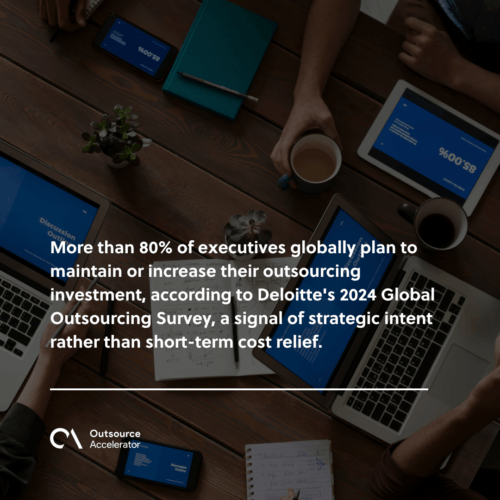
Plenty of Australian retailers have already made this shift, and the broader market backs them up. More than 80% of executives globally plan to maintain or increase their outsourcing investment, according to Deloitte’s 2024 Global Outsourcing Survey, a signal of strategic intent rather than short-term cost relief.
Where it works, the difference usually comes down to the operating model. Unlike the typical outsourcing model, which involves handing tasks to a rotating vendor, these retailers build dedicated offshore teams that learn their systems and processes and stay in place.
There are detailed guides to how Australian retailers structure an offshore operations function as a long-term capability. With that continuity in place, offshoring becomes an operational advantage rather than a short-term cost play.
A step-by-step guide on your offshoring journey
Deciding to offshore retail back-office functions is only the first step for retailers looking to improve margins. The real success comes from how the transition is done, from planning to execution.
A structured approach helps minimise disruption, maintain service quality and ensure your offshore team becomes a seamless extension of your business, not a separate support function.
1. Map and prioritise
List your back-office functions and start with two or three that are well-documented and rules-based.
2. Document the SOPs
Write down each process step by step before transfer, including exceptions and escalation paths.
3. Pilot, then expand
Move one function, validate quality and turnaround, then scale into adjacent tasks.
4. Govern it
Set KPIs, run QA, and remember that data security and privacy obligations remain yours regardless of where processing happens.
5. Integrate the team
Share tools, run standups in the overlap window and treat offshore staff as part of the operation, not a separate vendor.
Getting this right has little to do with chasing the cheapest possible labour. It comes down to rebuilding the operating model so that routine work is handled efficiently offshore and onshore teams are freed to focus on customers and growth.
In a market where wages keep climbing and talent stays scarce, that is proving to be a durable advantage.






 Independent





