


Software Developer
HR Manager
Team Leader
Accountant
Copy Writer
Customer Service
Virtual Assistance
 Join the upcoming Outsource Insights live session. OA's Zoom room is open! Come chat with our outsourcing expert now.


Japanese convenience stores, known as Konbini, have become lauded institutions for their wide range of products and services, sumptuous bento meals, and cleanliness. The konbini has become a symbol of efficiency, but behind it is a country rife with workforce woes.
Last year, a 38-year-old convenience store manager committed suicide in the Oita prefecture. The Labour Standards Inspection Office found that the man’s death was related to overwork, as a thorough investigation revealed he had worked without a day off for six months.
Konbini store managers in Japan, as well as in other countries, often work alone and have a wide range of responsibilities throughout their shifts. They man the register, mop the floors, restock coolers and shelves, and perform basic accounting tasks. It’s standard practice for these workers to punch in well over 40 work hours per week.
Japan has the oldest population in the world, with nearly a third of its citizens aged 65 and older. Workforce shortages have forced banks, supermarkets, and malls to close down in rural areas. As such, convenience stores have become the people’s one-stop shop for eating, paying bills, withdrawing cash, and even purchasing travel tickets. Worsening shortages may soon prompt some konbini to shut down, straining the daily lives of Japanese citizens.
Outsourcing and the combination of humans and technology may be the new lifeblood of convenience stores and their employees. Workers from the Philippines, equipped with virtual reality headsets and joysticks, are restocking shelves in convenience stores in Tokyo, Japan, as part of an effort to close its workforce gaps.
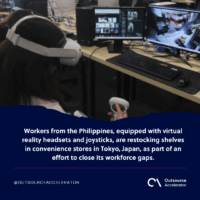
Each teleoperator manages 50 robots in a shift. Although the robots can usually refill shelves on their own, they occasionally make mistakes about 4% of the time. The bots struggle with mimicking the human grip, and that’s where the human pilot steps in.
The job is a step away from the occupations typically associated with AI and outsourcing, such as customer service. It reveals how man and machines can collaborate to address persistent challenges, enhance productivity, and improve societies.
AI, robotics, and virtual technology have supercharged the potential of offshore outsourcing. The same technology is being utilized in other industries such as manufacturing, construction, and even healthcare.
People initially feared AI for its potential to replace human jobs. However, experts claim that full automation will never be fully achieved, as some systems will still need human intervention. The future is not AI, but a robotic-AI-automation-human hybrid workforce.
This model is particularly attractive to a country like Japan, which is known for its receptiveness to new technologies but reluctance to large-scale immigration. The offshore-AI arrangement aligns with the country’s emphasis on cultural homogeneity and will help alleviate its critical labor shortages. The tandem of robots and humans will keep the lights on in these fabled convenience stores.
How can you adapt your workplace to offshore talent?
 IndependentSecureTransparent
Scale your business fast while reducing costs —
the average all-in employment costs
in the
Philippines are typically 70% less than its
Western counterparts
You can save 70% on staff costs, whilst driving quality & growth. Connect with an outsourcing expert to see how outsourcing can transform your business.







How many staff to outsource?



Outsource Accelerator is the trusted source of independent information, advisory and expert implementation of Business Process Outsourcing (BPO).
Outsource Accelerator offers the world’s leading aggregator marketplace for outsourcing. It specifically provides the conduit between world-leading outsourcing suppliers and the businesses – clients – across the globe.
The Outsource Accelerator website has over 5,000 articles, 450+ podcast episodes, and a comprehensive directory with 4,000+ BPO companies… all designed to make it easier for clients to learn about – and engage with – outsourcing.
Derek Gallimore has been in business for 20 years, outsourcing for over eight years, and has been living in Manila (the heart of global outsourcing) since 2014. Derek is the founder and CEO of Outsource Accelerator, and is regarded as a leading expert on all things outsourcing.
Outsource Accelerator in the media
See all media mentions