
10 examples of Japanese companies that outsource to the Philippines


Japanese companies that outsource to the Philippines now rank among the biggest contributors to the country’s fast-growing economy. For many years, firms worldwide have set up operations here. As a result, they come to reach Filipino talent in manufacturing, technology, creatives, telecommunications, and other sectors.
The BPO industry keeps thriving, and it should grow further. In fact, some of the country’s biggest investors are Japanese companies. They outsource parts of their daily operations to the Philippines.
In this article, we highlight ten Japanese companies that outsource to the Philippines. In addition, we explain what draws these firms to Filipino talent. So read on to find out more.
Which Japanese companies outsource to the Philippines?
Major Japanese firms include Hitachi, Marubeni, Nissan, Toyota, Fujifilm, Murata, and Bandai. They run subsidiaries, factories, or service offices in the Philippines. As a result, they tap affordable, English-speaking Filipino talent.
- They span manufacturing, automotive, electronics, IT, and trading sectors.
- Most set up local operations to serve both Philippine and global customers.
- Cost savings, English proficiency, and strong work ethic are the top draws.
What attracts Japanese companies that outsource to the Philippines?
Notably, Japanese companies that outsource to the Philippines have grown their presence year after year. Beyond Japan, the country is also a top offshoring destination worldwide. In particular, many Western firms choose it.
So what makes the Philippines an ideal outsourcing hub for foreign companies, and for Japanese companies in particular? The main reasons follow below.
Cost-saving labor fees
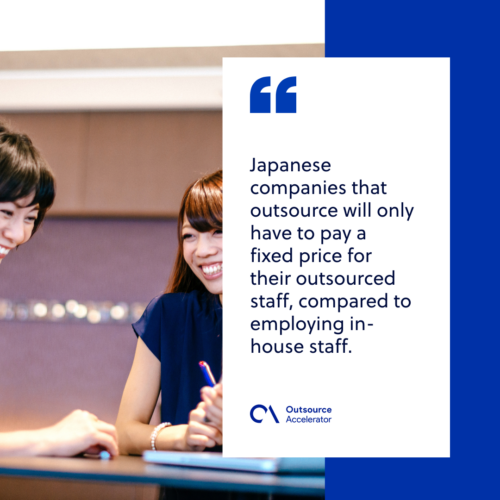
Offshore outsourcing to emerging countries like the Philippines helps foreign firms save big on labor. Japanese companies usually pay a fixed price for offshore staff. As a result, the cost is far lower than hiring in-house workers back home.
In fact, foreign companies that farm out services to the Philippines can save up to 70% on labor costs. On top of that, they avoid heavy spending on training, office space, and technology.
Flexibility
BPO companies in the Philippines serve clients worldwide. As a result, Filipino workers in this sector routinely adjust their schedules to different time zones. In most cases, BPOs, especially call centers, operate 24/7.
English language proficiency
Most Filipinos treat English as their first or second language. In addition, the Philippines ranks among the leading countries in Asia for English proficiency.
Because of this, Japanese companies that outsource to the Philippines can communicate clearly with the global market. At the same time, they reach a wider demographic through their Filipino teams.
Cultural compatibility
Like the Japanese, Filipinos are known for a strong work ethic. They work hard so they will not let down the people around them. Notably, this trait also runs through Japanese culture. Moreover, people see both nations as welcoming, respectful, and warm.
For this reason, Japanese companies rarely struggle with their offshore staff. As a result, they work well with local BPO providers.
Government support
As noted, the BPO industry sits at the forefront of the country’s economic growth. Another factor that attracts more Japanese companies is the government’s full support for the sector.
Over the years, the government has passed laws to protect Filipino BPO workers and foreign investors. For example, RA 10173, the Data Privacy Act of 2012, strictly protects people’s private information.

10 examples of Japanese companies that outsource to the Philippines
Here are ten examples of Japanese companies that outsource parts of their day-to-day operations to the Philippines.
1. Hitachi, Ltd.
Hitachi, Ltd. is the parent of the Hitachi Group and the DKB Group of companies. It is highly diversified. In fact, it runs 11 business segments, including electronic systems and equipment, social infrastructure, and digital media.
How they outsource
Hitachi Asia Ltd. opened its Philippine branch in 1993 to serve Filipino customers. In addition, the move created jobs for Filipino workers. For example, these span information and telecommunication systems, social infrastructure and industrial systems, and other segments.
2. Marubeni Corporation
Marubeni Corporation ranks among the largest sogo shosha in Japan and overseas. Beyond trading and export, it also runs businesses in construction, agribusiness, ICT, real estate, and infrastructure.
How they outsource
Marubeni Philippines Corporation (MPC) is one of the oldest, most essential members of Marubeni’s global network. It runs as a wholly owned subsidiary of Marubeni Asean Pte. Ltd. As a result, it serves both Philippine and international clients.
3. Bizwind
Bizwind was founded in 2005 and is based in Taito-Ku, Tokyo, Japan. It specializes in IT solutions. For example, these include software development, ASP services, business development, system maintenance, and IT consulting.
How they outsource
As part of its global expansion, Bizwind opened its Philippine office in 2012. Today, Bizwind Philippines employs Filipino IT professionals. As a result, they handle offshore development projects for clients around the world.
4. Nissan Motor Corporation
Nissan is a world-renowned multinational automobile maker. In fact, it was originally based in Nishi-Ku, Yokohama, Japan. In addition, the company sells vehicles under Nissan, Datsun, Infiniti, Nissan Crossing, and Heritage.
How they outsource
A 2013 joint venture formed Nissan Philippines Inc. Its partners were Nissan Motor Corporation, Universal Motor Corporation, and Yulon Philippines Investment Co. Ltd. In addition, Nissan Philippines runs dealerships and provides technicians for servicing and maintenance.
5. Toyota Motor Corporation
Toyota ranks among the biggest automobile manufacturers worldwide. In fact, this multinational company produces millions of vehicles each year under five brands: Lexus, Daihatsu, Hino, Toyota, and Ranz.
How they outsource
Toyota Motor Philippines is a subsidiary of Toyota Motor Corporation. It operates from Sta. Rosa, Laguna. The company started in 1988. Since then, it has led the assembly and distribution of Toyota vehicles in the country.
6. ASABA Manufacturing Inc.
ASABA develops and makes products for agriculture, industry, stock breeding, food, and the environment. Since its founding in 1949, it has become a world leader. In particular, it leads in advanced piping systems and mist-controlling nozzles.
How they outsource
In 1988, ASABA built its Philippine site for overseas production and growth. For example, the Calamba, Laguna site handles aluminum and zinc die-casting molding, molding maintenance, and resin injection molding.
7. Fujifilm Corporation
Fujifilm Corporation is an internationally acclaimed conglomerate. For example, it produces products across biotechnology, optics, photography, office and medical electronics, and chemicals.
How they outsource
Fujifilm set up its Philippine subsidiary in 2012 as a sales arm. It sits under Fujifilm’s Asia Pacific regional headquarters. As a result, it mainly serves the Philippine market with medical systems, industrial products, graphic systems, electronics, and photo imaging products.
8. Murata Manufacturing Co. Ltd.
Murata manufactures a wide range of electronic components worldwide. In addition, it provides applications and solution technologies for the medical, healthcare, automotive, mobile communication, and other sectors.
How they outsource
Murata operates two offices in the Philippines. It opened one as a sales office in 1998. Then, in 2012, it built the Philippine Manufacturing Co. of Murata (PMM). This plant produces multilayer ceramic capacitors. In fact, it is the company’s largest production facility in Asia.
9. BANDAI
BANDAI is a toymaker and manufacturer that also produces plastic model kits. From 1981 to 2001, the company manufactured video game consoles as well. In addition, it sells its products under many brands, including Tamagotchi, Digimon, and Gundam Luminous.
How they outsource
BANDAI founded BANDAI NAMCO Philippines Inc. in 2013 in Lipa, Batangas. Today, the factory employs over 1,500 locals for the export production of toy products.
10. Toyota Tsusho Corporation
Toyota Tsusho Corporation is one of two sogo shosha Japanese companies that outsource to the Philippines. As a member of the Toyota Group, it serves as the group’s sole general trading company.
How they outsource
Toyota Tsusho Philippines Corporation operates from Calamba, Laguna. The company built this warehouse and storage facility in 2004. Today, it employs over 250 local staff.
What’s next for Japanese companies that outsource to the Philippines?
These Japanese companies that outsource to the Philippines have also opened local branches. Even so, they represent only a few of the many Japanese firms that tap Filipino talent.
Japan has long been a top source of foreign direct investment in the country. This was clear during an online roundtable discussion with Japanese investors and then Trade and Industry Secretary Ramon M. Lopez. At that event, more than ten Japanese manufacturers shared plans to expand in the Philippines.
One thing is clear: more Japanese companies will likely invest in the Philippines in the years ahead.
Frequently asked questions
Why do Japanese companies outsource to the Philippines?
Japanese companies outsource to the Philippines mainly for lower labor costs, a large English-speaking workforce, and strong cultural compatibility. In addition, government support for the BPO sector and the country’s 24/7 service culture add to the appeal.
How much can companies save by outsourcing to the Philippines?
Foreign companies can save up to 70% on labor costs by outsourcing to the Philippines. On top of the wage gap, they also cut spending on training, office space, and technology.
What industries do Japanese companies outsource to the Philippines?
Japanese firms tap the Philippines across automotive, electronics, manufacturing, IT and software development, and general trading. For example, Toyota, Nissan, Murata, Fujifilm, and Bizwind all run local operations in these fields.
Do Japanese companies set up their own offices in the Philippines?
Yes. Many Japanese companies establish local subsidiaries, factories, or sales offices rather than relying only on third-party providers. For example, Hitachi, Marubeni, and Toyota Tsusho all have dedicated Philippine entities.
Key takeaways
- Japanese companies that outsource to the Philippines include Hitachi, Marubeni, Bizwind, Nissan, Toyota, ASABA, Fujifilm, Murata, Bandai, and Toyota Tsusho.
- Lower labor costs (up to 70% savings), English proficiency, flexible schedules, cultural fit, and government support drive this trend.
- Most Japanese firms build local subsidiaries or factories to serve both Philippine and global customers.
- Japan remains one of the top sources of foreign direct investment in the country, with more expansion expected.






 Independent





