
Outsourcing back-office operations for startups

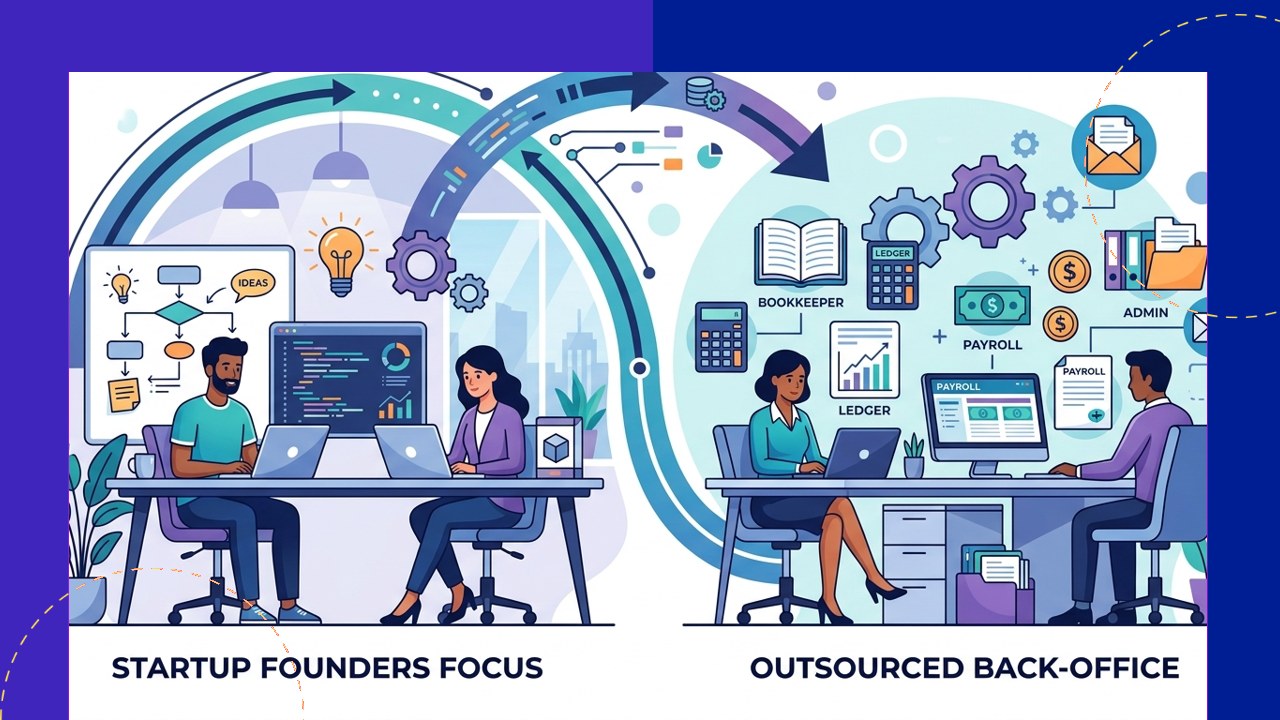
- Outsourcing back-office operations for startups keeps headcount lean and lets founders spend their time on product and growth instead of admin.
- Bookkeeping, payroll, HR administration, data entry, and IT support are the functions most startups hand off first because they are rules-based and repeatable.
- The payoff depends on choosing the right partner, protecting your data, and keeping clear ownership of compliance and quality controls.
Every startup runs on a mountain of administrative work that customers never see. Invoices, payroll runs, expense reconciliation, benefits paperwork, help-desk tickets, and data cleanup all have to happen, and none of them directly build the product. Outsourcing back-office operations for startups is the practice of handing this non-customer-facing work to an external team so the founders and early hires can stay focused on what actually moves the business.
The appeal is simple: a small company gets access to trained specialists and established processes without carrying the fixed cost of full-time staff. This article covers why startups do it, which functions to hand off first, when the timing is right, how to pick a partner, and the risks to manage.
Why startups outsource the back office
Founders have limited hours and limited cash, so every function run in-house competes with product and sales for attention. Outsourcing converts a set of fixed salaries into a variable cost that scales with the business.
Stay lean and protect focus
Early teams win by concentrating on a few things. The U.S. Small Business Administration’s guide to hiring and managing employees lists the routine work a founder otherwise absorbs, noting a business needs someone to manage “Accounts receivable, Accounts payable, Available cash, Bank reconciliation, Payroll.” Handing that block to a partner keeps the core team on the activities that drive startup growth rather than reconciliation and filing.
Access expertise you cannot afford to hire
A seed-stage company rarely needs, or can pay for, a full-time payroll manager or IT engineer. An outside team brings people who already know the rules, the software, and the common mistakes, which reduces errors in expensive areas such as tax filing and worker classification.
Turn fixed cost into variable cost
In-house staff cost the same whether volume is high or low. An external provider is usually billed by hours, seats, or transaction volume, so spending tracks the actual workload. That flexibility matters when revenue is still lumpy and headcount decisions are hard to reverse.
Which functions to outsource first
Start with work that is rules-based, repeatable, and easy to measure. These functions have clear inputs and outputs, so quality is simple to check and mistakes surface quickly.
1. Bookkeeping and accounting
Transaction entry, reconciliation, and monthly close follow standard procedures. A provider can keep the ledger current and hand your accountant clean books at tax time.
2. Payroll
Payroll is deadline-driven and rule-heavy. Setting it up correctly is non-trivial: the SBA advises founders to first “Get an Employer Identification Number (EIN)” and check state and local tax IDs before running a single cycle. A specialist absorbs that complexity.
3. HR administration
Onboarding paperwork, benefits enrollment, records, and leave tracking are process work rather than strategy. Outsourcing the admin lets a founder keep culture and hiring decisions in-house.
4. Data entry and document processing
Cleaning records, updating the CRM, and processing forms are high-volume and low-judgment, which makes them a natural first handoff.
5. IT support
Help-desk tickets, account provisioning, and device setup can run on a support desk long before a startup needs an internal IT hire.
In-house versus outsourced back office
The trade-off is control and immediacy against cost and flexibility. The table below compares the two models on the factors that matter most to an early-stage company.
| Factor | In-house team | Outsourced partner |
|---|---|---|
| Cost structure | Fixed salaries, benefits, software, and equipment | Variable by hours, seats, or transaction volume |
| Speed to start | Weeks to recruit, hire, and train | Days to onboard an existing team |
| Expertise | Limited to who you can afford to hire | Trained specialists with established processes |
| Scalability | Slow to add or cut headcount | Scales up or down with workload |
| Control | Direct, day-to-day oversight | Managed through a contract and SLAs |
When to make the move
The signal is usually time, not size. When founders spend evenings on invoices, when close takes too long, or when admin errors start slipping through, the back office is stealing hours from higher-value work.
Two moments are common triggers. The first is your first employee, when payroll and compliance suddenly get real. The second is a growth burst, when transaction volume outpaces the person handling it. For a broader view, see this explainer on how back office outsourcing works and why companies use it.
How to choose a partner
Treat the selection like a hire. The provider will touch your money, your records, and your employees, so vet them on more than price.
Match experience to your functions
Ask for references from companies of a similar stage and industry. A partner fluent in startup bookkeeping is not automatically strong at IT support.
Check security and data handling
Confirm how they store and transmit sensitive data, who has access, and what certifications they hold. Payroll and financial records are prime targets, so this is not optional.
Agree on service levels and reporting
Define turnaround times, accuracy targets, and how issues get escalated in writing. Clear SLAs turn a vague relationship into a measurable one.
Start with a pilot
Run one function for a fixed period before expanding. A small trial reveals communication gaps and quality problems while they are still cheap to fix.
Risks to manage
Outsourcing moves work, not accountability. You remain responsible for compliance, so keep ownership of the controls even when a partner does the tasks.
Worker classification is a frequent trap. The IRS guidance on classifying workers reminds businesses that “you must withhold and deposit income taxes, Social Security taxes and Medicare taxes from the wages paid to an employee,” and getting the employee-versus-contractor line wrong carries real penalties. Recordkeeping is another: the SBA’s guide to staying legally compliant notes “the IRS requires businesses to keep records of employment taxes for at least four years.” Other risks include over-dependence on a single vendor, communication lag across time zones, and quality drift if no one is reviewing output. Regular reviews and a documented exit plan keep these in check.
Frequently asked questions
Is outsourcing the back office only for big companies?
No. Startups often benefit more, because they lack the scale to justify full-time specialists. Outsourcing gives a small team access to expertise and infrastructure it could not otherwise afford.
How much can a startup save by outsourcing back-office work?
Savings vary by function, location, and volume, so treat any single figure with caution. The larger gain is often flexibility: you pay for work as you use it instead of carrying fixed salaries during slow periods.
What should a startup outsource first?
Begin with rules-based, repeatable functions such as bookkeeping, payroll, and data entry. They have clear outputs, so quality is easy to check and the handoff is low-risk.
Who is responsible for compliance after outsourcing?
Your business is. A provider performs the tasks, but legal responsibility for tax filing, worker classification, and recordkeeping stays with you, so keep oversight of those controls.
Key takeaways
- Outsourcing back-office operations lets a startup stay lean, access specialist expertise, and pay for admin work as a variable cost.
- Hand off rules-based functions first: bookkeeping, payroll, HR administration, data entry, and IT support.
- Choose a partner on experience, data security, and clear SLAs, and start with a pilot before expanding.
- You keep accountability for compliance and quality, so manage vendor dependence, communication, and oversight from day one.






 Independent





