
A practical guide to nearshore call center outsourcing

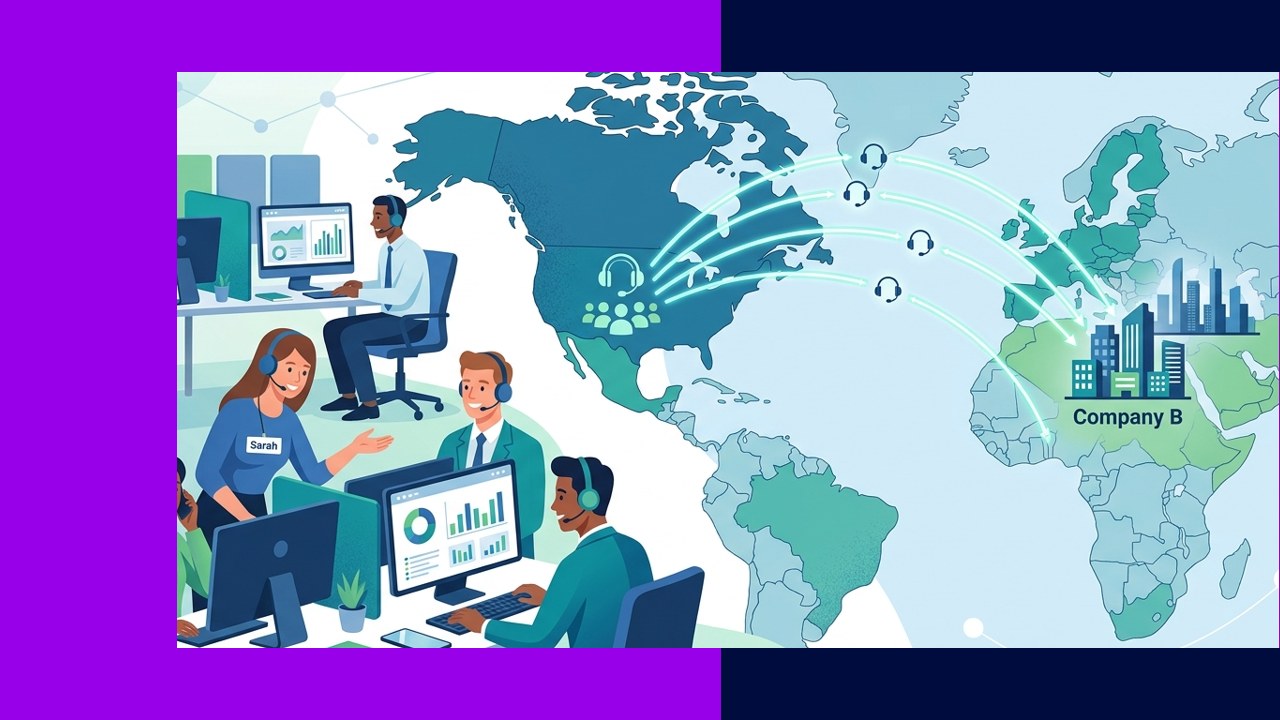
- Nearshore call center outsourcing places your support team in a nearby country with strong time-zone and cultural overlap.
- It usually costs more than distant offshore options, but it adds easier oversight, simpler travel, and real-time teamwork.
- Choose a region on language fit, time-zone match, talent depth, and total cost, not on price alone.
Nearshore call center outsourcing means running your customer support from a nearby country or region. The provider sits within a few hours of your home market. As a result, your agents share most of your working day. That overlap changes how support feels for both your team and your customers.
This guide explains what the model is and where it fits. It covers the benefits, the trade-offs against offshore, and a simple way to choose. Because the choice affects cost and service quality, it deserves a clear framework.
What nearshore call center outsourcing means
Nearshore support comes from a country close to yours in distance and time zone. A United States company, for example, might staff a team in Mexico, Colombia, or Costa Rica. A United Kingdom firm might look to Eastern Europe instead.
The idea sits between two other models. Onshore keeps the work in your own country. Offshore sends it to a distant, lower-cost region. Nearshore aims for a middle path. It trades some savings for closeness, so managers can collaborate in real time.
If you want a fuller primer on the strategy, this overview of how nearshoring differs from offshoring is a useful starting point.
The main benefits
Overlapping work hours
Time-zone overlap is the headline benefit. Your agents are online when your customers and staff are. Because of that, escalations move fast and live coaching becomes practical. Global teams struggle when hours barely overlap, a point Harvard Business Review explores in its guide to communicating with a global team.
Easier travel and oversight
A short flight makes site visits realistic. Managers can run training on the ground and return the same week. Closer distance also simplifies scheduling for reviews and calls. In short, oversight feels lighter and more frequent.
Cultural and language fit
Nearby regions often share cultural reference points with your market. Many nearshore hubs also offer strong bilingual talent. For example, Latin American agents frequently support both English and Spanish lines. That fit reduces friction on sensitive or complex calls.
Cost below onshore rates
Nearshore labor typically costs less than hiring at home. You give up some of the deepest offshore savings, but you gain overlap and control. For many teams, that balance improves the total value of each support hour.
Nearshore vs offshore vs onshore
The three models suit different priorities. The table below compares them on the factors that matter most to buyers.
| Factor | Nearshore | Offshore | Onshore |
|---|---|---|---|
| Location | Nearby country or region | Distant, lower-cost country | Your own country |
| Time-zone overlap | High | Low to partial | Full |
| Cost | Moderate | Lowest | Highest |
| Talent pool | Smaller than offshore | Very large | Limited by local wages |
| Travel and oversight | Easy | Harder | Easiest |
| Cultural and language fit | Strong | Varies | Strongest |
The trade-offs against offshore
Nearshore is not automatically the best choice. It carries real costs against the offshore model. First, wages tend to run higher than in the largest offshore hubs. If price is your only lever, offshore usually wins.
Second, the talent pool is smaller. Distant offshore markets can supply agents at massive scale. A nearshore region may run short during fast hiring, especially for niche skills or rare languages.
Third, some nearshore markets are newer to complex support. Deep, mature operations still cluster in a few large offshore centers. Because of that, you should test each provider on its own record, not on the region alone. It also helps to weigh the trade-offs between offshore and onshore models before you commit.
Popular nearshore regions in general terms
Buyers usually pick a nearshore hub that matches their home base. United States and Canadian firms often look south to Latin America. The pull is partly economic. Mexico is now the top United States trading partner, with “839.9” billion dollars in two-way trade in 2024, or 15.8% of the country’s total, according to the U.S. Census Bureau.
European companies tend to nearshore within Europe. Western European firms often staff teams in Eastern Europe. The reasons mirror the Americas: close hours, shared business norms, and lower costs than at home. In each case, proximity does the heavy lifting.
How to choose a nearshore partner
1. Map your service needs first
Start with the calls you actually handle. List your languages, peak hours, and complexity. Then match those needs to a region. The best fit depends on your customers, not on a generic ranking.
2. Check the time-zone math
Count the hours of real overlap with your team. Four or more shared hours usually support smooth collaboration. If a region only overlaps briefly, some nearshore value disappears.
3. Test language and culture
Listen to live or recorded calls before you sign. Judge accent, tone, and problem-solving on your actual issues. Strong scores here protect customer satisfaction.
4. Weigh total cost, not headline rate
Add setup, management, travel, and attrition to the quoted price. A slightly higher rate can still deliver better value. Compare providers on outcomes, such as resolution and retention.
Frequently asked questions
Is nearshore always cheaper than hiring onshore?
Usually, yes. Nearshore wages tend to sit below home-market rates. However, the gap varies by country and role, so confirm the numbers for your specific needs.
How is nearshore different from offshore?
Both move work to another country. Nearshore stays close, so hours and culture overlap more. Offshore travels farther for deeper savings and a larger talent pool.
Which functions suit a nearshore call center?
Live phone support, chat, and sales calls all fit well. These channels reward real-time overlap and cultural fit. Complex or bilingual support often performs especially well nearshore.
How many overlap hours do I need?
Aim for at least four shared working hours. That window supports live coaching and quick escalations. More overlap generally means smoother daily collaboration.
Key takeaways
- Nearshore call center outsourcing trades some offshore savings for time-zone overlap, easier oversight, and cultural fit.
- Expect higher wages and a smaller talent pool than the largest offshore hubs offer.
- Latin America suits North American firms, while Eastern Europe suits many Western European firms.
- Choose on service needs, overlap hours, language quality, and total cost, then test each provider directly.






 Independent





