
Why MSOs and medical billing companies are turning to healthcare outsourcing


This article is a submission by FGC+, a people-driven BPO company headquartered in New York, with offshore teams based in the Philippines. FGC+ helps growing businesses scale through customer support, technical support, medical billing, accounting, and data management services.
Healthcare administration has become increasingly complex. Management services organizations (MSOs) and medical billing companies are expected to support multiple healthcare providers while navigating staffing shortages, rising operational costs, evolving payer requirements, and growing administrative workloads.
These organizations play a critical role in keeping healthcare operations running efficiently. Their responsibilities can include revenue cycle management (RCM), medical billing, insurance verification, prior authorization, credentialing, patient scheduling, and other back-office functions.
As administrative demands increase, however, expanding an in-house workforce is not always the most practical or scalable solution. This is one reason healthcare administrative outsourcing is gaining attention among MSOs, medical billing companies, and other healthcare support organizations.
By outsourcing selected administrative functions, these organizations can supplement internal teams, increase operational capacity, standardize workflows, and build a more flexible support model for growth.
The growing operational pressure on MSOs and medical billing companies
MSOs and medical billing companies often serve several healthcare practices, provider groups, or facilities simultaneously. As their client base grows, so does the volume of administrative work their teams must manage.
Tasks such as eligibility and insurance verification, prior authorization, claims-related support, patient scheduling, and billing follow-up require consistent attention. Payer requirements and healthcare regulations can add another layer of complexity.
When administrative capacity does not keep pace with demand, organizations may encounter several operational challenges, including:
- Workflow bottlenecks
- Delayed billing and reimbursements
- Increased employee workloads
- Longer turnaround times for administrative requests
- Inconsistent service across healthcare practices or clients
- Greater risk of administrative errors
These challenges can have consequences beyond the back office. Administrative delays may affect revenue cycle performance, provider satisfaction, patient experience, and an organization’s ability to take on additional clients.
Traditionally, an organization might address rising workloads by hiring more employees. But healthcare support organizations are operating in a labor environment where recruiting, training, and retaining qualified administrative staff can be costly and time-consuming.
Outsourcing provides another option.
Healthcare administrative outsourcing supports scalability
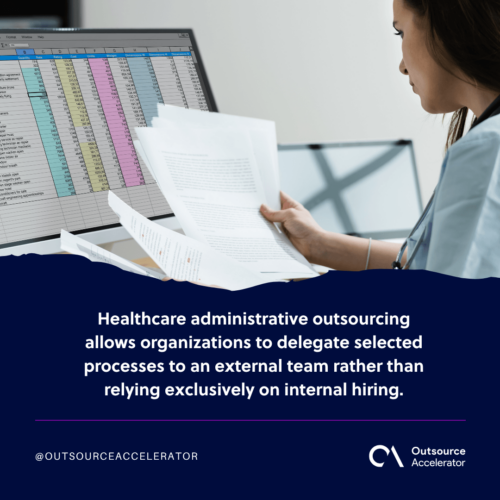
Healthcare administrative outsourcing allows organizations to delegate selected processes to an external team rather than relying exclusively on internal hiring.
Depending on the outsourcing arrangement, external teams can support functions such as:
- Medical billing and RCM
- Insurance eligibility and benefits verification
- Prior authorization
- Patient scheduling
- Claims follow-up
- Credentialing support
- Data entry and documentation
- Other healthcare back-office processes
For MSOs and billing companies experiencing rapid growth, this model can make it easier to add operational capacity without continually expanding the internal workforce.
This flexibility is particularly useful for organizations managing fluctuating workloads. Instead of building staffing levels around peak demand, outsourcing can provide additional resources as business requirements change.
As a result, internal employees can devote more attention to functions that require direct client relationships, specialized expertise, management oversight, or strategic decision-making.
Improving revenue cycle operations
Revenue cycle performance is particularly important for MSOs and medical billing companies because administrative delays can ultimately affect healthcare providers’ cash flow.
Many RCM processes involve high-volume, repetitive activities that must nevertheless be completed accurately and consistently. Eligibility verification, claim status follow-up, authorization processing, and billing support are examples.
When internal teams become overloaded, these activities may take longer to complete. A backlog in one part of the revenue cycle can also create downstream delays.
RCM outsourcing can give organizations dedicated resources for these processes, helping internal teams manage workloads and maintain established turnaround times. The objective is not necessarily to replace an organization’s existing billing or RCM team.
In many cases, outsourcing functions as an extension of that team, taking responsibility for defined processes while the internal organization maintains oversight and control.
This hybrid approach can be especially relevant for medical billing companies that need to increase capacity as they acquire new healthcare clients.
Standardizing administrative processes across multiple healthcare clients
Scalability is only one consideration. MSOs and medical billing companies must also maintain consistent service across the healthcare organizations they support.
That can become increasingly difficult as the number of clients, locations, providers, and administrative workflows grows.
An outsourcing model built around documented standard operating procedures (SOPs), defined performance expectations, and dedicated teams can help organizations establish more repeatable processes.
Potential benefits include:
- Reduced process variation. Documented workflows can help teams complete recurring administrative tasks more consistently.
- Clearer communication. Defined escalation procedures and dedicated points of contact can simplify coordination between internal and outsourced teams.
- More predictable staffing. Outsourcing can reduce dependence on continually recruiting employees to meet increases in administrative volume.
- Greater operational visibility. Defined service levels and performance metrics can make it easier to monitor administrative outcomes.
- Scalable processes. Organizations can build workflows that can be replicated as new healthcare practices or clients are added.
For MSOs in particular, process standardization can be valuable because they may need to deliver a consistent level of administrative support across several provider organizations while accommodating differences in systems and workflows.
Addressing healthcare staffing challenges
Administrative staffing remains another major consideration.
Recruiting an employee involves more than salary. Organizations must account for recruitment expenses, onboarding, training, benefits, technology, management time, workspace, and employee turnover.
When an employee leaves, the organization may also experience temporary capacity gaps while recruiting and training a replacement.
Healthcare administrative outsourcing can shift some of this staffing responsibility to the outsourcing provider.
Rather than recruiting individual employees for every increase in workload, MSOs and medical billing companies can access teams that are recruited and managed specifically to perform defined administrative functions.
This does not eliminate the need for internal expertise. Organizations still need appropriate oversight, quality controls, compliance processes, and performance management.
However, it can reduce the operational burden associated with building every administrative function entirely in-house.
Compliance and data security remain essential
Healthcare outsourcing also requires careful consideration of compliance and information security.
Administrative teams may handle protected health information (PHI), billing records, insurance information, and other sensitive data. Consequently, organizations evaluating outsourcing partners should assess more than staffing capacity and cost.
Due diligence should include areas such as:
- HIPAA compliance practices
- Data access controls
- Employee security training
- Confidentiality procedures
- Technology and network security
- Quality assurance processes
- Business continuity and disaster recovery
- Performance monitoring and reporting
Responsibilities should also be clearly defined between the healthcare organization, MSO or billing company, and outsourcing provider.
A successful outsourcing relationship depends on governance as much as staffing. Clear procedures, measurable expectations, communication protocols, and ongoing monitoring help ensure the outsourced operation remains aligned with the organization’s requirements.
Outsourcing as a long-term operating strategy
Healthcare administrative outsourcing is about more than reducing labor costs. For MSOs and medical billing companies, the larger opportunity is to create an operating model that can adapt to changing demand.
A well-designed outsourcing strategy can provide additional capacity during growth, support standardized processes across clients, reduce pressure on internal teams, and allow organizations to concentrate internal resources on higher-value activities.
It can also help organizations avoid a common growth problem: winning new business faster than their administrative infrastructure can support it.
The most effective approach is therefore selective rather than simply outsourcing as many functions as possible. Organizations should determine which processes are suitable for external support, establish measurable performance expectations, and maintain appropriate internal oversight.
The future of healthcare administrative outsourcing
Healthcare administration is only going to become more complex. MSOs and medical billing companies will continue to navigate payer requirements, workforce constraints, cost pressures, and growing expectations from the healthcare organizations they serve.
Outsourcing offers one way to respond to those pressures without relying solely on additional in-house hiring.
By using external teams for well-defined administrative and revenue cycle functions, healthcare support organizations can increase capacity, improve process consistency, and create a more scalable operational structure.
For MSOs and medical billing companies evaluating their next stage of growth, the question may no longer be simply whether to outsource. The more important question is which administrative functions can be outsourced effectively while maintaining the quality, compliance, and oversight healthcare organizations require.
Key takeaways
- Outsourcing helps MSOs and medical billing companies address staffing gaps and growing administrative workloads.
- Healthcare administrative outsourcing can improve scalability, efficiency, and operational consistency.
- Outsourced RCM support can help strengthen billing processes and reduce administrative bottlenecks.
- Compliance, data security, and quality control are essential when choosing an outsourcing partner.
- The most effective approach is selective outsourcing of well-defined functions, with internal oversight and quality control retained.






 Independent





