
Machine learning for customer service: Implementation, benefits, and challenges


What is machine learning for customer service?
Machine learning for customer service uses smart algorithms that learn from data to answer questions, route tickets, and personalize support at scale.
- It automates routine tasks, so agents can focus on harder cases.
- It studies past data to predict what each customer needs next.
- It runs day and night, so help is always on.
Customer expectations keep rising, so businesses look for smarter ways to help. Machine learning for customer service is one of those game-changers. For example, Statista revealed that 57% of companies and businesses use machine learning to improve customer satisfaction. Many firms also say the tech helps with better business decisions. So how do you put it to work?
Think of a tireless assistant that solves customer queries fast, accurately, and around the clock. That is the heart of this approach. Unlike older methods that lean on constant human effort, it helps teams in three ways. First, it automates work. Next, it spots patterns in data. Finally, it delivers support that feels personal. Because of this, many brands now pair it with AI-driven customer service tools.
How do you implement machine learning for customer service?
Implementing machine learning for customer service takes a few clear steps. Each one sets up the next. As a result, the rollout stays smooth and easy to manage.
Define objectives and use cases
First, set clear goals and use cases. Ask yourself a simple question. What specific problems do you want to fix?
For example, you may want to automate repeat tasks, boost personalization, or speed up issue resolution. Once you name your goals, you can match the tech to your business plan.
Data collection and preparation
Good data is the base of any machine learning project. So start by gathering useful information from many sources, such as:
- Customer interactions
- Feedback surveys
- Purchase history
Next, make sure the data is clean, accurate, and fair to your audience. This may need some prep work, like cleaning, normalization, and feature engineering.
Select and train models
Once your data is ready, pick and train your models. Your choice depends on the problem you want to solve. For example, you may use:
- Decision trees
- Support vector machines
- Neural networks
Then train these models with labeled data. Also, tune their settings to lift accuracy and speed.
Integration with customer service systems
Next, connect your models to the tools you already use. This step keeps daily work smooth.
So make sure your chatbot or analytics engine links well with your CRM, ticketing, and chat platforms. These connections also support broader customer service outsourcing setups. Work closely with your IT team to build strong APIs and data pipelines.
Testing and evaluation
Before you go live, test your work with care. Use machine learning models on past data or mock cases. This checks accuracy, reliability, and scale.
In addition, run A/B tests to compare the new models with old methods. Then gather feedback from a small pilot group.
Deployment and monitoring
Once you are happy with results, deploy the models into live support. Still, launch day is just the start. Ongoing checks keep results strong over time.
So set up systems to track key metrics, such as:
- Response times
- Customer satisfaction scores
- Resolution rates
Meanwhile, review feedback and usage data often. This helps you spot weak spots and make small fixes fast.
Iterate and improve
Machine learning for customer service is not a one-time job. Instead, it is a cycle of steady gains. So ask customers and agents for feedback often. As a result, you can find pain points and fresh ways to improve.
Benefits of using machine learning for customer service
This tech brings many clear gains. Below are the main benefits for support teams.
Personalized interactions
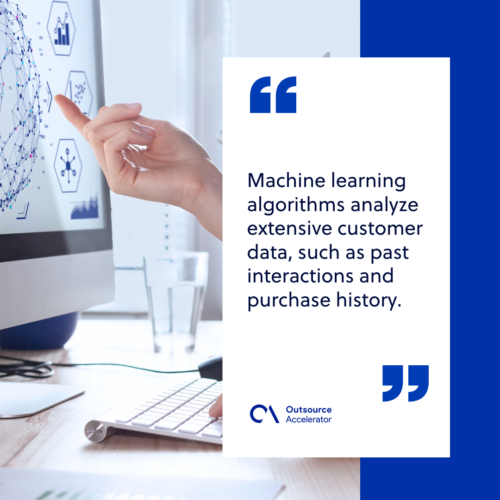
One of the biggest wins is personal service. Machine learning studies lots of customer data, such as past chats and purchase history. As a result, it shapes replies and tips for each person.
24/7 availability
These tools give your business 24/7 customer support. Human agents work set hours, but smart systems do not. So they stay ready at any time to:
- Answer questions
- Troubleshoot issues
- Suggest products
- Help customers whenever they need it
Efficient issue resolution
Machine learning is great at routine tasks and flow. For example, it can cut response times by:
- Sorting support tickets
- Routing questions to the right place
- Giving instant answers through chatbots
This speed lifts the customer experience. It also frees agents to handle complex work. Many teams pair this with outsourced call center services for extra coverage.
Predictive analytics
Another strong benefit is predictive analytics. Machine learning reads past data to guess customer needs and habits. It does this by spotting patterns and trends.
Because of this, businesses can:
- Fix issues before they grow
- Offer the right deals
- Use their resources well
Sentiment analysis
It also helps you read how customers feel. Machine learning can scan text from emails, chats, and social posts. As a result, conversational AI tools can reply with more care and context.
Cost reduction
Finally, it can cut costs by a wide margin. Machine learning automates tasks, so teams spend less on manual work.
Challenges of using machine learning for customer service
This approach brings real value, but it is not free of hurdles. So businesses must plan for a few common challenges.
Data quality and quantity
First, data quality can be a problem. Machine learning needs clean, rich data to work well. However, many firms deal with gaps, errors, or bias. As a result, weak data can drag down model accuracy.
Algorithm bias and fairness
Models learn from the data they get. So biased data can lead to unfair or wrong results. For example, bias may come from skewed samples or old patterns baked into the design.
Complexity and interpretability
Some models are hard to read. This makes it tough to explain their choices. Still, clear answers matter most in customer-facing tools.
Integration and deployment
Adding machine learning to current systems takes time. For example, you may hit data migration snags or tool conflicts. So careful planning and teamwork help a lot here.
Training and expertise
Building this capability needs special skills, such as:
- Data science
- Machine learning engineering
- Domain knowledge in customer service
However, many firms lack this talent in-house. As a result, they often look for outside help to fill the gap.
Maximizing customer satisfaction through machine learning
Machine learning for customer service is no longer optional. Instead, it is a smart move for growth.
With smart algorithms and data, businesses can work faster and serve people better. From chatbots to predictive analytics, the options keep growing. Still, success needs good planning, steady tuning, and real care for customers.
Frequently asked questions
Is machine learning the same as AI in customer service?
No, they are related but not the same. AI is the broad field of smart systems. Machine learning is one part of it that learns from data. In support, machine learning often powers the tools that make AI features work.
How long does it take to see results?
It depends on your data and goals. Simple chatbots can go live in weeks. However, deeper models like prediction engines may take a few months. Clean data speeds the whole process up.
Can small businesses afford machine learning support tools?
Yes, many tools now come as low-cost cloud services. So small teams can start small and scale later. This makes the tech open to more than just large firms.
Will machine learning replace human agents?
No, it works best beside people. It handles routine tasks, while agents solve complex cases. As a result, your team gains time for the work that needs a human touch.
How do I keep machine learning models accurate over time?
You must review and retrain them often. Customer habits shift, so old data loses value. Regular checks and fresh data keep your results sharp.






 Independent





