
Live chat agents: Definition, roles, and key skills


What are live chat agents and why do they matter?
Live chat agents are trained staff who answer customer questions in real time through online chat, adding a human touch that bots cannot match.
- They give quick, friendly help right when customers need it.
- They also up-sell, gather feedback, and build a knowledge base.
- Strong communication, empathy, and multitasking set the best ones apart.
Many firms fight for the same buyers. Still, those with the best service tend to win. Today, more of that service happens online.
So it makes sense that live chat is one of the fastest-growing support channels worldwide. In fact, the growth of live chat support may soon pass phone and email as more industries go digital.
To keep up, your company needs strong live chat agents. They must have the right skills and mindset for the job.
The right hires make a big difference. As a result, your business can offer fast, easy, and friendly chats that today’s clients want.
What is a live chat agent?
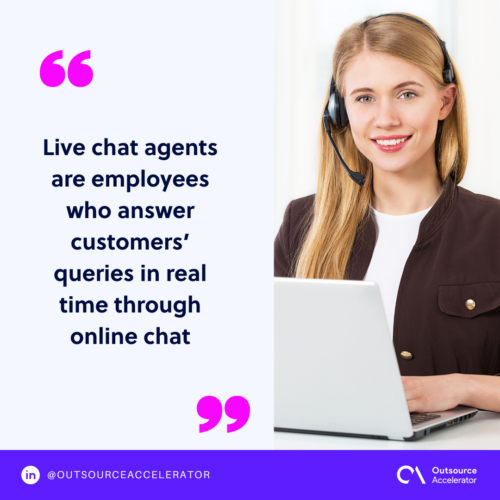
Live chat agents are staff who answer customer questions in real time through online chat.
Even the best chat software has limits. For example, some cases still need a human to step in. To see the wider toolset, browse these chat tools for customer support.
This is where live chat agents come in. In short, they handle what bots cannot.
These workers need clear communication skills. They must also type fast, juggle tasks, and know your tech and industry.
The role of live chat agents in your business
A live chat agent talks with clients and answers their questions. Still, their role runs deeper than that.
To see why live chat agents matter, let us look at more of their duties.
Carrying meaningful conversations
A bot and a human chat differ in one key way: the human touch. So live chat agents must set the right mood for each talk.
They should not give short, flat replies. Instead, they build a real, warm exchange. Good chat etiquette guides how they do this.
Up-selling and cross-selling
Online chats can also work as a sales channel. So a good agent should spot each cross- and up-selling chance.
A live chat agent should add the right products at the right time. To do this well, they use customer data points.
For example, a happy customer just got a clear answer. As a result, they feel good about your brand.
A live chat agent should use that moment with care. So they mention related goods as part of the flow, never in a pushy way.
Using knowledge of customer pain points
A sharp agent learns the common triggers behind client issues. In fact, they spot them from past chats.
They should also suggest the best fix each time. So the customer gets a clear path forward.
A live chat agent must draw on past cases, find the root cause, and give useful help. As a result, they solve issues without going back and forth.
Developing a knowledge base
An agent who talks with many clients learns the big issues fast. So they see the same questions come up again and again.
Live chat agents can then turn this into customer FAQs. Next, they add those to a knowledge base. This also helps agents handle customer complaints with a proven, steady approach.
Coordinating improvements
Live chat agents also learn how clients view your products. As a result, they hold useful insight for the whole firm.
A smart business uses this to run better. So it feeds those lessons back into its work.
For example, agents can share feedback with tech, product, marketing, and sales teams.
These are the duties that seasoned live chat agents from SixEleven, a premier BPO provider, are well known for delivering.

4 Skills your live chat agents should have
Each duty above needs matching skills. So your live chat agents should build the ones below.
Make sure your training plan covers these four.
Excellent online communication skills
As with any support role, strong communication comes first. So it is the top skill for live chat agents.
To run online chat well, an agent must write clearly. In addition, they need fast, accurate typing. This lets them reply quickly while staying thorough.
Empathy and personalization
Empathy is a big part of good communication. In short, it helps agents read each customer and solve issues well.
Say customer X is having a bad day. Then agents should stay kind and fix things fast. Meanwhile, a joke with customer Y should not carry over to customer Z.
Another key skill is personalization. Every customer is unique, and they like to feel seen.
So train agents to use each customer’s name and title. They should also use profiles and past records at hand.
Empathy and personalization pay off. As a result, customers walk away happy and feel valued.
These traits are hard for bots to copy, too. So they rank among the most valuable skills a human agent can have.
Responsiveness
The goal of live chat is quick, real-time help. So agents must stay sharp and focused.
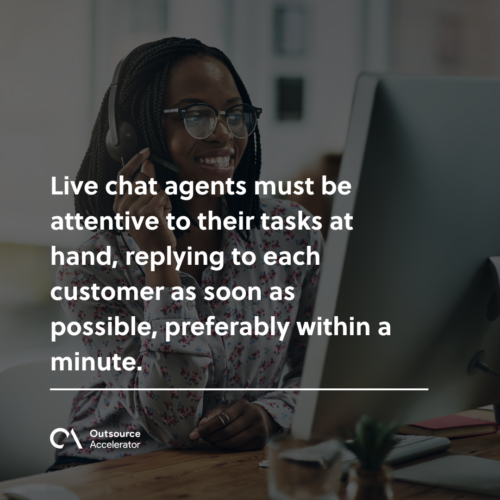
They should reply to each customer fast, ideally within a minute. In short, speed builds trust.
Multitasking
Each agent will handle several chats at once. So they must multitask with ease. This means they can sort, prioritize, and recall fast.
Train your live chat agents to rank tasks well. For example, if an angry customer appears, they should fix that issue first. As a result, the case does not get worse.
With strong multitasking, agents keep balance. So they help one client while still guiding others.
Agents also need to recall each chat’s details as they switch. Because of this, they can adapt fast as a talk moves along.
Without this skill, agents reread the same chat again and again. As a result, they waste valuable time.
Your training should also cover asking customers for feedback.
So make a short survey that customers can fill in after each chat. As a result, you spot what to keep and what to improve.
Outsourcing live chat support
Want to boost service without hiring in-house? Then outsourcing live chat is a smart, low-cost option.
Outsource live chat to trusted BPO providers like Cloudstaff, and you gain 24/7 access to skilled agents. As a result, they answer support tickets fast and with a personal touch.
You also save time and money this way. In short, you skip the work of hiring, onboarding, and managing an in-house team.
Outsourcing offers easy scaling, too. So you can shift staffing fast when demand goes up or down. Many teams also compare it with chatbot best practices to find the right blend of bots and human agents.
Frequently asked questions about live chat agents
What do live chat agents do?
Live chat agents answer customer questions in real time online. They also up-sell, gather feedback, and build FAQs. As a result, they keep service fast and helpful.
What skills do live chat agents need?
The top skills are clear writing and fast typing. In addition, they need empathy, speed, and strong multitasking.
Are live chat agents better than chatbots?
Both have a place. Bots handle simple, repeat questions well. Still, humans bring empathy and judgment that bots cannot match.
Can you outsource live chat support?
Yes, many firms outsource it to trusted BPO providers. As a result, they get 24/7 coverage at a lower cost. You also save on hiring and training.
How fast should a live chat agent reply?
Speed is key in live chat. So agents should reply within about a minute. Quick answers build trust and keep customers happy.
Key takeaways
- Live chat agents answer customer questions in real time online.
- They also up-sell, gather feedback, and build a knowledge base.
- Top skills include clear writing, empathy, speed, and multitasking.
- Human agents bring warmth and judgment that bots cannot copy.
- Outsourcing live chat gives 24/7 coverage at a lower cost.






 Independent





