
The hidden cost of cheap offshore BPO: What happens after you sign the contract


This article is a submission by Afrishore BPO, a South African-based BPO company delivering high-quality, cost-effective outsourcing solutions to clients across the U.S., U.K., and beyond. Afrishore BPO specialize in customer service, sales support, debt collection, and back-office functions.
When a UK insurance company signed an offshore BPO contract at 70% below their onshore rates, the finance team celebrated. Month one looked promising-all the metrics were green, calls were being answered, and the spreadsheets showed significant savings.
But by month four, something had shifted. First-contact resolution had dropped 18%, escalations were up 30%, and the internal team was spending two additional hours every day on quality checks nobody had budgeted for.
The rate card promised savings. The P&L told a different story.
The hidden cost of cheap offshore BPO isn’t what you see on the initial rate card-it’s the operational drag that compounds silently after you sign:
- Repeat contacts eating into your support budget
- Supervisor burnout accelerating attrition
- Compliance exposure in regulated industries
- Rework absorbed by your own internal team,
- And ultimately, customer churn that costs 5 to 25 times more than acquisition
These offshore BPO hidden costs surface weeks or months into the contract, long after the decision-makers have moved on to other priorities.
If you’re evaluating BPO providers right now, here’s a framework for looking beyond the per-seat price and understanding what you’re actually buying.
Where do cheap BPO costs actually hide?
The real expense of bottom-tier BPO contracts doesn’t appear in vendor proposals. It shows up in five specific places that quietly drain resources, morale, and customer trust.
1. Rework and Repeat contacts
Low first-contact resolution (FCR) means the same customer calls back two, three, sometimes four times for the same issue. According to SQM Group’s research, the industry benchmark for FCR sits between 70-79%.
When you drop below that threshold, you’re not just providing poor service-you’re multiplying your cost per resolution.
Here’s the math: each repeat contact costs 3-5x the original interaction when you factor in supervisor time, QA review cycles, customer patience erosion, and the productivity lost switching between cases.
A $5 interaction that requires three callbacks suddenly costs $15-25, and that’s before you account for the brand damage.
As Brad Cleveland, a leading authority on contact center design, points out: weak operating design turns normal support demand into escalations and rework.
The cheapest BPO provider might staff agents at rock-bottom rates, but if those agents lack proper training, process documentation, or system access, every “resolved” ticket becomes a time bomb.
2. Supervisor burnout and attrition
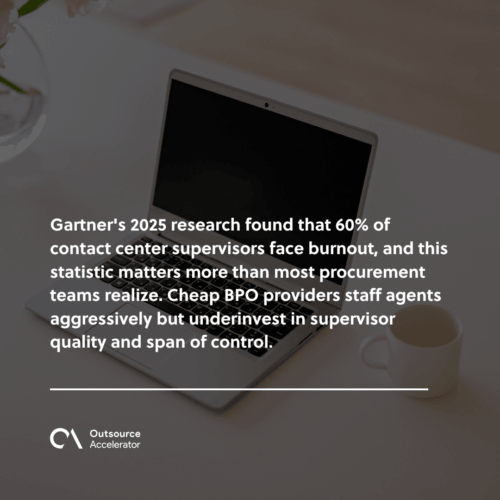
Gartner’s 2025 research found that 60% of contact center supervisors face burnout, and this statistic matters more than most procurement teams realize. Cheap BPO providers staff agents aggressively but underinvest in supervisor quality and span of control.
Industry best practice suggests supervisor-to-agent ratios between 1:8 and 1:15 for complex workflows, with 1:12 being the sweet spot according to ICMI research. When those ratios stretch to 1:20 or 1:25-as they often do in cost-optimized operations-supervisors can’t coach effectively, can’t catch quality issues early, and can’t maintain team culture.
When burned-out supervisors leave, institutional knowledge walks out with them. New supervisors take 4-6 months to ramp fully, and during that gap, agent performance deteriorates further.
This is the hidden attrition cost nobody prices into the original contract-the continuous drag of training new leadership while service quality slides. ClearSource’s analysis demonstrates how high agent turnover drains BPO costs and damages service quality.
3. Compliance and regulatory exposure
In regulated industries like insurance, financial services, and iGaming, a non-compliant customer interaction isn’t just a quality miss-it’s potential regulatory exposure that can trigger fines, audits, or licensing reviews.
Cheap BPO providers often lack sector-specific compliance training, ongoing regulatory monitoring, and quality frameworks aligned to actual regulatory standards.
An agent who doesn’t understand FCA regulations in insurance, FSCA requirements in finance, or UKGC standards in gaming can create liabilities that dwarf a year’s worth of “savings.”
According to recent industry analysis, BPO compliance risks in regulated industries include everything from data privacy violations and labor law breaches to tax reporting failures and inadequate audit trails.
The cost of a single compliance failure-whether it’s a data breach averaging $4.88 million in 2024, or a regulatory fine-can eliminate years of supposed cost efficiencies.
For businesses in gaming, understanding AML compliance requirements is critical to avoiding catastrophic regulatory penalties.
4. Client-side time absorption
Here’s what the RFP process rarely accounts for: when you hire a low-quality BPO, you don’t eliminate internal work-you transform it.
Your own team absorbs QA oversight they didn’t plan for, handles exception cases the BPO can’t resolve, coaches agents on basics that should have been covered in training, and essentially becomes an unpaid quality management layer.
Gartner found that 46% of service leaders say organizational structure prevents them from achieving critical goals. Outsourcing that creates more internal coordination requirements instead of less is a net-negative proposition.
As CX expert Annette Franz observes: “Brands invest harder in the promise than the part of the business that has to keep it.” When your promise is outsourced but the cleanup stays in-house, you’ve simply shifted where the cost appears on the org chart.
5. Customer churn
Poor service quality drives customer churn, and customer churn is breathtakingly expensive. Research consistently shows that acquiring a new customer costs 5 to 25 times more than retaining an existing one, with the multiple varying by industry complexity and switching costs.
ServiceNow’s 2026 CX Shift Study found that UK businesses alone lost 445 million hours to poor service quality. When customers experience the downstream effect of cheap BPO operations-multiple transfers, unresolved issues, lack of empathy, compliance mistakes-they don’t just complain. They leave.
And when they leave, every dollar you “saved” on the BPO contract gets spent 10-20x over trying to replace them.
The cheapest BPO provider becomes the most expensive when they cost you customers.
How do you evaluate BPO quality before you sign?
Smart buyers don’t just compare rate cards-they audit the underlying operational model that produces (or destroys) value. Here’s a seven-point framework for due diligence that goes beyond the RFP boilerplate:
1. Ask for Resolution Rate, not just Handle Time
Average Handle Time (AHT) obsession is the #1 red flag of a cost-first BPO operation. AHT optimization without FCR context just means agents are rushing customers off the phone, not actually solving problems.
Ask this question: “What is your first-contact resolution rate for [specific workflow type], and how do you measure it?” If they can’t answer with workflow-specific data, or if they deflect to talk about AHT instead, you’re looking at a provider optimized for activity, not outcomes.
Industry benchmark: 70-79% FCR according to Zendesk’s research on customer service metrics. Anything consistently below 65% means you’re buying a repeat-contact factory.
2. Check supervisor-to-agent ratios
For complex workflows-insurance claims, technical support, regulated customer service-supervisor span of control matters enormously. Ask what their standard supervisor-to-agent ratio is, and be skeptical of anything above 1:15.
Why? Because Gartner’s research shows 60% of supervisors already face burnout at industry-standard ratios.
When you stretch that to 1:20 or 1:25 to save costs, you’re not buying supervision-you’re buying surveillance. Supervisors can’t coach, develop, or catch quality issues early when they’re overwhelmed.
Watch this helpful overview on call center best practices to understand what effective supervision looks like.
3. Demand workflow-specific references
Generic references don’t cut it. “We do insurance” isn’t the same as “We handle claims escalations for motor insurance in the UK market with FCA compliance requirements.”
Ask for references from clients with your exact workflow complexity, in your industry, serving your geography. Then actually call those references and ask about the BPO contract pitfalls they encountered after go-live.
The gaps between the sales pitch and operational reality show up fastest in reference checks.
4. Verify regulatory alignment
If you’re in a regulated industry, compliance isn’t optional-it’s existential.
Ask:
- Insurance: Do they understand FCA regulations? Can agents identify regulated advice vs. information?
- Finance: Are they aligned with SAICA standards, FSCA requirements, or your specific jurisdiction?
- iGaming: Do they have experience with UKGC, MGA, or your licensing authority’s requirements?
Don’t accept “we’re ISO certified” as proof. ISO certifications are table stakes, not evidence of sector-specific regulatory competence.
For businesses in banking and financial services, regulatory alignment is non-negotiable.
5. Audit the QA framework
Gartner’s research on QA program design found that most QA programs capture agent-level data but produce little executive value. The QA is cosmetic-checkbox compliance that doesn’t drive improvement.
Ask: “What does your QA framework measure-individual agent scores, or system-level insights that predict operational issues before they become crises?”
If they can’t articulate how QA findings flow into training redesign, process improvement, or customer experience changes, they’re grading agents, not improving operations.
6. Model total cost of ownership
The rate card is a starting point, not a total cost. Build a TCO model that includes:
- Base rate (per seat, per hour, or per transaction)
- Supervisor time your team will absorb (QA reviews, exception handling, coaching)
- Rework cost from low FCR (repeat contacts, escalations)
- Compliance risk (potential fines, audit costs)
- Ramp time (how long to reach acceptable performance levels)
- Attrition replacement (recruitment, training, knowledge loss)
A 60% cost saving on paper that produces a 20-point drop in resolution rates isn’t a saving-it’s expensive failure disguised as procurement success.
7. Test with a pilot, not a pitch
Don’t scale based on promises. Structure a modular pilot with 5-10 FTEs for 90 days, measuring:
- First-contact resolution rate
- Escalation rate
- CSAT (customer satisfaction)
- Supervisor time absorbed by your internal team
- Compliance incidents or near-misses
Set clear thresholds before the pilot starts: “If FCR drops below X or escalations rise above Y, we kill the pilot.” Then actually enforce those thresholds.
The providers who resist measurement-driven pilots are the ones most likely to create offshore BPO hidden costs.
Why South Africa’s quality-first model is gaining on cheaper destinations
While procurement teams have historically defaulted to the lowest-cost destinations, a noticeable shift is happening. South Africa’s BPO market has moved from pure labor arbitrage positioning to a quality-compliance-culture value proposition that’s resonating with buyers who’ve been burned by choosing a BPO provider based solely on price.
The numbers tell the story: South Africa’s Global Business Services (GBS) sector tripled its workforce from 65,000 in 2019 to 150,000 in 2024, with 48% of new jobs driven by UK clients and 32% from the US.
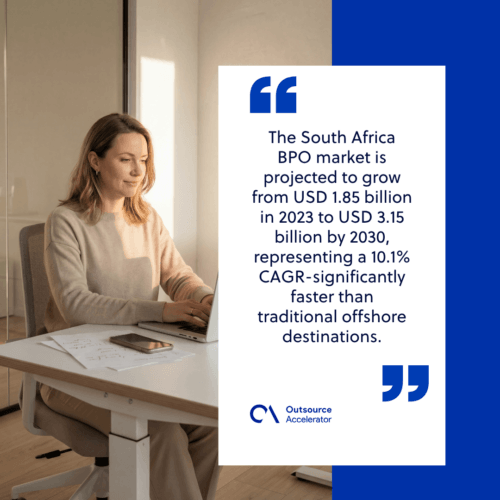
The South Africa BPO market is projected to grow from USD 1.85 billion in 2023 to USD 3.15 billion by 2030, representing a 10.1% CAGR-significantly faster than traditional offshore destinations.
Why? It’s because South Africa delivers 55-65% cost savings compared to UK/US onshore operations (according to BPESA 2025 data), but without the hidden cost profile of bottom-tier providers.
Lower attrition = Less hidden cost
Attrition in South Africa’s BPO sector averages 15-20%, compared to 30-40% in some segments of other offshore markets. Lower attrition directly reduces the hidden costs of recruitment, training, knowledge loss, and performance variability that plague cheap BPO operations.
English proficiency reduces rework
South Africa ranks 13th globally in English proficiency (EF EPI 2025)-1st in Africa-which translates to clearer customer communication, fewer misunderstandings, and higher first-contact resolution rates. Language proficiency isn’t cosmetic; it’s operational.
Time zone alignment enables real-time QA
For UK clients, South Africa operates in GMT+2, allowing real-time collaboration, live call monitoring, and same-day issue resolution. For US East Coast clients, there’s significant overlap.
This matters because the client-side time absorption problem (Category 4 in the hidden costs section) is dramatically reduced when you can coach, correct, and collaborate in real-time instead of asynchronously.
Regulatory sophistication in growth sectors
South Africa’s regulatory ecosystem has matured significantly for business process outsourcing in high-compliance sectors:
- Finance: SAICA (South African Institute of Chartered Accountants) and FSCA alignment
- Insurance: Growing alignment with FCA standards for UK-facing operations
- iGaming: UKGC-compatible compliance frameworks increasingly common among providers
This regulatory infrastructure reduces compliance exposure-one of the five hidden cost categories outlined earlier. For specialized needs like debt collection outsourcing or healthcare administration, South African providers offer sector-specific compliance expertise.
Providers like Afrishore have built their operations around this quality-first positioning: cost savings comparable to traditional offshore destinations, but with lower attrition, stronger compliance alignment, and operational models designed to avoid the cheap BPO problems that create expensive downstream consequences.
The BPO due diligence checklist
Before you sign any offshore BPO contract, run through this evaluation framework:
✓ Resolution rate verification: Ask for workflow-specific FCR data (target: 70%+ industry benchmark)
✓ Supervisor ratio check: Confirm ratios are 1:15 or better for complex work (1:12 ideal)
✓ Workflow-specific references: Demand references from similar industries, workflows, and compliance requirements
✓ Regulatory alignment proof: Verify sector-specific certifications and compliance frameworks, not just generic ISO
✓ QA framework audit: Ensure QA drives systemic improvement, not just agent scoring
✓ Total cost of ownership model: Include rework, client-side time, compliance risk, and attrition in your cost comparison
✓ 90-day pilot with kill criteria: Test with 5-10 FTEs, measure FCR/escalations/CSAT, and enforce performance thresholds
Frequently Asked Questions
What are the hidden costs of offshore BPO?
The five major hidden cost categories are:
(1) Rework and repeat contacts from low first-contact resolution
(2) Supervisor burnout and attrition from overstretched span of control
(3) Compliance exposure in regulated industries from inadequate training
(4) Client-side time absorption for QA and exception handling
(5) Customer churn from poor service quality
These costs compound after contract signature and often exceed the initial rate card savings.
How do I evaluate an offshore BPO provider beyond price?
Focus on seven due diligence areas:
- Resolution rates (not just handle time)
- Supervisor-to-agent ratios
- Workflow-specific references
- Regulatory alignment for your industry
- Depth of QA frameworks
- Total cost of ownership modeling
- Structured pilot testing with clear performance thresholds
Cheap providers often fail on supervisor ratios, compliance depth, and FCR performance.
Is the cheapest BPO bid always the worst choice?
Not always-but it’s the highest-risk choice without proper due diligence. A 70% cost reduction that produces 30% more escalations and 18% worse first-contact resolution isn’t a saving-it’s expensive failure disguised as procurement success.
Model total cost of ownership, not just rate card pricing, before deciding.
Why is South Africa gaining BPO market share from traditional offshore destinations?
South Africa offers comparable cost savings (55-65% below UK/US rates) with significantly lower attrition rates (15-20% vs. 30-40%), stronger English proficiency (13th globally), better time zone alignment with Western markets (GMT+2), and growing regulatory sophistication in finance, insurance, and compliance-heavy sectors.
These factors reduce the hidden cost categories that plague bottom-tier providers.
What is a reasonable pilot size for testing a BPO provider?
Industry best practice suggests 5-10 full-time equivalents (FTEs) for 90 days, with clearly defined performance metrics: first-contact resolution rate, escalation rate, customer satisfaction (CSAT), supervisor time absorbed by your internal team, and compliance incidents.
Set kill criteria before the pilot starts-if performance thresholds aren’t met, terminate fast rather than scaling a problem.
The real calculation: Savings vs. cost
The offshore BPO market will always have providers competing on price alone. Some will deliver acceptable quality at low rates. Many won’t. The difference between the two isn’t visible in the proposal-it emerges in month three, month six, and month twelve when the operational reality settles in.
Before you sign, ask yourself: are we evaluating this contract based on what it costs to start, or what it costs to run? Because in outsourcing quality issues, the gap between those two numbers is where profits disappear and customers walk away.
The cheapest bid often costs the most. Make sure you’re measuring the right number.
Ready to evaluate BPO providers with a quality-first framework? Contact Afrishore to see how a risk-adjusted approach to offshore outsourcing avoids the hidden cost traps outlined in this article.






 Independent





