
Improving patient care with healthcare data analytics


What is healthcare data analytics, and how does it improve patient care?
Healthcare data analytics turns raw health data into clear insights that help providers improve patient care, guide decisions, and run operations more smoothly.
- It spots trends, risks, and gaps across large sets of patient data.
- It supports faster, evidence based choices at the point of care.
- It helps cut waste and use staff and resources better.
The healthcare industry is going through a digital shift. At the heart of this change sits healthcare data analytics. Providers now create huge amounts of data each day. By using it well, they gain useful insights, improve patient care, and boost efficiency. In short, this practice turns raw data into smart action. As a result, teams make better calls that help patients and speed up care.
The importance of technological developments in the healthcare industry
Tech developments are now woven into the healthcare industry. For example, electronic health records, AI diagnostics, and wearable devices have changed how care is given. In addition, systems that share data help providers work as one. So this supports joined up care and puts the patient first.
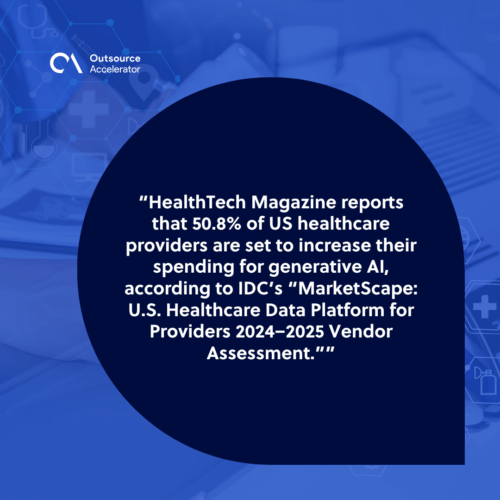
Many providers are already getting ready. HealthTech Magazine reports that 50.8% of US healthcare providers plan to increase their spending on generative AI, based on IDC’s “MarketScape: U.S. Healthcare Data Platform for Providers 2024 to 2025 Vendor Assessment.” So the shift is clearly underway. By embracing new tools, providers can use data driven insight to lift patient outcomes even more. A strong business intelligence strategy often guides these steps.
Types of healthcare data analytics
Healthcare data analytics splits into five key types. Each one serves a clear purpose in better care and operations.
1. Descriptive analytics looks at past data to find trends and patterns. So it helps providers see what has happened. For example, it can track disease outbreaks or readmission rates.
2. Diagnostic analytics goes a step further. It studies past data to find the root causes of health issues. For instance, it can flag factors behind high mortality rates.
3. Predictive analytics uses data models and machine learning to forecast future events. As a result, it can predict disease risk and support early action. In fact, many teams rely on predictive analytics tools for this work.
4. Prescriptive analytics suggests the best next step from the data. So it helps doctors make data driven choices. It also helps improve hospital workflows.
5. Cognitive analytics mimics human thought with AI and natural language processing. Because of this, it improves diagnostics and automates medical coding. It also sharpens decisions with deep insight.
5 Key ways healthcare data analytics improves patient care
Here is how healthcare data analytics makes a real difference in patient care.
1. Personalized medicine
Think of it as your own health blueprint. Providers study patient data, like genes and medical history. Then they build treatment plans that fit each person. As a result, care gets more precise and outcomes improve. In short, it respects that every health journey is different.
2. Proactive disease management
Imagine spotting health issues before they grow. Healthcare data analytics makes this possible. It flags patients at higher risk of chronic disease. Through predictive models, providers can step in early. So they can act with prevention and simple lifestyle plans. For example, an at risk patient may get a diet and exercise plan before diabetes sets in.
3. Enhanced clinical decision support
Clinicians know a lot, but no one recalls every detail. Healthcare data analytics acts like a real time assistant. It surfaces patient data and evidence based guidance at the point of care. Even so, much data still goes unused. In fact, the World Economic Forum cites 97% as unused. Clinical decision support systems can:
- Alert clinicians to potential drug interactions
- Suggest appropriate diagnostic tests
- Offer treatment recommendations
As a result, errors drop and care quality rises.
4. Optimized resource allocation
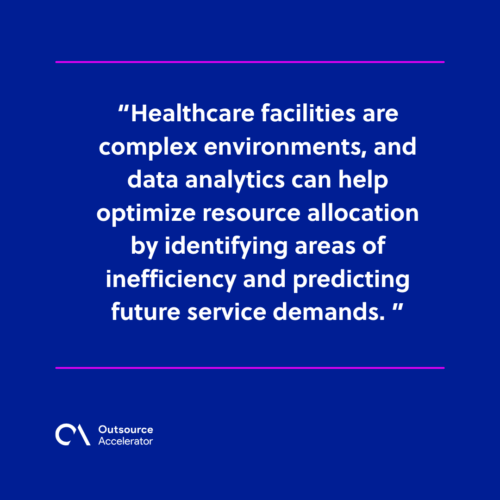
Healthcare facilities are complex places. Data analytics can help use resources better. It finds waste and predicts future demand. By studying patient flow, staffing levels, and resource use, providers make smart choices. So they cut costs and improve efficiency. This also means shorter wait times and better access. In addition, strong patient care coordination supports these gains.
5. Enhanced patient engagement
Patient portals and mobile apps give people a bigger role in their care. Healthcare data analytics powers these tools. It offers access to health data, learning resources, and easy messaging. As a result, patients feel more informed and involved. This also builds trust in your methods. In turn, people stick to treatment plans and see better outcomes.
Overcoming challenges in implementing healthcare data analytics
Rolling out healthcare data analytics brings real challenges. First, patient data must stay private and secure. After all, sensitive health data needs strong protection. Second, interoperability is a big hurdle. With so many systems and formats, sharing data is not always smooth. Modern electronic health records can ease this problem.
Third, there is a talent gap. Teams need people who know both data and healthcare. Sadly, that mix is hard to find. So progress needs teamwork from providers, tech firms, and policymakers. Together, they must set strong security rules and shared data standards. In addition, they should invest in training. For deeper needs, some turn to big data consulting for extra support.
Frequently asked questions about healthcare data analytics
What is healthcare data analytics used for?
It turns health data into useful insight. So providers can improve care, guide decisions, and run smoother operations.
What are the main types of healthcare data analytics?
There are five: descriptive, diagnostic, predictive, prescriptive, and cognitive. Each one serves a clear purpose.
How does healthcare data analytics improve patient care?
It supports personal treatment and early action. It also aids clinical decisions and better use of staff. As a result, outcomes improve.
What are the biggest challenges with healthcare data analytics?
Data privacy, system compatibility, and a talent gap. Still, strong rules and training help teams get past them.
Key takeaways
- Healthcare data analytics turns raw data into better patient care.
- Five types cover the past, the present, and the future.
- It powers personal medicine, early action, and smarter decisions.
- Privacy, interoperability, and skills remain the top challenges.






 Independent





