
GBS vs. Offshore outsourcing: Key differences unveiled


More companies now hand parts of their work to third-party providers. So this move lets teams focus on core work while they gain expertise, speed, and cost savings.
GBS vs. offshore outsourcing: What is the difference?
GBS centralizes many business functions into one in-house unit for control and consistency, while offshore outsourcing hands specific tasks to third-party providers abroad, mainly to cut costs.
- GBS keeps work in-house under one shared model across regions.
- Offshore outsourcing sends set tasks to outside vendors in other countries.
- GBS suits long-term control, while offshore outsourcing suits fast cost cuts.
Whether it is customer service, IT support, or back-office functions, outsourcing is now a key growth tool. In this article, we compare two popular models: global business services (GBS) vs. offshore outsourcing. So we will show their differences and help you pick the right fit.
GBS vs. Offshore outsourcing: Definition of terms
Knowing each model helps you make smart choices. So let us define both. GBS and offshore outsourcing each bring clear benefits and trade-offs.
What is global business services (GBS)?
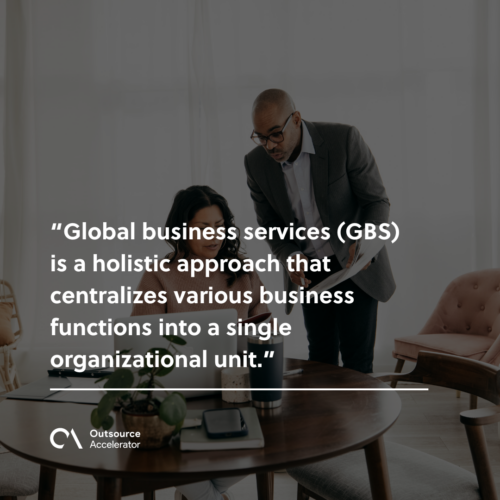
GBS is a whole-of-business approach. It brings many functions into one unit. This model uses shared services and joined-up processes. As a result, it can streamline work across regions and teams. In short, the GBS model aims for more speed, more consistency, and more agility. It sets one standard and shares best practices across the firm. So it often leads to better service and real cost savings.
What is offshore outsourcing?
Offshore outsourcing means you contract set tasks to third-party providers in other countries. Firms often pick places where labor costs are lower. So the main goal is to cut costs and reach a wider talent pool.
Offshore outsourcing is common for tasks such as:
- Customer support
- Software development
- Back-office operations
For companies that want this model, specialized firms like Sourcefit build and manage dedicated offshore teams tailored to client specifications. To go deeper, it also helps to review the main offshore outsourcing models before you choose.
This model brings big cost gains. However, it needs careful management. For example, you must handle cultural gaps and communication barriers.
GBS vs. Offshore outsourcing: Distinct differences
When you weigh GBS vs. offshore outsourcing, look at a few key areas. So here are the main differences to keep in mind.
Structural
GBS brings many functions into one organizational framework. It joins processes across regions and teams. In contrast, offshore outsourcing hands tasks to outside providers abroad. As a result, it creates a looser structure built on external partners.
Operational
GBS leans on one standard and smooth processes within a single entity. So service stays consistent, and control stays strong. Offshore outsourcing, however, relies on outside vendors. Because of this, practices can vary, and you need firm vendor management to stay aligned.
Cost implications
GBS often needs a big upfront spend on setup and tech. Still, it can lead to long-term savings through economies of scale and better processes. Offshore outsourcing, on the other hand, gives fast cost cuts thanks to lower labor costs abroad. However, it may add costs for vendor management and quality checks. For a fuller view, weigh the pros and cons of offshore outsourcing first.
Impact on business agility and scalability
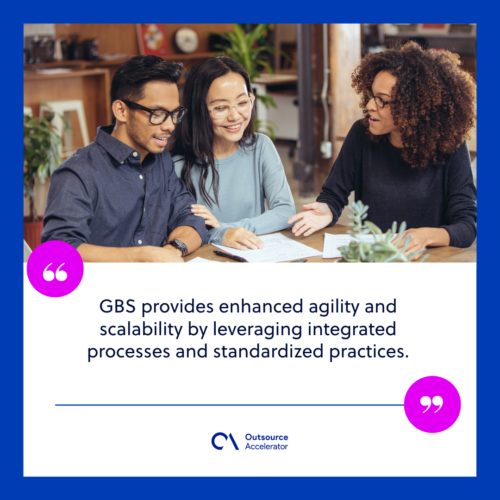
GBS boosts agility and scale through joined-up, standard processes. So firms can adapt fast as markets shift. Offshore outsourcing also scales well by flexing outside resources. Still, it may struggle with agility due to communication gaps and reliance on third-party vendors.
By comparing these areas, you can see which model fits your goals. Meanwhile, strong best practices for offshore teams can close many of these gaps.
GBS vs. Offshore outsourcing: Choosing the right approach
The right choice depends on your goals and your setup. So weigh these factors before you decide.
GBS vs. Offshore outsourcing: Business goals and strategy
First, think about your main goal. Is it cost cuts, better processes, or long-term growth? GBS tends to fit long-term efficiency and integration. Offshore outsourcing, however, tends to fit fast cost savings.
GBS vs. Offshore outsourcing: Nature of services and tasks
Next, weigh how complex and critical the work is. GBS suits joined-up, cross-team processes. Offshore outsourcing, on the other hand, suits set, routine tasks.
GBS vs. Offshore outsourcing: Budget and resource availability
Also check your budget. GBS may need higher upfront costs for setup and tech. Offshore outsourcing, meanwhile, can bring quicker cost gains.
GBS vs. Offshore outsourcing: Long-term and short-term needs
Then decide your time frame. GBS supports steady, long-term gains. Offshore outsourcing, however, works well for quick, short-term wins.
GBS vs. Offshore outsourcing: Risk management and compliance
Consider your rules and compliance needs too. GBS gives more control and one standard, which lowers compliance risks. Offshore outsourcing, on the other hand, needs close checks on vendor compliance.
GBS vs. Offshore outsourcing: Cultural and communication factors
Also weigh culture and communication. As an in-house model, GBS keeps these issues small. Offshore outsourcing, however, needs clear communication to manage outside vendors well.
GBS vs. Offshore outsourcing: Scalability and flexibility
Finally, check your need to scale. GBS scales through central, joined-up processes. Offshore outsourcing gives flexibility through outside resources, though agility can be harder. By weighing all of these, you can make a smart, well-informed choice.
GBS vs. offshore outsourcing: FAQs
Is GBS the same as offshore outsourcing?
No, the two differ. GBS keeps work in-house under one shared model. Offshore outsourcing, however, hands set tasks to outside vendors abroad.
Which model is cheaper?
Offshore outsourcing often cuts costs faster due to lower labor rates. Still, GBS can save more over time through scale and better processes.
Can a company use both GBS and offshore outsourcing?
Yes, many firms blend the two. For example, a GBS unit may run core work while it offshores set tasks. As a result, the firm gains both control and cost savings.
Which model is better for scaling fast?
Both can scale. GBS scales through central processes, while offshore outsourcing flexes outside resources. So the best fit depends on your goals and budget.
What risks come with offshore outsourcing?
Main risks include quality gaps, communication barriers, and vendor compliance. However, clear contracts and strong vendor management help reduce them.






 Independent





